Answer: For basements needing steady warmth, radiant oil-filled and infrared heaters provide consistent heat with controls that fit larger, cooler spaces. The top picks below are best for medium to large basements, offering energy efficiency, quiet operation, and built-in safety features. The buyers most likely to benefit are homeowners seeking whole-room warmth without loud fans, renters needing portable solutions, and hobbyists using basements as living or work spaces. Summary table shows key strengths and target uses for each model.
| Product | Best For | |
|---|---|---|
| De’Longhi EW7707CM | General living spaces in basement | Energy saving ComfortTemp |
| DREO 1500W Oil Filled Radiator | Quiet, steady warmth for bedrooms or offices | Eco mode, 7 safety checks |
| DR Infrared Heater DR-968 | Large basement rooms | Dual heating system, auto timer |
| Sundate 1500W Infrared Patio Heater | Outdoor basement areas or covered spaces | WiFi control, wall-mount option |
| De’Longhi Dragon Digital TRD40615E | Programmable, energy-aware heating | Large radiant surface, digital control |
De’Longhi EW7707CM Oil-Filled Radiator
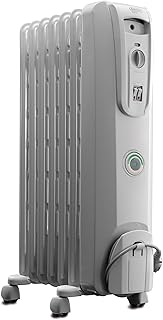
Features include simple controls to adjust power level and temperature. The ComfortTemp feature helps automatically maintain the optimal temperature and power levels, claiming up to 20% more efficiency compared to maximal thermostat use without ComfortTemp. An exclusive thermal slot design maximizes heat flow while maintaining a cool surface temperature. Best for: small-to-midsize basement rooms where quiet operation and steady room warmth are priorities. Caution: oil-filled radiators can take longer to heat up a large space compared with infrared options.
DREO 1500W Oil Filled Radiator Heater

Best for quiet, even warmth in larger basements thanks to 1500W output and 7-fin design. It emphasizes safety with triple overheat protection, fire-resistant material, and ETL listing, plus tilt protection and a burn-proof plug in a 7-layer safety check process. Eco mode helps maintain a comfortable temperature with lower energy consumption. Choose this if you want precise temperature control with strong safety assurances in a multi-room basement living area. Caution: ensure adequate clearance around the unit due to heat emission.
Dr Infrared Heater DR-968 Portable Space Heater

Best for large basement rooms needing rapid, directed warmth. It offers a dual heating system (infrared quartz tube + PTC) for around 60% more heat than many conventional units and a high 5200 BTU rating. Features include auto energy-saving mode, 12-hour timer, and low-noise operation with a remote control. Best for: larger, open basement spaces where you want quick warmth and zone control. Limitation: infrared heat can feel uneven if the space isn’t well arranged for direct radiance.
Sundate 1500W Infrared Patio Heater

Best for outdoor basement-adjacent spaces or covered areas that require direct radiant warmth. This unit provides 9 heat levels and a 24-hour timer, controlled via WiFi app, remote, or touch panel. Its wall, ceiling, or hanging installation helps save floor space in compact basements or covered outdoor sections. Caution: designed for outdoor or sheltered spaces; indoor use may require different heater type for full-room warmth.
De’Longhi Dragon Digital Oil Filled Radiator TRD40615E

Best for precise programmable heating with a large radiant surface. The digital control panel with LED display enables easy selection of functions and a 24-hour timer. The design claims significantly more radiant surface area than comparable models, improving heat transfer. Best for: basements where you need programmable, scheduled warmth with consistent radiant output. Limitation: digital controls may require occasional power-on resets after outages.
Buying Guide
What size basement heater should I choose?
For medium to large basements, look for 1500W units or dual-heating systems to cover more space. If your basement is well insulated but small, a 1000W option may suffice. Consider heat dispersion and fan-free operation to reduce dust and noise.
Oil-filled vs. infrared: which is better for basements?
Oil-filled radiators provide steady, gentle heat and are quiet, ideal for bedrooms or living spaces. Infrared heaters deliver radiant warmth to people and objects, heating quickly and efficiently in open areas. For closed basements, a hybrid or a combination of radiant and infrared can balance speed and consistency.
Which safety features matter most?
Overheat protection, tip-over sensors, and ETL or UL listings are important. Look for auto shut-off, cool-touch casings, and child-lock features if children are present. For installed or wall-mounted units, ensure proper clearance and secure mounting.
Energy efficiency considerations
Features like Eco mode, ComfortTemp, and programmable timers help reduce energy consumption. Higher radiant output with efficient heat distribution minimizes time spent heating the space, potentially lowering overall energy use.
Placement and usage tips
- Place heaters on level floors with ample clearance from walls and furnishings.
- Avoid obstructing vents or doors that could impede heat distribution.
- Use thermostats or smart controls to maintain comfortable room temperatures without overshoot.
- For basements with high humidity, choose heaters with protective housings and consider dehumidification to protect electronics.
FAQ
- Q: Are oil-filled radiators safer for basements than infrared heaters? A: Both can be safe with proper use, but oil-filled units are generally cooler to the touch and quieter, which can be preferable in living spaces.
- Q: Do these heaters work well in uninsulated basements? A: Insulation improves effectiveness; for poorly insulated spaces, infrared heaters may provide faster targeted warmth while oil-filled units offer steady background heat.
- Q: How long should I run a basement heater each day? A: Run according to comfort needs and energy goals; use programmable timers to avoid excessive operation.
- Q: Can I use a single heater to heat an entire basement? A: Larger spaces may require multiple units or a combination of heating methods to maintain even warmth.
- Q: Do these units require special electrical outlets? A: Most 1500W units plug into standard 120V outlets; verify outlet capacity and avoid daisy-chaining multiple high-wattage devices.
- Q: Is it necessary to maintain a constant temperature? A: For energy efficiency, steady temperatures with gradual adjustments are preferable to frequent on/off cycling.