Finding a reliable no-tank water heater depends on your space, hot-water needs, and energy goals. The top picks below are suited for apartments, small homes, RVs, or anyone seeking space-saving, on-demand hot water. Each option is evaluated for who benefits most, plus a practical note on limitations.
| Product | Type | Best For | Key Benefit | Limitations |
|---|---|---|---|---|
| VEVOR Electric Water Heater, 18 Gallon Tank | Storage Tank, Electric | Small family homes needing continuous supply | Large 18-gallon capacity with 1600W heating | Requires space for storage tank |
| 110V Tankless Water Heater, 3000W | Tankless, Electric | Apartments or kitchen/bathroom under-sink use | High power, fast on-demand heat with LCD display | Limited flow at higher temps |
| Electric Tankless 3.5KW, Under Sink | Tankless, Electric | Compact spaces, remote control users | Remote control for precise temp | Lower max flow than higher watt models |
| MIZUDO Natural Gas Tankless Water Heater | Gas, Tankless | Whole-home hot water with high flow | High BTU for large households | Gas installation requirements |
| ThermoMate 8kW Tankless Electric | Tankless, Electric | Point-of-use, small spaces | Self-modulating, 1.56 GPM at 35°F rise | Requires dedicated 40A circuit |
VEVOR Electric Water Heater, 18 Gallon Tank

Best for families that want a balance of storage and hot-water reliability. This model provides an 18-gallon capacity with a 1600W heater to reduce wait time at the faucet. It uses an immersion heating element with a temperature range of 30℃ to 75℃ (86℉ to 167℉) and features an LED display for easy monitoring. The enamel coating adds protective safety against leaks and burns. Useful for homes where some reserve hot water is preferred, or where a small storage unit is acceptable.
- Best for: Small to mid-size households needing steady hot-water supply
- Why selected: Strong balance of storage and fast heating
- Caution: Actual recovery time depends on incoming water temperature and usage
110V Tankless Water Heater Electric, 3000W
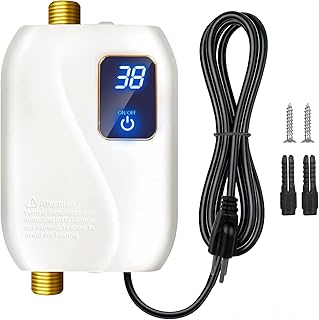
Best for spaces like kitchens or under-sink setups where instantaneous heat is needed. This 110V model uses 3000W to raise water temperature quickly and offers IPX4 protection with water-electricity isolation and automatic shutoff for overheating. It features an LCD display and is designed for compact installations, making it suitable for apartments, RVs, or small bathrooms. It delivers high efficiency, but note that flow rate can vary with incoming water temperature and hot-water demand.
- Best for: Under-sink or compact-space hot-water needs
- Why selected: Strong balance of power and space-saving design
- Caution: Higher flow may reduce temperature rise in very cold conditions
Electric Tankless Water Heater, 3.5KW

Choose this for a compact, wall-mounted solution with remote control for precise temperature adjustments. The 3.5KW heater is designed for point-of-use applications and offers self-modulating technology to optimize energy use. It is ideal for small apartments or spaces where a full-sized heater is impractical. Caution: remote control requires line-of-sight operation and may have limited range in some installations.
- Best for: Point-of-use hot water in small spaces
- Why selected: Remote operation adds convenience and precise control
- Caution: Performance depends on electrical setup and distance from outlet
MIZUDO Natural Gas Tankless Water Heater

Best for households seeking high-flow, continuous hot water across multiple outlets. This gas-powered unit claims up to 199,000 BTU and 10.3 GPM, suitable for whole-home use. It supports WiFi and app control in some variants and is CSA certified. Its strength lies in delivering ample hot water for multiple simultaneous demands. Limitations include the need for proper gas line installation and venting requirements, which may affect setup time.
- Best for: Large homes with simultaneous hot-water needs
- Why selected: High flow and potential remote monitoring
- Caution: Gas installation prerequisites may impact installation cost and complexity
Tankless Electric, ThermoMate 8kW

Best for point-of-use or small homes needing efficient on-demand hot water with space savings. The ThermoMate 8kW unit features self-modulating technology and delivers up to 1.56 GPM at a 35°F rise. It operates at 240V and requires a dedicated circuit. This model emphasizes energy savings through modulation and eliminates the standby heat losses of traditional tanks.
- Best for: Point-of-use installations and space-constrained areas
- Why selected: Self-modulating, energy-efficient operation
- Caution: Requires appropriate electrical infrastructure and circuit capacity
Buying Guide
Key considerations when choosing a no-tank water heater:
- Space and installation: Under-sink or wall-mounted units save space; verify mounting and venting requirements for gas models.
- Flow rate and temperature rise: Higher wattage or gas BTUs enable more simultaneous outlets or higher temperature rise; match to your peak hot-water demand.
- Electrical vs gas: Electric models are easier to install in many homes; gas models deliver higher flow but require venting and gas supply.
- Temperature control: Look for precise controls (LED/LCD displays, remote control) to keep temperature comfortable and energy use predictable.
- Safety features: Overheat protection, dry-fire protection, leakage safeguards, and IP ratings matter for longevity and safety.
- Reliability and maintenance: Self-modulating technology can improve efficiency; consider ease of access for service and replacement parts.
FAQ
- Q: Do I need a tankless system if I already have a traditional water heater?
- A: A tankless system is best when you want on-demand hot water and space savings; it may be used to supplement or replace a tank in specific scenarios.
- Q: Can tankless heaters supply hot water to multiple outlets at once?
- A: Yes, but flow rates vary by unit; high-BTU gas models or high-wattage electric models perform better for multi-outlet use.
- Q: Is professional installation required?
- A: Gas models typically require professional installation; many electric units also benefit from licensed electrical work to meet safety codes.
- Q: How do I choose between 110V and 240V models?
- A: 110V units are easier for smaller layouts but have lower power; 240V units offer higher heating capacity for faster hot water but require proper wiring.
- Q: Do these devices require venting?
- A: Gas models generally require venting; electric models do not, simplifying installation in many spaces.