Line voltage thermostats designed for heat-only setups offer precise control for electric baseboards, convectors, and fan heaters. This guide highlights top options suited for apartments, homeowners upgrading older systems, and commercial spaces seeking reliable, maintenance-friendly heating control. Each product section explains who it’s best for, why it stands out, and potential limits to consider. A quick buying table summarizes the key picks to compare at a glance.
Product Summary Table
| Product | Type | Best For | Key Note |
|---|---|---|---|
| Honeywell TL8230A1003 | Digital, 7 Day Programmable | Busy households seeking energy savings | Precise control; quiet operation |
| Honeywell RLV3120A1005 | Digital, Non-Programmable | Silent switching lovers; simple control | High accuracy; no-click switching |
| Stelpro SWT1F | Mechanical Dial, Single Pole | Residential or commercial spaces needing quick tweaks | No batteries; straightforward install |
| Cadet B07FTVGXGM | Double Pole, 240V capable | Comprehensive shutoff and safety | Dual-pole design handles full disconnection |
| Stelpro SWT2F | Mechanical Dial, Double Pole | Cold climates; higher power baseboards | Wide voltage compatibility; robust control |
Honeywell TL8230A1003 Electric Heat Digital 7 Day Programmable Thermostat

The TL8230A1003 is a digital, seven-day programmable thermostat designed for electric heat. It supports a programmable schedule to reduce energy use by up to an estimated 20% when followed. The device offers precise temperature control with an accuracy of ±1 F, contributing to potential additional savings. Its operation is relatively quiet due to soundproofed electronics, which helps reduce typical thermostat clicking sounds in busy living spaces.
Best for: households that want customizable daily programming to align with work, sleep, and routine changes. It’s suited for users who prefer a digital interface and energy-savings potential over simple on/off control.
Limitation: as a programmable unit, it requires setup and periodic schedule adjustments to maximize savings. If you rarely adjust settings, a non-programmable model may be easier to operate.
Honeywell Home Digital Non-Programmable Thermostat for Electric Heat Only | RLV3120A1005
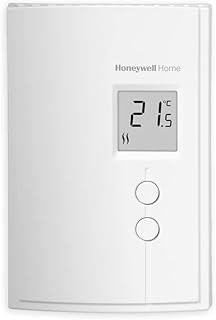
The RLV3120A1005 is a digital, non-programmable thermostat for electric baseboard heaters and convectors with two wires. It prioritizes ultimate temperature control with extremely tight accuracy, around ±0.27°F in baseboard configurations. The device uses a TRIAC switching mechanism to provide 100% silent switching, eliminating noticeable temperature swings and the familiar thermostat “click.”
Best for: spaces where silent operation matters and control needs are straightforward, without scheduling. It’s ideal for rooms that maintain a stable pattern and for users who want precise, quiet regulation.
Limitation: lacks programmable scheduling, so it cannot adapt automatically to different times of day or occupancy patterns.
Stelpro Line Voltage Wall Thermostat – Single Pole SWT1F

The SWT1F is a mechanical, single-pole line voltage thermostat designed for 240V applications. It uses a simple dial to set temperatures within a typical 40–80°F range, with a tight 3–6 degree comfort band to help maintain steady temperatures. It is designed for quick DIY installation with a two-wire connection and no batteries or programming required.
Best for: users who want a reliable, low-maintenance dial control with no power draw for programming. It’s also suitable for light commercial projects needing a practical, straightforward solution.
Caution: single-pole models do not fully disconnect power in all configurations, which may affect safety or energy shutoffs in certain setups; ensure you select the correct model for your circuit and safety requirements.
Cadet Double Pole Line Voltage Thermostat for Baseboard & Wall Heaters

The Cadet thermostat is a double-pole line voltage switch that handles 120, 208, and 240-volt circuits. It is designed to replace most standard wall-mounted line voltage thermostats with color-coded wiring for easier DIY installation. The control offers a simple twist-dial range from roughly 40 to 80°F, with a secure off position for fully stopping heat when desired.
Best for: installations that benefit from full electrical isolation and higher wattage capacities, with an emphasis on straightforward replacement and simple operation.
Limitation: the dual-pole design requires careful wiring and correct voltage compatibility; improper installation can affect performance or safety.
Stelpro Line Voltage Wall Thermostat SWT2F – Double Pole 22A

The SWT2F is a double-pole line voltage thermostat rated for 22 amps, suitable for 120–277V systems. It provides a robust, mechanical dial control within a 50–90°F range and features a clear interface for easy operation. The double-pole configuration fully disconnects power, offering greater safety and energy efficiency in colder climates or when a complete shutoff is preferred.
Best for: environments requiring maximum safety and full disconnection, particularly in longer-term baseboard or high-power installations.
Limitation: mechanical dial models have no programming, so users must manage adjustments manually; this may not suit homes with variable occupancy patterns.
Buying Guide
What should I consider when choosing a line voltage thermostat for heat-only systems?
- Voltage and power rating: Ensure the unit supports your heater’s voltage (120V, 208V, 240V or 277V) and wattage. A double-pole model is safer for full circuit disconnection.
- Control type: Digital thermostats offer programmable schedules and precise controls; mechanical dials provide simple, immediate adjustments without power draws.
- Installation: Check wire configuration (two-wire vs. four-wire) and whether the unit is intended for baseboard, convectors, or fan heaters. DIY replacement is common for many models but verify compatibility with your existing wiring.
- Noise considerations: Digital models may operate quietly, while some mechanical models have no moving parts that click or hum.
- Safety features: Look for models with clear off positions and proper isolation (double-pole) for environments requiring full shutdown capability.
How do I choose between programmable and non-programmable line voltage thermostats?
Choose programmable models to align heating with daily schedules and energy-saving goals. Non-programmable models are best for spaces with steady occupancy or where simple on/off control is sufficient.
Are double-pole thermostats safer for cold climates?
Yes. Double-pole models fully disconnect both hot and neutral lines, which can improve safety and energy efficiency in certain installations and climates.
Can I install these without a contractor?
Many line voltage thermostats are designed for DIY replacement, especially single- and double-pole mechanical units. Always follow wiring diagrams and local electrical codes. If in doubt, consult a licensed professional.
Will these thermostats work with all electric baseboard heaters?
Most are designed for standard electric baseboards, convectors, and fan-forced heaters within their voltage and wattage ratings. Verify compatibility with your heater type and voltage before purchase.
What maintenance do line voltage thermostats require?
Repair-free operation is common for mechanical dials; digital units may require occasional battery checks or firmware updates. Periodically inspect wiring for signs of wear or looseness.
Frequently Asked Questions
- Which thermostat is best for energy savings?
Answer: Programmable digital models that match your daily schedule typically yield the best savings. - Can I replace my old line voltage thermostat myself?
Answer: Yes, many models are designed for DIY replacement, but ensure proper wiring and voltage compatibility. - What is the advantage of a double-pole thermostat?
Answer: It fully disconnects power to the heater, improving safety and energy efficiency in some setups. - Do these thermostats produce heat quickly?
Answer: Temperature response depends on the heater and room; thermostats regulate setpoints rather than heat rate. - Are there quiet options available?
Answer: Yes, digital non-programmable models with TRIAC switching can provide silent operation. - Is a mechanical dial better for commercial spaces?
Answer: Mechanical dials are simple and durable, suitable where programming isn’t necessary or desired.