The best high-BTU vertical radiators in this selection are the Q-Hillstar 8-panel model, rated up to 4,700 BTU, and the AB 8-panel model, rated up to 4,616 BTU. Both are wall-mounted hydronic heaters for hot-water systems. The smaller EMKE is better for a compact room, while the two copper-aluminum options suit buyers comparing slim wall-mounted designs. Check your room’s heat requirement and plumbing connections before choosing.
| Radiator | Listed heat output | Best suited for |
|---|---|---|
| Q-Hillstar 8-Panel | Up to 4,700 BTU | Buyers prioritizing the highest stated output |
| AB 8-Panel | Up to 4,616 BTU | Hot-water systems needing a high-output wall radiator |
| Q-Hillstar 4-Section | Approximately 1,201 BTU/hr | Compact spaces and a slim profile |
| WiseWater 4-Panel | Per-section ratings vary by temperature difference | Buyers comparing copper-aluminum hydronic models |
| EMKE Vertical Flat | 297 W | Small rooms and a narrow vertical footprint |
Q-Hillstar 8-Panel Radiator

Best for: Buyers who want the highest stated heat output among these listed models. The manufacturer gives this 8-panel hot-water radiator an output of up to 4,700 BTU, making it the top output choice in this group by its published figure.
The unit measures 22.84 by 3.66 by 22.36 inches. Its aluminum construction is described as having high thermal conductivity, and side baffles are intended to support even airflow. The product is designed to connect to a boiler or central heating system, and its non-blowing operation is described as quiet.
- Listed output: up to 4,700 BTU.
- Hydronic operation uses circulating hot water rather than a fan.
- Manufacturer lists a water flow rate up to 8.77 GPH and working pressure up to 174–261 PSI.
Limitation: This is a hot-water radiator, so it requires a compatible hydronic setup. Confirm the system’s connection and operating requirements before purchase; its maximum listed output is not a guarantee of the heat delivered in every installation.
AB 8-Panel Wall-Mounted Radiator

Best for: Buyers seeking a high-output hydronic radiator with a stated maximum close to the top model in this comparison. The AB 8-panel heater is rated up to 4,616 BTU, 84 BTU below the Q-Hillstar model’s listed maximum.
The radiator uses scratch-resistant aluminum and a baked-paint surface. Its side air vents are designed to help circulate air and radiate heat. The manufacturer describes the unit as quiet and intended for stable hot-water system operation. A 24-hour pressure test is also listed as a product feature.
- Listed output: up to 4,616 BTU.
- Recommended working pressure: 1.2–1.8 MPa; stated maximum pressure: 2.0 MPa.
- Designed for hot-water heating, not steam.
Limitation: The product information explicitly says it is not compatible with steam systems. Choose it only if the home has an appropriate hot-water radiator circuit, and verify pressure and connection requirements with a qualified installer.
Q-Hillstar 4-Section Copper-Aluminum Radiator

Best for: Buyers who want a compact wall-mounted radiator and do not need the output claimed by the 8-panel models. This four-section unit is listed at approximately 1,201 BTU per hour and measures 12.8 inches long, 21.85 inches high, and 2.95 inches deep.
Copper tubing carries hot water through aluminum fins, which increase the heat-dissipating surface area. The slim profile is intended to preserve floor space and can fit areas such as bedrooms, bathrooms, and home offices. The listed weight is 7.17 pounds, and the package includes four mounting brackets and a bubble level.
- Listed output: approximately 1,201 BTU/hr.
- White finish and wall-mounted design.
- Recommended clearance below the radiator: 3.94–4.73 inches.
Limitation: Its stated output is substantially lower than the 8-panel choices, so it may not meet the heat requirement of a larger or poorly insulated room. The product data does not specify a room-size rating.
WiseWater 4-Panel Copper-Aluminum Radiator
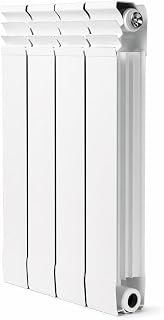
Best for: Buyers comparing a white, wall-mounted copper-aluminum radiator with output figures given per section at several temperature differences. The listed ratings are 180 BTU per section at ΔT 30°C, 300 BTU per section at ΔT 44.5°C, and 349 BTU per section at ΔT 50°C.
The product is described as a hydronic radiator with quiet operation and steady heat. Its white finish is intended to coordinate with varied interior styles. Because the output is expressed per section and depends on temperature difference, compare the rating conditions with the specifications of the home heating system rather than treating one number as a universal whole-unit output.
- Four-panel wall-mounted design.
- Per-section output is reported at three temperature differences.
- Manufacturer notes that real-world performance varies with flow, insulation, and installation.
Limitation: The product details do not provide a single total BTU rating for the complete radiator. Ask the seller or installer to confirm the total output under the system’s actual operating conditions before using it for room sizing.
EMKE Vertical Flat Panel Radiator

Best for: Buyers heating a small space who prefer a narrow vertical design. The EMKE radiator measures 900 by 304 by 52 millimeters and is listed at 297 watts, with the product information suggesting suitability for rooms up to approximately 5 square meters.
This single-layer steel radiator has four panels and a flat anthracite finish. Its listed connection thread is G1/2 inch, with a 50-millimeter axle spacing and an 85-millimeter distance from the wall. The manufacturer describes its steel construction as robust and says its surface coating is designed to resist rust and leakage.
- Listed heat output: 297 W.
- Vertical format for a smaller floor footprint.
- Listed dimensions and connection details support planning before installation.
Limitation: Its stated room guidance is approximately 5 square meters, and its output is not presented in BTU. It is not the best match when the main goal is choosing one of the highest-BTU models in this selection.
Buying Guide: How to Choose a High-BTU Vertical Radiator
How much heat does the room need?
Start with the room’s required heat output, not the radiator’s appearance or panel count alone. Room size matters, but so do ceiling height, insulation, window area, climate, air leakage, and the temperature maintained indoors. A heating professional can calculate the room’s heat loss and compare it with the radiator’s output at the planned water temperature.
Product ratings are not always directly comparable. The Q-Hillstar and AB 8-panel models state maximum BTU figures, while WiseWater gives BTU per section at specified temperature differences. EMKE lists watts, and the four-section Q-Hillstar gives an approximate BTU-per-hour figure. Match rating units and test conditions before making a close comparison.
Which listed model has the highest stated output?
The Q-Hillstar 8-panel radiator has the highest stated maximum, at up to 4,700 BTU. The AB 8-panel model is listed at up to 4,616 BTU. These figures make the two 8-panel radiators the most relevant choices for buyers prioritizing higher listed output, but they do not establish that either will adequately heat every room.
The four-section Q-Hillstar is listed at approximately 1,201 BTU/hr. WiseWater provides per-section ratings rather than a clear total-unit figure, so its rating needs additional interpretation. EMKE’s 297-watt output is paired with approximate small-room guidance. Select based on an apples-to-apples comparison at your system’s operating conditions.
Will the radiator work with your heating system?
Check whether the radiator is designed for hot-water hydronic heating or another system type. The AB listing specifically says it is not compatible with steam. The Q-Hillstar 8-panel model is described as connecting to a boiler or central heating system. Connection location, thread size, pipe spacing, system pressure, and water temperature should be verified before ordering.
Do not assume that radiators with similar shapes share compatible fittings. Have an installer compare the product’s connection details with the existing pipes and heating system. If the manufacturer information does not show a needed measurement or a total output rating, get clarification before purchase.
Does a vertical radiator save space?
A vertical radiator can use wall height rather than taking up floor area, which can be useful in compact rooms or where furniture placement is important. The EMKE is explicitly a vertical flat design, while the other listed radiators are described as wall-mounted. Compare the actual height, width, and depth with the available wall space and nearby furniture.
Leave the installation clearances required by the product and installer. For the four-section Q-Hillstar, the listed bottom clearance is 3.94–4.73 inches. Clearance affects placement and can matter for access, airflow, and safe installation, so do not select a location based on dimensions alone.
What materials and maintenance details matter?
Aluminum is used in the listed Q-Hillstar 8-panel and AB models, while the smaller Q-Hillstar combines copper tubing with aluminum fins. EMKE is steel, and WiseWater is identified as copper-aluminum. Material alone does not determine the heat a radiator will provide; system conditions and the model’s output rating matter as well.
Consider the finish and access for cleaning. The Q-Hillstar 8-panel and AB models describe baked-paint surfaces, while EMKE lists a protective coating. These details can inform routine care, but they do not replace the manufacturer’s installation and maintenance instructions.
How should you compare installation requirements?
Review dimensions, weight, mounting hardware, connection details, and pressure specifications before purchase. The four-section Q-Hillstar lists its weight, brackets, level, and recommended floor clearance. EMKE provides dimensions and connection measurements. These details help determine whether the radiator can fit the intended wall and connect to the existing circuit.
Wall-mounted radiators need secure attachment to a suitable structure, and hydronic connections must be installed correctly to prevent leaks. Use a qualified professional when the installation requires plumbing changes or when system pressure and compatibility are uncertain.
Frequently Asked Questions
Which radiator in this list has the highest stated BTU output?
The Q-Hillstar 8-panel model is listed at up to 4,700 BTU. The AB 8-panel radiator follows at up to 4,616 BTU. Actual delivered heat depends on operating conditions and installation.
Are these radiators electric heaters?
The listed Q-Hillstar 8-panel radiator is a hot-water model connected to a boiler or central heating system. The AB model is also described as a hot-water radiator. Check each product’s system requirements; the provided details do not identify these models as plug-in electric heaters.
Can the AB radiator be used on a steam system?
No. Its product information states that it is not compatible with steam and is intended for hot-water heating.
Is a higher BTU rating always better?
No. The radiator’s output should be appropriate for the room’s heat loss and the heating system’s operating temperature. An undersized radiator may not meet the room’s demand, while an unsuitable size or rating can complicate system planning.
Which option is intended for a small room?
EMKE lists a 297-watt output and approximate room guidance of up to 5 square meters. The four-section Q-Hillstar is another compact option, with an approximate output of 1,201 BTU/hr. Verify the required heat output for the specific room before choosing.