For point-of-use hot water, a compact 110V, 3000W electric heater is the closest match to a small under-sink installation; the APUS propane model and WINTEMP 18kW electric model are options for larger hot-water needs. The best choice depends on available power or fuel, water flow, installation location, and whether you need hot water at one faucet or several fixtures. The comparison below summarizes the five listed models and the buyer each one may suit.
| Product | Best suited for | Key listed detail |
|---|---|---|
| AIYEZIDT 110V Mini Heater | Compact point-of-use installations | 3000W, wall-mounted, stated maximum 131°F |
| 110V 3000W LED Heater | Buyers comparing flow-specific temperature claims | 82°F at 0.3 GPM; 131°F at 0.5 GPM |
| Jflapil 110V 3000W Heater | Buyers who want temperature adjustment and display | 82°F–131°F stated range by flow |
| APUS Propane Heater | Higher-flow, multi-fixture hot-water needs | 140,000 BTU; up to 6.8 GPM claimed |
| WINTEMP 18kW Electric Heater | Residential shower use with suitable electrical service | 240V, 18kW, up to 4.3 GPM claimed |
AIYEZIDT 110V Mini Tankless Water Heater

This compact 110V, 3000W electric model is best for a buyer seeking a wall-mounted heater near a single sink or another point of use. The listing describes it as suitable for kitchens, bathrooms, apartments, RVs, and camping, and says it heats water on demand without preheating. It also lists a digital display, IPX4 water resistance, leakage protection, dry-burn protection, and automatic power-off features.
The product description states a maximum temperature of 131°F and says hot water can arrive in three to five seconds. Those results can depend on incoming water temperature and flow, so they should not be treated as a guarantee for every installation. Choose this if a compact footprint and 110V supply fit the intended setup. Its stated 3000W capacity makes it a point-of-use option, not a listed whole-home solution; confirm electrical and plumbing requirements before purchase.
110V 3000W Heater With LED Display
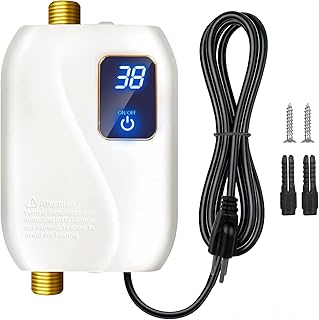
This model is best for buyers comparing a small electric heater with stated output temperatures at specific flow rates. Its listing says the heater can raise water temperature by 82°F at 0.3 GPM and reach 131°F at 0.5 GPM. It has a digital display, permits switching between Fahrenheit and Celsius, and is described as using stainless steel and ABS materials. The listed safeguards include IPX4 protection, water-electric isolation, leakage protection, dry-boil protection, and automatic shutoff for overheating or inactivity.
The manufacturer describes the unit as wall-mounted and suitable for locations such as kitchens, apartments, bathrooms, RVs, and camping. It also claims ETL standard qualification and thermal efficiency of up to 98%; verify any certification or installation details directly with the seller and product documentation. This is a better fit for a localized hot-water need than a high-demand household application. The stated temperature figures vary with flow, so avoid assuming it will provide the maximum temperature at every faucet flow rate.
Jflapil 110V Tankless Heater

The Jflapil is best for buyers who want a compact 110V heater with an LED readout and stated temperature adjustment. The listing describes a 3000W unit made with stainless steel and ABS, designed for wall mounting in narrow spaces. It gives a temperature range of 82°F at 0.3 GPM to 131°F at 0.5 GPM and says the display can switch between Celsius and Fahrenheit by holding the power button for six seconds.
Listed safety functions include IPX4 water resistance, water-electric isolation, leakage and dry-burn protection, overheating protection, and automatic power-off when idle. The description also claims 98% thermal efficiency and ETL certification; check the product documentation for details applicable to the exact unit. Choose this model if those controls and compact form match a point-of-use installation. A key limitation is the flow-dependent temperature range: the maximum listed temperature is associated with a specific flow, so it may not meet every user’s preferred temperature and flow simultaneously.
APUS 140,000 BTU Propane Tankless Heater

The APUS is best for buyers considering a higher-flow propane heater for multiple household fixtures. Its listing specifies a 140,000 BTU burner, an oxygen-free copper heat exchanger, a built-in booster pump, and a maximum flow claim of up to 6.8 GPM. The manufacturer says it can support two showers and two sinks at the same time, and lists Wi-Fi app control, a 95°F–140°F temperature range, and anti-freeze capability.
The product description also promotes a zero-cold-water circulation feature and an ECO cycle, but these are manufacturer claims; review the operating requirements to understand how the system works in a particular home. The listing says it connects to standard 120V AC, so it is not a fuel-only appliance. Choose it if propane and a larger, multi-fixture output are priorities. Avoid choosing it solely based on its maximum flow claim: actual performance depends on installation conditions and simultaneous demand, and propane installation and venting requirements should be checked before purchase.
WINTEMP 18kW 240V Electric Tankless Heater

This WINTEMP model is best for buyers looking at an electric tankless heater for showers and everyday household use, provided the home can support its electrical requirements. The listing specifies 18kW at 240V, a maximum amperage of 75A, up to 4.3 GPM, and a recommended 150-amp household service. It says installation requires two 40-amp double-pole breakers and 2 x 8/2 AWG wiring, and gives dimensions of 11.1 inches wide, 19.2 inches high, and 4 inches deep.
Its self-modulating feature is described as adjusting power according to water flow and incoming temperature. The listing says it is intended for 2–3 bathroom homes in mild to moderate climates. This is a better fit for a planned residential installation than a simple under-sink replacement. The main caution is substantial: the stated electrical requirements may not match an existing panel or wiring. The seller specifically advises consulting a qualified electrician before purchase.
Buying Guide: How to Choose a Tankless Water Heater
“Waterless heater” is often used informally to refer to a tankless water heater. Tankless models heat water as it passes through the unit rather than storing a tank of heated water. A point-of-use model serves a nearby fixture, while a higher-capacity unit may be intended to supply several fixtures. Compare the product’s stated flow and installation needs with the job you expect it to do.
Do you need hot water at one sink or throughout the home?
Start by identifying the fixtures that need hot water at the same time. The three 110V, 3000W options in this list are described as compact under-sink or point-of-use heaters. Their stated temperature performance is tied to relatively low flow rates. The APUS propane model and WINTEMP 18kW electric model advertise higher maximum flow figures and broader household use, but those figures do not by themselves guarantee sufficient output in every home.
For one distant sink, a point-of-use heater may be worth considering if the plumbing and power supply suit it. For showers or multiple fixtures, compare the combined flow demand against the heater’s documented output. Ask the seller or a qualified installer how incoming water temperature affects the output you can expect in your climate.
Should you choose electric or propane?
Electric models require an electrical circuit capable of supporting their rated voltage and power. Do not assume that a standard outlet or existing household circuit is suitable just because a product listing mentions 110V or 120V. The WINTEMP model has specific 240V, breaker, wiring, and service recommendations that should be reviewed with an electrician.
A propane model requires an appropriate fuel supply and installation conditions. The APUS listing also specifies a 120V AC connection, so buyers should account for electrical needs as well as propane. Confirm ventilation, location, code, and connection requirements using the manufacturer’s documentation and qualified local professionals.
How should you compare flow and temperature claims?
Flow rate and temperature rise are related: a heater may deliver a different temperature at a higher water flow. The 110V listings make this especially clear by pairing temperature figures with stated flows such as 0.3 or 0.5 GPM. Compare products using equivalent conditions rather than relying on a headline maximum temperature or maximum GPM alone.
Check the expected incoming water temperature, desired outlet temperature, and the flow needed for the intended fixture. If a listing does not provide enough information to compare those conditions, request clarification before buying. Maximum flow figures in product descriptions are not a substitute for a sizing calculation.
What safety and installation details matter?
Look for the exact installation instructions, connection sizes, required circuit or fuel supply, and any stated safety functions. Some listed models describe protections such as leakage detection, dry-burn prevention, overheating shutoff, or water resistance. These features are not a reason to skip correct installation, and listing claims should be confirmed in the product documentation.
Check whether the unit is intended for indoor or outdoor use and whether its placement is suitable for the location. For electrical work, gas connections, plumbing changes, or venting, use qualified professionals when required by local rules or the manufacturer. Confirm the product’s dimensions and water connection details before planning a tight installation.
Is a compact heater suitable for an RV or camping?
Several 110V product descriptions mention RVs and camping, but suitability depends on the available electrical supply, plumbing arrangement, and intended flow. Confirm those requirements for the specific vehicle or campsite before relying on the heater. A product being described as portable or compact does not establish that it is compatible with every RV, power source, or outdoor setup.
What information should you verify before ordering?
- Voltage, wattage, amperage, breaker, and wire requirements.
- Fuel type and any required electrical connection.
- Intended use, such as one sink, a shower, or multiple fixtures.
- Flow rate at the temperature rise you need.
- Water connection size, unit dimensions, and installation location.
- Certification and safety claims in the manufacturer’s documentation.
Frequently Asked Questions
What is a tankless water heater?
A tankless water heater heats water as it flows through the unit rather than storing hot water in a tank. Its practical output depends on the unit’s capacity, water flow, and incoming water temperature.
Can a 110V, 3000W heater supply a whole house?
The three 110V, 3000W products listed here are described as compact point-of-use heaters. Their supplied information does not establish whole-house capacity. Compare the manufacturer’s flow and temperature specifications with the home’s demand before choosing one.
Why does the listed outlet temperature change with flow?
A heater has a finite heating capacity. When more water passes through it, the temperature rise may be lower. Use the product’s flow-specific temperature information rather than assuming its highest temperature applies at every flow rate.
Does a tankless heater provide hot water instantly?
Tankless units heat water on demand, but water may still need to travel through the plumbing between the heater and the faucet. Product claims about heating time or reduced waiting should not be assumed to eliminate plumbing wait time in every installation.
What should I check before buying a 240V tankless heater?
Check the required service capacity, amperage, breaker configuration, wire size, and installation instructions. The WINTEMP listing recommends 150-amp household service and advises consulting a qualified electrician.
Is a higher maximum GPM always the better choice?
No. Maximum GPM is only one comparison point. The suitable model must also deliver the desired temperature at the combined flow your household uses, and it must match the home’s electrical or fuel supply and installation conditions.