A thermostatically controlled fan heater warms a room and adjusts its operation according to a selected temperature. The DREO model with a 41–95°F setting range is best for precise temperature selection; the EXNOS 2-in-1 is better for shoppers who want heating and fan-only modes. The Plexon offers a straightforward heater with adjustable heat, while the BN-LINK is a separate cooling thermostat controller—not a heater—and suits a different purpose.
| Product | Best For | Key Feature |
|---|---|---|
| DREO 1500W With Adjustable Tilt | Directional warmth | Four manual tilt positions |
| DREO Portable Heater With Remote | Temperature control | 41–95°F settings in 1°F increments |
| EXNOS 2-in-1 Fan Heater | Year-round use | Heating, fan speeds, and oscillation |
| Plexon Milkhouse Heater | Simple high/low heat | Fan-only mode and metal construction |
| BN-LINK Cooling Thermostat Outlet | Temperature-triggered cooling equipment | Probe-based cooling control |
DREO 1500W Heater With Adjustable Tilt

This DREO heater is best for someone who wants to aim warm airflow at a particular seating or work area. Its body can be tilted manually through 0°, 20°, 40°, and 60° positions, so it can be placed on the floor or a table and angled toward the user.
The listed features include 1500W Hyperamics heating, a stated two-second warm-air delivery, three modes, a remote, and a 34 dB quiet-operation claim. Safety features include tip-over and overheat protection, V0 flame-retardant materials, and a safety plug. The listing states that it is ETL-certified.
Choose this if directing heat matters more than setting a precise temperature range. Limitation: The provided feature details do not specify the thermostat’s temperature range or adjustment increments, so it is harder to compare its temperature precision with the other DREO model.
DREO Portable Heater With Precise Thermostat

This DREO model is best for buyers who want a clearly specified thermostat range. It lets users select temperatures from 41°F to 95°F in 1°F increments. Its NTC chipset is described as providing more precise temperature control, allowing the heater to be set to a chosen comfort level.
The heater uses a 1500W PTC system and a heat-funnel design. The product description says it delivers heat within seconds and circulates warm air up to 200% farther than traditional heaters. It also lists a remote, tip-over protection using a tilt-detection sensor, overheat protection, V0 flame-retardant materials, and an ETL-certified safety plug.
Best for: shoppers comparing thermostatic control settings and those who prefer a remote. Limitation: The listed features do not state an oscillation function or adjustable tilt, so choose another model if directing or sweeping the airflow is a priority.
EXNOS 2-in-1 Fan Heater With Oscillation

The EXNOS 2-in-1 is best for people who want one appliance for heating and fan-only airflow. It offers low and high fan settings, plus low 750W and high 1500W heating. Its 40° oscillation is designed to spread airflow across a wider area.
The thermostat has four listed target settings: 70°F, 75°F, 80°F, and 85°F. According to the product information, the heater shuts off when the selected target is reached and restarts when the temperature drops. A control panel and remote can operate the temperature, fan speed, and oscillation.
Choose this if seasonal versatility and oscillating airflow are more important than fine-grained temperature selection. Limitation: The thermostat offers four stated temperature choices rather than the 1°F increments listed for the DREO precision-control model.
Plexon Milkhouse Heater With Fan-Only Mode
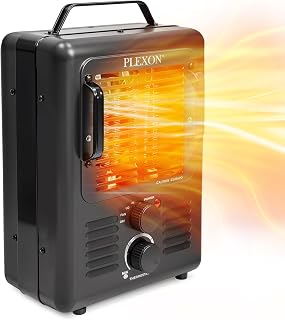
The Plexon is best for shoppers seeking a simple portable heater with high- and low-heat choices and a fan-only mode. The product description lists a 1500W output, adjustable thermostat, metal construction, overheat protection, and a tip-over safety switch.
The maker describes it as suitable for rapidly warming small-to-medium spaces and lists rooms, garages, and greenhouses as possible uses. It also claims suitability for spaces around 300 square feet and larger areas such as garages or greenhouses. Actual results can vary with room conditions, insulation, and other factors; the listing does not provide a detailed sizing method.
Best for: buyers who value simple heat settings and fan-only operation. Limitation: The provided features do not give a thermostat temperature range, digital temperature increments, or a remote control. Avoid choosing it for precise setpoint programming based on the available product details.
BN-LINK Digital Cooling Thermostat Controller

This BN-LINK unit is not a fan heater. It is a cooling thermostat outlet controller, so it is best for buyers who need a probe-based controller for compatible cooling equipment rather than a self-contained room heater. Its sensor probe measures temperature, and the controller has a three-button interface and a digital display that supports Fahrenheit and Celsius.
Listed details include cooling and power indicator lights, a hanging tab, a tough plastic housing, a 3.94-foot three-prong power cord, and a 4.92-foot temperature probe. These features can help a user monitor a temperature-controlled cooling setup.
Choose this if your goal is controlling cooling equipment through a temperature-sensing outlet. Limitation: The product is specifically described as a cooling controller, not a heater or a thermostat built into a fan heater. Confirm that the equipment and intended use match the controller’s specifications before purchase.
Buying Guide: How to Choose a Thermostatically Controlled Fan Heater
What Does the Thermostat Control?
A thermostat lets a heater respond to the surrounding temperature instead of relying only on continuous manual operation. Depending on the model, the user may select a target temperature, and the heater may cycle off when that target is reached and restart when the temperature falls. Check the product details for explicit descriptions of this behavior rather than assuming every heater uses the same control method.
For a defined setting range, the DREO precision-control model lists 41–95°F adjustments in 1°F increments. EXNOS lists four choices—70°F, 75°F, 80°F, and 85°F—and describes automatic shutoff and restart around the selected target. The supplied details for the other heater models do not state comparable ranges or increments.
Do You Need a Heater, a Fan, or Both?
A heater with fan-only mode can provide airflow when heat is not needed, but the feature descriptions do not establish that it functions like a dedicated cooling fan. The EXNOS and Plexon product descriptions list fan-only operation. The EXNOS also specifies low and high fan speeds, while the Plexon listing identifies fan-only mode without giving fan-speed details.
If you only need temperature-based control for separate cooling equipment, the BN-LINK may be relevant, but it is not a substitute for a space heater. Keep the distinction clear: a heater’s built-in thermostat controls that heater, while an outlet controller is a separate device intended for compatible equipment.
Which Heating Settings Fit Your Room?
Consider the room, how quickly you need warmth, and whether you want more than one heat level. The EXNOS lists 750W and 1500W heat settings. The DREO models and Plexon listing specify 1500W. The Plexon description mentions small-to-medium spaces and claims use in spaces around 300 square feet, but room performance depends on conditions and should not be treated as a guaranteed result.
Heating output alone does not establish how evenly a room will feel. Oscillation, tilt, and airflow design can affect where warmth is directed. Choose the EXNOS for listed 40° oscillation or the tilting DREO for manual directional adjustment. The other product details do not list these same airflow features.
How Important Are Remote Controls and Adjustability?
A remote can make it easier to change settings from across a room. Both DREO models and the EXNOS list a remote. The EXNOS description says the remote can adjust fan speed, temperature, and oscillation. The first DREO listing highlights a remote and tilt positions, while the second lists temperature control and a remote.
Compare the kind of adjustability you will actually use. A tilt mechanism aims airflow in a chosen direction, while oscillation sweeps it across an area. A thermostat’s range and increments determine how specifically you can choose a target temperature. These are separate benefits, so one feature does not replace another.
What Safety Details Should You Check?
Review the safety features stated for the exact model. The two DREO listings mention tip-over and overheat protection, V0 flame-retardant materials, and a safety plug; their descriptions also state ETL certification. The Plexon lists overheat protection and a tip-over switch. Do not assume that a feature listed for one model applies to another product.
Use a portable heater according to its instructions and keep it away from anything that could obstruct airflow or be affected by heat. Check the unit’s power and placement requirements before use. The product descriptions do not provide every operating instruction, so consult the manufacturer’s documentation for model-specific guidance.
Which Heater Is Best for Your Priorities?
- For specific temperature increments: Consider the DREO model listing a 41–95°F range in 1°F increments.
- For seasonal fan and heater functions: Consider the EXNOS, which lists fan-only operation, two fan speeds, two heat levels, and 40° oscillation.
- For directional airflow: Consider the tilting DREO, which lists four manual angle positions.
- For basic heat modes and a fan-only setting: Consider the Plexon, while noting that the listed thermostat details are limited.
- For controlling cooling equipment: Consider the BN-LINK only if you need a separate cooling thermostat controller, not a heater.
Frequently Asked Questions
What Is a Thermostatically Controlled Fan Heater?
It is a heater that uses a thermostat to respond to temperature. Depending on its design, it may stop heating at a selected target and resume when the temperature falls. Check the product description for the control range and operating behavior.
Which Listed Heater Has the Most Specific Temperature Settings?
The DREO portable heater with the precision thermostat lists settings from 41°F to 95°F in 1°F increments. EXNOS lists four target temperatures: 70°F, 75°F, 80°F, and 85°F.
Can a Fan Heater Also Work as a Fan?
Some models include a fan-only mode. The EXNOS and Plexon listings specify fan-only operation. This does not establish that either product provides the same cooling performance as a dedicated cooling fan.
What Is the Difference Between Oscillation and Tilt?
Oscillation moves airflow across an angle while the heater operates. Manual tilt changes the direction the heater faces. The EXNOS lists 40° oscillation, while the first DREO model lists four manual tilt positions.
Is the BN-LINK Controller a Space Heater?
No. It is listed as a digital cooling thermostat outlet controller with a temperature probe. It is intended for a different use from a self-contained fan heater.
Should I Choose a 750W or 1500W Setting?
The EXNOS lists both 750W and 1500W heat modes, allowing a choice between its lower and higher settings. The appropriate setting depends on your comfort needs and the heater’s instructions. Check the product documentation for safe operation and placement.