For a radiator with a smooth, fin-free appearance, compare flat-panel and panel-track designs first—but verify the actual construction before buying. The product listings below include compact flat steel, panel-track, and hydronic panel radiators; their descriptions do not all explicitly confirm that they have no fins. The EMKE is best suited to small spaces, the Embassy to buyers seeking a panel-track heater, and the Q-Hillstar and AB models to shoppers comparing aluminum hot-water radiators by stated heat output.
| Product | Best suited for | Key stated detail |
|---|---|---|
| EMKE Vertical Flat Radiator | Small rooms and a slim vertical format | 297 watts; listed for rooms up to about 5 m² |
| Embassy Panel Track Heater | Residential or light commercial installations | 48-inch panel track with 3/4-inch element |
| Q-Hillstar 6-Panel Radiator | Buyers comparing compact hydronic aluminum units | Up to 3,500 BTUs |
| AB 10-Panel Radiator | Buyers seeking a higher stated BTU output | Up to 5,768 BTUs |
| WiseWater 4-Panel Radiator | Buyers comparing section-level output information | Output stated per section at specified temperature differences |
EMKE Vertical Flat Radiator

The EMKE is a compact, single-layer vertical radiator with a flat design. Its stated dimensions are 900 × 304 × 52 mm, and the listing gives a heat output of 297 watts. The manufacturer describes it as suitable for rooms up to approximately 5 m², making it the most clearly specified option here for a small space.
Best for: Buyers who want a narrow vertical radiator for a small bathroom, bedroom, or living area and can confirm that its flat-panel appearance meets their preference. The listing identifies four panels, but does not explicitly say that the unit is fin-free.
The radiator is made from steel and has a G1/2-inch connection thread, a 50 mm axle spacing, and a stated 85 mm distance from the wall. Its coating is described as protecting against rust and leakage. Check the connection arrangement and measurements against the existing pipework before ordering.
Limitation: Its listed output and room guidance are modest, and the description does not establish a no-fins construction. Avoid choosing it for a larger room without calculating the required heat output.
Embassy 48-Inch Panel Track Heater

The Embassy is a 48-inch panel track heater listed for residential or light commercial installations. The included components are a front cover, back panel, damper, brackets, and a 3/4-inch element. That component list gives buyers a practical starting point for checking what is supplied with the heater.
Best for: Buyers considering a panel-track format for a residential or light commercial project. Choose this if the track-style design and included parts suit the planned installation and the seller can confirm the heat source, output, and fit for the intended system.
The product name and listing do not specify a heat output, fuel or water connection details, or whether the internal construction is entirely fin-free. The listing also states that end caps are sold separately, so account for that when checking the complete installation requirements.
Limitation: The supplied details are sparse. Confirm compatibility, required accessories, and whether the actual unit satisfies a strict no-fins requirement before purchase.
Q-Hillstar 6-Panel Aluminum Radiator

The Q-Hillstar is a wall-mounted hot-water radiator with six panels. Its stated dimensions are 17.13 × 3.66 × 22.36 inches, and the listing claims heat output up to 3,500 BTUs. Side baffles are described as supporting airflow and heat transfer. The product connects to a boiler or central heating system and circulates hot water.
Best for: Buyers comparing a compact aluminum hydronic radiator with a stated BTU figure. The listing says the unit operates quietly and does not require gas or electricity at the radiator itself, because it transfers heat from circulating hot water. The overall heating system still needs a heat source.
The product description identifies scratch-resistant aluminum and a baked-paint finish. It also states a water flow rate up to 8.77 GPH and a pressure range of 174–261 PSI. Confirm those specifications against the intended system and installation requirements.
Limitation: This is not described as a fin-free flat panel; it has side baffles, and “six-panel” does not by itself confirm a smooth, finless face. Ask for construction details if the lack of fins is essential.
AB 10-Panel Aluminum Radiator
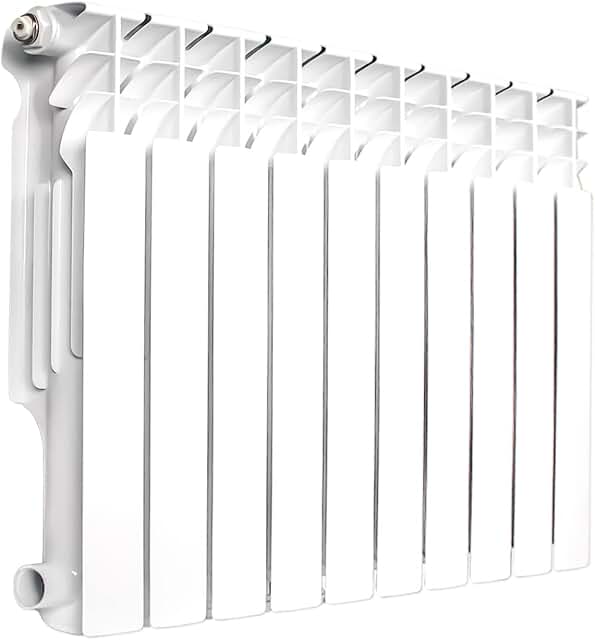
The AB is a wall-mounted, 10-panel aluminum hot-water radiator. Its stated dimensions are 28.54 × 3.66 × 22.36 inches, and the listing gives a maximum output of 5,768 BTUs. Side air vents are described as improving air circulation and heat radiation. Its higher stated output makes it useful to compare with the smaller-output options, but output alone does not determine whether it can heat a particular room.
Best for: Buyers who want to compare a larger panel count and a higher listed BTU figure for a kitchen, bedroom, or greenhouse. The listing describes quiet plumbing-based operation and a baked-paint finish intended to resist peeling and corrosion.
The product is described as having a welded construction and a 24-hour pressure test. The listing states a maximum pressure of 2.0 MPa and recommends a working pressure of 1.2–1.8 MPa. Have an installer check that these limits match the planned hydronic system.
Limitation: Side air vents are part of the described design, so this may not suit buyers seeking a completely smooth, fin-free unit. The stated BTU output should not be treated as a room-size guarantee.
WiseWater 4-Panel Copper-Aluminum Radiator

The WiseWater is a wall-mounted copper-aluminum radiator with four panels and a white finish. Its listing provides thermal output per section at three temperature differences: 180 BTU/h at ΔT 30°C, 300 BTU/h at ΔT 44.5°C, and 349 BTU/h at ΔT 50°C. These figures give buyers more context for comparing output under different stated conditions.
Best for: Buyers who want per-section output information and a white finish that can fit different decor styles. The listing also describes quiet operation and steady heat from a hydronic system.
Compare the listed output conditions with the temperatures and flow conditions of the heating system under consideration. The manufacturer notes that actual field performance varies with system flow, insulation, and installation. The listing does not specify overall dimensions or explicitly confirm that the construction is fin-free.
Limitation: Per-section figures are not the same as a complete-room heat calculation. Verify the total number of sections, final output, dimensions, and surface design before selecting this unit.
Buying Guide: How to Choose a Single-Panel Radiator Without Fins
A “single-panel” radiator and a radiator “without fins” are not necessarily the same thing. Single-panel describes a product’s panel arrangement, while fins or internal baffles can be separate construction details. Product titles and images may not show the internal structure clearly. If a smooth, fin-free design is essential, request a clear product diagram or written confirmation before ordering.
What Does “No Fins” Mean for a Radiator?
Buyers may use “no fins” to mean a flat outer face, no visible convection fins, or no finned components inside the casing. Those are different requirements. State whether you care about appearance, cleaning access, or internal design when comparing products. A radiator can look flat from the front while still containing internal channels or heat-transfer components.
How Much Heat Output Does the Room Need?
Start with the manufacturer’s output rating, then compare it with the room’s heat requirement. Room size, ceiling height, windows, insulation, climate, and heat-system temperatures can all affect the required output. The EMKE listing provides a 297-watt figure and approximate room guidance; the Q-Hillstar and AB listings state BTU figures; WiseWater gives output per section under specified temperature differences. These figures are not directly comparable without accounting for units and test conditions.
Should You Choose a Hydronic or Electric Radiator?
The Q-Hillstar, AB, and WiseWater products are described as hot-water or hydronic radiators. They rely on heated water supplied by a boiler or central heating system; they are not standalone electric heaters. The Embassy listing mentions an element but does not provide enough information to determine the complete heat source or system requirements. Confirm how each model operates before purchase.
Will the Radiator Fit the Existing Pipework?
Check the product’s dimensions, connection thread, connection location, pipe spacing, wall clearance, and mounting needs. The EMKE listing provides several of these measurements, including its G1/2-inch thread and 50 mm axle spacing. The other listings provide different levels of installation detail. A qualified installer can compare product specifications with the existing system and identify any additional fittings required.
Which Materials and Finishes Should You Compare?
Aluminum, steel, and copper-aluminum construction are represented in these listings. The product descriptions make material-specific claims, but they do not provide a direct independent comparison of durability or heating performance. Check the finish and cleaning instructions, and confirm that the material and stated pressure limits are appropriate for the system. Do not assume that a finish or material makes a product suitable for every installation.
What Should You Verify Before Ordering?
- Whether the radiator is genuinely fin-free in the way you require.
- The heat output and conditions used to state that output.
- Whether the unit is hydronic, electric, or another type of heater.
- Connection dimensions, pipe spacing, mounting requirements, and wall clearance.
- Working-pressure limits and any system requirements stated by the manufacturer.
- Which accessories are included. The Embassy listing says end caps are sold separately.
Frequently Asked Questions
Are single-panel radiators always fin-free?
No. “Single-panel” does not prove that a radiator has no fins or internal baffles. Check the manufacturer’s construction details if a fin-free design is a requirement.
Which listed radiator is specifically described as a flat design?
The EMKE is described as a vertical flat radiator with a single-layer design. Its listing does not explicitly state that it has no fins, so confirm that detail before buying.
Can a hydronic radiator work without a boiler or central heating source?
No. A hot-water radiator needs a source of heated water and a compatible system to circulate it. The radiator itself transfers heat but does not generate hot water.
Are the listed BTU and watt ratings directly comparable?
Not without conversion and context. Output can depend on the test conditions, water temperature, flow, and system installation. Compare ratings using consistent units and comparable conditions.
What is the best option for a small room?
The EMKE listing identifies the radiator as suitable for a room up to approximately 5 m² and gives a 297-watt output. Confirm the room’s actual heat requirement and the unit’s fit before choosing it.
Does the Embassy heater include every installation accessory?
The listing says it includes a front cover, back panel, damper, brackets, and 3/4-inch element. It also states that end caps are sold separately. Check the complete installation requirements with the seller or installer.