The best outdoor ceiling-mounted radiant heater depends on the size of the area, available electrical supply, and how much control you want. The Bromic Tungsten and Cobalt are high-output choices for larger patios, while the Sundate offers app control and multiple heat levels. The Infratech is a 120-volt option for focused warmth, and the Shinic two-pack is better suited to garages and work areas. Check mounting clearances and the product’s installation requirements before choosing a location.
| Product | Best For | Key Consideration |
|---|---|---|
| Bromic Tungsten Smart Heat | Large patios with 220–240V supply | Requires substantial ceiling clearance |
| Shinic 2-Pack Quartz Heater | Garages and work areas | Product features emphasize indoor workspaces |
| Bromic Cobalt Smart Heat | Large patios with 240V supply | Requires substantial ceiling clearance |
| Sundate 1500W Infrared Heater | Compact spaces needing adjustable control | Check installation and outdoor-use instructions |
| Infratech C-1512 SS | Focused heat from a 120V fixture | Single 1500W element |
Bromic Tungsten Smart Heat 6000W

Best for: Buyers heating a larger patio or commercial outdoor area who have access to a compatible 220–240V electrical supply. The listed coverage is 160 square feet, and the 6000W dual-element infrared design directs heat toward people and objects rather than primarily warming the air.
The fixture has a stainless-steel body with a high-temperature, corrosion-resistant finish. Its directional bracket can be adjusted to aim warmth toward the seating or gathering area. Installation is specified for a wall or ceiling, and the product can also be recessed with an optional kit.
- 6000W dual quartz heating elements
- 220–240V electrical supply
- Listed heating coverage of 160 square feet
- Minimum clearance listed as 96 inches for ceiling mounting
Why it was selected: It combines high stated output, a defined coverage area, and flexible mounting options for larger spaces. Limitation: The electrical requirements and 96-inch minimum ceiling clearance may rule it out for some homes. Confirm installation conditions and electrical suitability before purchase.
Shinic 2-Pack Ceiling-Mounted Quartz Heaters

Best for: Garage, workshop, shop, and other work-area buyers who want radiant heat and a built-in work light. The listing describes two 120V heaters with 1500W and 750W settings. Dual quartz tubes provide direct radiant warmth to people and objects in front of each unit.
A built-in halogen work light adds visibility around a workbench or tools. The heater can rotate up to 90 degrees, which helps direct heat toward a particular workspace while keeping the unit off the floor. The two-pack may be useful where separate work areas need individual heat sources.
- Two heaters in the package
- 120V operation with 1500W and 750W settings
- Quartz radiant heating and halogen work light
- Ceiling mounting with up to 90-degree rotation
Why it was selected: It offers a practical combination of task lighting, adjustable direction, and radiant warmth for garage-style spaces. Limitation: The product details focus on garages, workshops, and commercial spaces rather than weather exposure. Do not assume it is suitable for an uncovered patio; check the manufacturer’s placement and use instructions.
Bromic Cobalt Smart Heat 6000W

Best for: Buyers who need a high-output heater for a larger patio and have a compatible 240V supply. Its listed 160-square-foot heating area and 6000W dual quartz elements make it comparable in stated output to the Tungsten model.
The Cobalt uses 304 stainless steel with a high-temperature, corrosion-resistant finish. It is designed for wall or ceiling installation, and an adjustable directional bracket helps focus heat on the intended area. The supplied product information lists a minimum 96-inch clearance for ceiling mounting.
- 6000W dual-element infrared heating
- 240V electrical supply
- Listed coverage of 160 square feet
- 304 stainless-steel construction
Why it was selected: It is a strong candidate for buyers comparing high-output patio heaters who prefer the listed 240V configuration and stainless-steel construction. Limitation: Its output and clearance needs require careful planning. Choose it only if the electrical supply and mounting location meet the product requirements.
Sundate 1500W WiFi Infrared Heater

Best for: Buyers who want several ways to adjust heat in a compact patio, balcony, gazebo, or covered area. This 1500W carbon-fiber infrared heater offers nine heat levels, a 24-hour timer, WiFi app control, a remote, and a touch panel.
The heater is designed for wall-mounted, hanging, or ceiling-mounted installation, so it can be positioned without taking up floor space. Its infrared heating is intended to warm people and objects directly. The product listing describes it as waterproof and identifies covered outdoor spaces among its intended settings.
- 1500W output and nine heat levels
- WiFi app, remote, and touch controls
- 24-hour timer
- Wall, hanging, or ceiling installation options
Why it was selected: It is the most control-focused option in this group and suits buyers who want to adjust output rather than choose a single fixed setting. Limitation: Its 1500W output is much lower than the 6000W Bromic models. Check the installation instructions and electrical requirements for the intended location.
Infratech C-1512 SS 1500W Heater
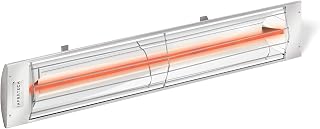
Best for: Buyers seeking a focused 120V infrared fixture with a stainless-steel finish. The C-1512 SS is a 1500W, single-element heater that produces targeted radiant warmth. Its 33-inch fixture has a brushed 304 stainless-steel construction.
The product information states that more than 90% of input energy is converted directly into radiant heat. It also specifies zero on-site combustion, which distinguishes its operation from heaters that burn fuel at the point of use. The 120V supply may be relevant for buyers who cannot use a 240V fixture, but installation suitability should still be confirmed.
- 1500W single-element infrared heat
- 120V electrical supply
- 33-inch fixture in brushed 304 stainless steel
- Product-listed energy conversion above 90%
Why it was selected: It provides a lower-output alternative to the large 6000W fixtures and a clearly stated 120V specification. Limitation: The listing does not provide a coverage area or mounting-clearance figures in the supplied features. Confirm those details before planning a ceiling installation.
Buying Guide: How To Choose An Outdoor Ceiling-Mounted Radiant Heater
How much area do you need to heat?
Start with the dimensions of the seating or work area, not just the overall patio footprint. Radiant heaters direct warmth toward people and objects in their path, so placement and direction matter. Of the products here, the Bromic Tungsten and Cobalt list coverage of 160 square feet. The other supplied features do not state a coverage area, so avoid estimating one from wattage alone.
For a large gathering area, compare the Bromic models first if the electrical supply and clearance requirements work. For a compact balcony or a spot where adjustable output matters, the Sundate offers nine heat levels. A 1500W fixture is not automatically sufficient for a large or exposed space; consider the area’s layout and exposure when choosing.
What electrical supply does the heater require?
Match the heater’s listed voltage to the electrical supply at the installation location. The Tungsten specifies 220–240V, the Cobalt specifies 240V, and the Sundate and Infratech list 1500W output, with the Infratech specifying 120V. The Shinic listing identifies 120V operation and 1500W and 750W settings.
Do not select a heater based on wattage alone. Check the full product and installation documentation for circuit requirements and have electrical work evaluated by a qualified professional where needed. The listed voltage is a comparison point, not confirmation that a particular household circuit is suitable.
Will the ceiling meet mounting and clearance requirements?
Measure the mounting height and the distance from the heater to nearby surfaces before buying. The Tungsten and Cobalt list a 96-inch minimum clearance for ceiling installation. The Tungsten also lists 72 inches for wall mounting and says recessing requires an optional kit. Do not assume that another model uses the same clearances.
Review the manufacturer’s installation instructions for each heater, including any required distances from ceilings, walls, furniture, and people. If the space cannot meet the stated requirements, choose a different installation location or product rather than reducing the clearance.
Do you need fixed output or adjustable controls?
A heater with several heat levels can be useful when outdoor conditions or occupancy change. The Sundate lists nine levels, a timer, app control, remote operation, and a touch panel. The Shinic offers two power settings and a rotating head, while the Bromic models have directional brackets for aiming heat. Compare the specific controls you will use rather than treating all radiant heaters as equally adjustable.
For a straightforward installation with focused heat, a fixed-output option may be adequate. For a space used at different times or by changing numbers of people, adjustable controls may provide more flexibility. Verify whether controls require any additional equipment; do not assume features that are not listed.
Is the installation location actually suitable for outdoor use?
“Outdoor heater” does not mean every product can be installed in every exposed location. The Sundate listing describes the heater as waterproof and names covered outdoor areas. The Bromic products are described for patios and outdoor spaces, while the Shinic listing emphasizes garages, workshops, shops, and commercial spaces. Follow each manufacturer’s specific instructions for exposure and placement.
For an uncovered location, confirm the product’s permitted exposure and installation conditions directly in its documentation. A product description that mentions a patio or says “waterproof” does not replace checking the full specifications and instructions for the exact mounting location.
Which construction and style fit the space?
The Tungsten is described as stainless steel with a high-temperature, corrosion-resistant finish. The Cobalt specifies 304 stainless steel with a similar finish, and the Infratech lists brushed 304 stainless steel. These details can help narrow choices when appearance and material are important, but they do not establish that a heater is maintenance-free.
Compare the fixture’s finish with the surrounding architecture and consider whether the unit will be visible from the seating area. Also check its dimensions, mounting orientation, and access for installation before making a final selection.
Frequently Asked Questions
Do radiant ceiling heaters warm the air?
Radiant heaters primarily direct warmth toward people and objects in their path rather than relying on heating all the surrounding air. Wind and placement can affect how comfortable an outdoor area feels, so aim the heater toward the occupied zone.
Which heater in this list has the highest stated output?
The Bromic Tungsten Smart Heat and Bromic Cobalt Smart Heat each list 6000W output. Both specify a 160-square-foot heating area, and each requires a compatible higher-voltage supply.
Which options list 120V operation?
The Shinic two-pack specifies 120V operation, and the Infratech C-1512 SS specifies 120V. Check each product’s complete electrical requirements before installation.
Can I mount any outdoor heater on a ceiling?
No. Choose a model that explicitly permits ceiling installation and follow its mounting and clearance instructions. The products listed here describe ceiling mounting, but their requirements and intended locations differ.
Is a 1500W heater enough for a patio?
That depends on the size, exposure, layout, and intended use of the space. The supplied product details do not state coverage for the 1500W Sundate or Infratech models, so do not assume they will heat a particular patio area without checking further specifications.
Should I choose a 120V or 240V heater?
Choose based on the heater’s stated voltage and the electrical supply available at the installation location. Confirm circuit suitability and installation requirements before purchase; voltage alone does not establish that a heater can be connected safely to an existing circuit.