The best choice depends on whether you want radiant warmth, quiet low-wattage heat, or faster whole-room air circulation. Of these five wall-mounted electric heaters, the EconoHome panel is the only product description that specifically says it emits some radiant heat; it primarily heats by convection. The Envi is designed for quiet, gentle supplemental warmth, while the DREO and JNDRO offer oscillation and remote or smart controls. The 9815WH is a higher-capacity recessed option. Check the product’s installation and electrical requirements before choosing.
| Product | Best suited for | Heating detail to note |
|---|---|---|
| EconoHome 400W Panel | Small rooms and steady supplemental heat | Mostly convection, with some radiant heat |
| Envi Plug-In Panel | Quiet, low-wattage room heating | Fan-less stack convection |
| DREO Smart Wall Heater | App control and broad heat distribution | Oscillating PTC ceramic heater |
| JNDRO Wall-Mounted Heater | Remote adjustments and selectable oscillation | ECO thermostat mode and 24-hour timer |
| 9815WH Wall Heater | Higher-capacity recessed heating | 1500W fan-assisted heating |
EconoHome 400W Wall Heater Panel

Best for: Buyers seeking a low-wattage panel heater for a small room and who want a product description that explicitly mentions radiant heat. EconoHome lists the panel as 400 watts and recommends it for rooms up to 120 square feet. It operates at 120 volts and has a thermostat with a stated range of 41°F to 86°F.
This is not described as a purely radiant heater. The manufacturer says the unit emits some radiant heat but mostly warms air through convection currents behind the panel. That distinction matters if you are comparing direct, line-of-sight radiant warmth with gradual room-air heating.
- Flat panel measures 23.5 by 23.5 inches and is listed as ¼ inch thick.
- A heat reflector is included, and hard-wiring is listed as a possible installation method.
- The product description lists overheat protection and cETL approval.
Why it was selected: It is the clearest match for a search focused on radiant heat, while its modest listed wattage and small-room guidance make its intended use easy to compare. Limitation: It primarily uses convection, and the casing becomes warm; the description says it is safe for adults only. Follow the instructions for installation and placement.
Envi Plug-In Fan-Less Panel Heater

Best for: People who prioritize quiet operation and targeted supplemental heat. Envi describes this wall-mounted panel as low-wattage and fan-less, using “Stack Convection” to circulate warmth without blowing air. That design may suit bedrooms or other spaces where fan noise and moving air are concerns.
The product listing also highlights a wall-sense safety sensor that cuts power if the heater is removed from the wall. It says the unit operates at a cool 90°F and can run continuously. The fan-less design is intended to avoid blowing dust and allergens, and the listing says it helps maintain humidity.
- Designed for localized or supplemental heating rather than described as a high-output whole-room unit.
- Includes a wall-sense safety sensor, according to the product information.
- Its automatic-dimming power light is intended to reduce distraction.
Why it was selected: It offers a distinct alternative to oscillating or fan-assisted wall heaters, with quiet convection as its central feature. Choose it if gentle, unobtrusive heat matters more than rapid air circulation. Limitation: The provided product details do not state a wattage or recommended room size, so confirm those specifications before comparing its capacity with other models.
DREO Smart 1500W Wall Heater
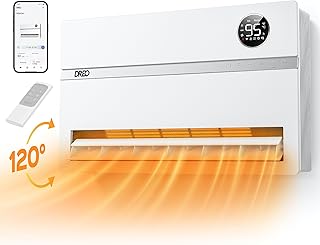
Best for: Buyers who want app-based scheduling, voice control, and wide heat distribution. The DREO uses a PTC ceramic heating system and has 120-degree oscillation, which moves warm air across a wider area than a fixed-direction heater.
The listed temperature range is 41°F to 95°F, with temperature adjustments stated to be accurate to 1°F. The product also supports scheduling through the DREO app and lists compatibility with Alexa and Google Home. These controls can help users coordinate heating with a daily routine, but they do not change the basic need to match heater capacity to the room and installation conditions.
- 1500-watt output is stated in the product name.
- 120-degree oscillation is designed to distribute warmth around the room.
- App scheduling and listed voice-assistant control provide remote operation options.
Why it was selected: It is a strong comparison choice for shoppers who value control features and broad circulation more than direct radiant warmth. Limitation: The product description focuses on ceramic heating and warm-air distribution, not a dedicated radiant panel. If you specifically want radiant heat directed toward people or objects, compare heating methods carefully.
JNDRO Wall Heater With Remote

Best for: Buyers who want to change heater settings from across the room and adjust the direction of heat distribution. JNDRO includes a remote and LED display, plus three oscillation choices: 60, 90, and 120 degrees. The remote is described as controlling temperature, timer, fan speed, and oscillation angle.
An ECO thermostat mode adjusts heating power based on ambient temperature, according to the product information. The stated temperature range is 41°F to 95°F, and a 24-hour timer provides another way to schedule operation. The product details mention fan-speed settings, making it more suited to buyers comfortable with a heater that circulates air than those seeking a silent radiant panel.
- Three selectable oscillation angles offer different coverage patterns.
- LED display shows current settings, according to the listing.
- The remote requires two AAA batteries, which are not included.
Why it was selected: It combines a thermostat mode, timer, remote, and adjustable oscillation in one wall-mounted option. Choose it if flexible controls are a priority. Limitation: The product description does not provide a wattage or recommended room size, so verify capacity and installation details before purchase.
9815WH 1500W Recessed Wall Heater

Best for: Buyers looking for a higher-capacity heater with a recessed installation style and fan-assisted room heating. The 9815WH is listed at 1500 watts and includes a built-in adjustable thermostat. Its product description says a nickel-chromium heating element and cross-flow fan distribute warm air.
The listing describes the heater as designed for recessed installation and claims it can heat a 350-square-foot room. Treat that figure as the manufacturer’s stated guidance, not a guarantee: actual heating results depend on the room, insulation, climate, and other conditions. The description also claims the heater begins distributing warmth in 15 seconds and operates below 25 decibels.
- Recessed format can keep the heater from occupying floor space.
- Listed for use in areas such as bedrooms, kitchens, bathrooms, and laundry rooms.
- Uses a fan to move heated air, rather than being presented as a radiant-only panel.
Why it was selected: Its stated 1500-watt capacity, recessed design, thermostat, and broad claimed coverage make it a useful comparison for shoppers considering a more powerful wall heater. Limitation: Recessed installation requires attention to the product’s installation requirements; confirm that the location and electrical setup are appropriate before buying.
Buying Guide: How to Choose a Radiant Heat Wall Heater
Do you want radiant warmth or heated air?
Radiant heaters transfer warmth directly to people and objects in their path. Convection heaters warm air, which then circulates through the room. Some products combine characteristics, and sellers may use broad “wall heater” language without describing the heat transfer method clearly.
In this selection, EconoHome explicitly says its panel emits some radiant heat, but mostly heats through convection. Envi describes fan-less stack convection. DREO and the 9815WH describe moving warm air, while JNDRO lists fan-speed control and oscillation. If direct radiant heat is essential, look for a clear description of the heating element and heat-transfer method rather than relying on the product title.
What room size and output should you check?
Compare wattage and the manufacturer’s stated room guidance, but do not assume that similar wattage guarantees identical comfort. EconoHome lists 400 watts and a recommended room size up to 120 square feet. DREO and the 9815WH are listed at 1500 watts; the 9815WH claims coverage up to 350 square feet. The supplied details do not give a room-size recommendation for Envi or JNDRO.
Room size is only one factor. Ceiling height, drafts, insulation, outdoor temperature, and whether the heater is supplemental can affect results. Use the stated coverage as a starting point, and check the manufacturer’s full instructions for the intended application.
Which control features are useful?
A thermostat helps regulate a target temperature, while a timer can limit how long a heater runs. Remote controls are useful when the heater is mounted out of easy reach. Oscillation can spread warm air across a broader area, but it is not the same as increasing the heater’s rated output.
- Choose DREO if app scheduling and listed Alexa or Google Home control are priorities.
- Choose JNDRO if you want a remote, LED display, timer, and multiple oscillation angles.
- Compare thermostat ranges: EconoHome lists 41°F to 86°F, while DREO and JNDRO list 41°F to 95°F.
- Check whether batteries are required; JNDRO’s remote uses two AAA batteries, not included.
How important is noise and air movement?
Fan-less heaters avoid fan noise and blown air, which can be helpful for a bedroom or a space where air movement is undesirable. Envi specifically describes a fan-less design. Fan-assisted models can distribute warmth around a room, but buyers should consider whether they prefer circulation or a quieter, gentler style of heating. The 9815WH lists a cross-flow fan, while DREO and JNDRO describe oscillation or fan controls.
What installation and safety details should you verify?
Wall-mounted does not always mean the same installation method. EconoHome lists wall mounting and says the unit may be hard-wired. Envi is described as a plug-in panel. The 9815WH is described as recessed. Verify whether your selected heater needs a wall outlet, hard-wiring, or an opening in the wall, and follow the supplied installation instructions.
Review safety features and placement requirements rather than assuming that a heater is suitable for every room. EconoHome lists overheat protection and notes that its casing becomes warm. Envi lists a wall-sense sensor that cuts power if the unit is removed from the wall. Check the manufacturer’s directions for clearances, surfaces, and room-specific use.
Should a wall heater replace central heating?
These products are presented as room heaters or supplemental heating options, but their suitability for replacing a central system depends on the building and the heater’s capacity. A low-wattage panel intended for a small room is not equivalent to a whole-home heating system. Consider whether you need steady background warmth in one space, rapid air circulation, or direct radiant comfort in a specific area.
Frequently Asked Questions
Which heater in this list specifically mentions radiant heat?
EconoHome says its 400-watt panel emits some radiant heat. The same description says it mainly heats through convection, so it should not be treated as a purely radiant heater.
Are wall-mounted panel heaters usually silent?
Not all of them. Envi describes a fan-less design intended for silent operation. Other products in this selection mention fans, fan-speed settings, or forced air, so check the specific model’s description if noise is a priority.
Can a 1500-watt wall heater heat a large room?
Coverage depends on the model and the room. The 9815WH listing claims coverage up to 350 square feet, while the DREO details provided do not state a room-size figure. Treat manufacturer coverage as guidance and consider insulation, drafts, and climate.
What is the difference between oscillation and radiant heating?
Oscillation moves a heater’s airflow or heat direction across an area. Radiant heating transfers warmth directly to people and objects. Oscillation can widen distribution, but it does not by itself make a heater radiant.
What should I confirm before installing a wall heater?
Confirm whether it plugs in, requires hard-wiring, or needs recessed installation. Check the model’s electrical requirements, mounting instructions, safety clearances, and the manufacturer’s room-use guidance before installation.