The best oil-filled radiator for a bathroom is one that is explicitly approved by its manufacturer for bathroom use; the product listings below do not establish that approval. These five electric radiators are better treated as supplemental heaters for dry indoor spaces, such as bedrooms or offices, unless their manuals specifically permit bathroom placement. The De’Longhi is best for simple temperature control, the DREO eight-fin model for heat distribution and listed safety features, Amazon Basics for adjustable settings, Caynel for its stated room coverage, and PELONIS for quiet operation.
| Product | Best suited for | Notable listed feature |
|---|---|---|
| De’Longhi EW7707CM | Simple temperature management | ComfortTemp feature |
| DREO eight-fin radiator | Even warmth and multiple safety features | Eight M-shaped fins |
| Amazon Basics seven-fin radiator | Selectable heat levels | 600W, 900W, and 1500W settings |
| Caynel oil-filled radiator | Buyers comparing stated room coverage | Coverage listed up to 200 square feet |
| PELONIS 1500W radiator | Quiet supplemental heat | Three heating modes |
De’Longhi EW7707CM Oil-Filled Radiator
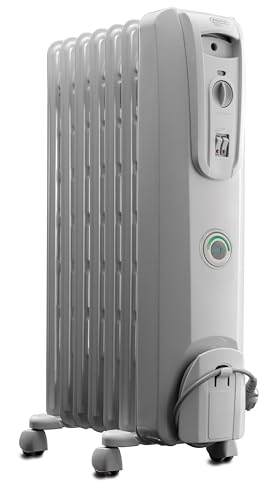
Best for: Buyers who want straightforward controls and automatic temperature maintenance in a dry indoor room. The listed ComfortTemp feature is designed to maintain an optimal temperature and power level, while simple controls adjust the power and temperature.
The manufacturer listing says ComfortTemp can be up to 20% more efficient than using the same unit’s thermostat at its maximum setting without that feature. The radiator’s thermal slot design is described as directing heat into the room while maintaining a low surface temperature. These details make this model a practical option for someone who prefers a set-and-maintain approach rather than repeatedly changing settings.
Why it was selected: It offers a distinct temperature-control feature and a design intended to improve heat flow. Limitation: The provided product details do not state that it is suitable for bathroom use or exposure to moisture. Do not place it near sinks, showers, or wet floors unless its manual expressly allows that use.
DREO Eight-Fin Oil-Filled Radiator

Best for: Buyers who prioritize broad heat distribution and clearly described protective features in a dry indoor space. The listing describes eight M-shaped fins, a 1500W heating level, tip-over protection, triple overheat protection, flame-retardant material, and a safety plug.
DREO says the fin design increases the heat-dissipation area and helps distribute warmth throughout a room. The listing also describes a surface-temperature design intended to reduce scalding risk. Its stated protections may be useful considerations for households, but they do not make the radiator waterproof or establish that it can safely be used in a bathroom.
Why it was selected: It combines a high listed power level with an eight-fin design and several specific safety features. Limitation: The listed product information does not give a bathroom-use approval or a square-foot coverage figure. Check the manual for placement requirements and keep the unit away from water.
Amazon Basics Seven-Fin Portable Radiator

Best for: Buyers who want several selectable heat settings and an adjustable thermostat. This model lists 600W, 900W, and 1500W settings, so users can choose among three output levels rather than relying on one setting.
The radiator has seven oil-filled wavy fins, which the listing says help disperse heat more evenly. It also describes heat retention after the unit is turned off. The listed safety features include tip-over and overheat protection, and the product description identifies an ETL safety certification. Confirm the current product documentation for exact operating and placement instructions.
Why it was selected: Its three heat levels, adjustable thermostat, and stated protective features make it easy to compare with other basic oil-filled radiators. Limitation: The supplied features do not provide room-size coverage or bathroom-use approval. It is not a substitute for a bathroom-rated fixed heater.
Caynel Nine-Fin Oil-Filled Radiator

Best for: Buyers comparing heaters by stated coverage and fin count. Caynel lists nine fins and coverage up to 200 square feet, alongside an adjustable thermostat and three heat settings of 600W, 1000W, and 1500W.
The higher number of listed fins and the stated coverage figure give buyers specific details to compare against their room size. The product description also identifies overheat protection and a tip-over switch. These specifications may suit someone seeking adjustable supplemental heat, but stated coverage should not be treated as a guarantee for every room: insulation, ceiling height, drafts, and the room’s starting temperature affect heating needs.
Why it was selected: It is the only product in this group with a specific coverage figure in the supplied information, plus three power settings. Limitation: The listing details do not establish that the heater is designed for damp bathrooms. Keep it in a dry area unless the product manual explicitly permits bathroom use.
PELONIS Quiet 1500W Oil Radiator

Best for: Buyers who want quiet supplemental heat for a bedroom, office, or other indoor room. The listing describes a fanless design and three heat modes at 600W, 900W, and 1500W. It also names tip-over protection.
PELONIS describes the heater as delivering gentle, lasting warmth and says its selectable power modes can help users adjust output. Because the product is described as fanless, it may be preferable for spaces where fan noise is unwelcome. That does not indicate that the unit is silent in every operating condition, and the listing does not provide a bathroom-specific rating.
Why it was selected: It offers clear output choices and a fanless design, making it a useful comparison for people focused on noise and adjustable heat. Limitation: The supplied feature list does not give room coverage or confirm safe use around bathroom moisture. Avoid wet locations unless the manufacturer’s instructions explicitly authorize them.
Buying Guide: How to Choose an Oil-Filled Radiator
Can an oil-filled radiator be used in a bathroom?
Only use a heater in a bathroom if the manufacturer’s instructions explicitly state that it is suitable for that location. The product details above do not establish bathroom approval. Oil-filled radiators are electrical appliances, and bathrooms can expose them to splashes, damp air, and wet floors. A general indoor-use description is not the same as a bathroom rating.
For bathroom heating, check the manual and product label for approved locations, required clearances, and any restrictions around water. If the documentation does not clearly permit bathroom use, choose a heater designed and rated for that environment instead. Never assume that tip-over or overheat protection makes a heater safe to use near water.
How much heating power should you compare?
Several models in this group offer a 1500W setting, while lower settings vary. The Amazon Basics and PELONIS models list 600W, 900W, and 1500W. Caynel lists 600W, 1000W, and 1500W. Multiple settings let users reduce output when full power is unnecessary, but a higher wattage alone does not guarantee that a heater will warm a particular room adequately.
Consider room dimensions, insulation, drafts, ceiling height, and how quickly you need supplemental warmth. Use a manufacturer-provided coverage figure when available, but treat it as a reference rather than a promise for every home. In this selection, Caynel’s listing states coverage up to 200 square feet; the other supplied product details do not give a comparable area.
Which features matter for temperature control?
An adjustable thermostat can help maintain a preferred temperature without manually switching the heater on and off as often. The De’Longhi listing highlights its ComfortTemp feature, while Caynel and Amazon Basics list adjustable thermostats. DREO describes an eco mode and a sensor-based temperature system in its product details, although the eight-fin model selected above is identified by its eight M-shaped fins and safety features.
Compare how each heater controls output, not just how many settings it offers. A basic low, medium, and high selector may suit buyers who want simple operation. A temperature-maintenance feature may be more useful to someone who expects to leave the heater running for a period, provided the manual allows that use.
What safety details should buyers check?
Look for clear documentation about tip-over response, overheat protection, electrical requirements, and required clearance from walls, furniture, and fabrics. Product listings in this group identify different combinations of these features. They are useful comparison points, but they do not replace following the manual or supervising a portable heater as instructed.
Place a portable radiator on a stable, dry surface and keep it away from towels, curtains, bath mats, and other combustible materials. Do not cover it, operate it with a damaged cord, or use an extension cord unless the manufacturer specifically permits one. Follow the label and manual for plugging in and storing the heater.
Is an oil-filled radiator quiet?
Oil-filled radiators are often considered by buyers who want heat without relying on a fan, but check the product description for the specific model. PELONIS describes its selected heater as fanless and quiet. That feature may suit a bedroom or office, but it does not make the heater appropriate for a damp bathroom.
What should you compare before buying?
- Bathroom approval: Confirm that the exact model is allowed in bathrooms before considering it for that room.
- Heat settings: Compare the available wattage levels and thermostat controls.
- Room size: Match any stated coverage to the space, while allowing for insulation and drafts.
- Safety information: Review tip-over, overheat, and placement instructions in the manual.
- Noise preference: Check whether the product is described as fanless if quiet operation matters.
- Portability and placement: Verify the unit’s dimensions and required clearances before choosing a location.
Frequently Asked Questions
Are oil-filled radiators safe for bathrooms?
Only if the manufacturer explicitly approves the exact heater for bathroom use. Do not infer bathroom suitability from a general indoor-use description or from protective features such as tip-over and overheat protection.
Does an oil-filled radiator heat a room after it is switched off?
Some products retain warmth after being turned off. The Amazon Basics listing specifically says its radiator retains heat longer. The amount and duration of residual warmth are not specified in the supplied details.
Which option lists the most heat settings?
The selected Amazon Basics and PELONIS radiators each list three settings. Amazon Basics specifies 600W, 900W, and 1500W; PELONIS lists the same three levels.
Which heater in this selection lists room coverage?
Caynel lists coverage up to 200 square feet. Treat that as the manufacturer’s stated figure, not a guarantee that the heater will perform identically in every room.
Does tip-over protection make a heater suitable near a bathtub?
No. Tip-over protection does not establish that a heater is waterproof or approved for use near a bathtub. Follow the manufacturer’s bathroom-use instructions and required clearances.