The best vertical hot water radiator depends on the heat output your room needs, the available wall space, and whether your heating system circulates hot water or steam. The options below are wall-mounted aluminum radiators in several panel counts. The 10-panel models are better suited to buyers seeking higher listed output, while the 8- and 6-panel options fit buyers comparing smaller units. Confirm system compatibility and installation requirements before choosing.
| Product | Panel Count | Listed Heat Output | Best For |
|---|---|---|---|
| Q-Hillstar 10-Panel | 10 | Up to 5,800 BTU | Higher listed output and quiet operation |
| AB 10-Panel | 10 | Up to 5,768 BTU | Buyers comparing a 10-panel aluminum unit |
| Q-Hillstar 8-Panel | 8 | Up to 4,700 BTU | Mid-sized panel count with stated dimensions |
| AB 8-Panel | 8 | Up to 4,616 BTU | Buyers who need an explicit hot-water-only note |
| Q-Hillstar 6-Panel | 6 | Up to 3,500 BTU | Smaller listed output and compact width |
Q-Hillstar 10-Panel Aluminum Radiator

Best for: Buyers looking for the highest stated heat output among the selected products. This wall-mounted model has 10 aluminum panels and a listed output of up to 5,800 BTU. Its stated dimensions are 28.54 by 3.66 by 22.36 inches, so measure the intended wall area before ordering.
The radiator connects to a boiler or central heating system and circulates hot water. Side baffles are intended to support airflow, while the product description identifies quiet operation and a baked-paint surface that is easy to clean. It is made from aluminum, which the listing describes as having high thermal conductivity.
Why it was selected: It combines a 10-panel format with the highest listed BTU figure in this comparison. Limitation: It requires a compatible hot-water heating system; the listing does not establish that it works with every boiler or installation.
AB 10-Panel Wall-Mounted Radiator

Best for: Buyers comparing 10-panel radiators who want a stated pressure range for installation planning. The AB model measures 28.54 by 3.66 by 22.36 inches and is listed at up to 5,768 BTU. Its output is close to the Q-Hillstar 10-panel model, so room heat requirements and system details may matter more than the small difference between listed outputs.
The product uses a scratch-free aluminum construction and a baked-paint finish. Side air vents are designed to improve air circulation and heat radiation. The listing describes quiet operation and says the radiator has undergone a 24-hour pressure test. It gives a maximum pressure of 2.0 MPa and a recommended working pressure of 1.2–1.8 MPa.
Why it was selected: It offers a clear 10-panel alternative with stated pressure information. Limitation: Its listed output is a product specification, not a guarantee of room performance; actual heating depends on system and installation conditions.
Q-Hillstar 8-Panel Radiator

Best for: Buyers who want a middle option between 6 and 10 panels. The 8-panel radiator is listed at up to 4,700 BTU and measures 22.84 by 3.66 by 22.36 inches. The stated width is narrower than the selected 10-panel radiators, which may help when comparing available wall space.
This model connects to a boiler or central heating system and uses circulating hot water. Its listing describes quiet operation, side baffles for airflow, and an aluminum body with a baked-paint surface. It also lists a water flow rate of up to 8.77 gallons per hour and pressure resistance of 174–261 PSI.
Why it was selected: It provides a stated size and output for shoppers who do not need to start with the largest panel count. Limitation: The listed BTU output alone cannot determine whether it will heat a particular room adequately.
AB 8-Panel Hot Water Radiator
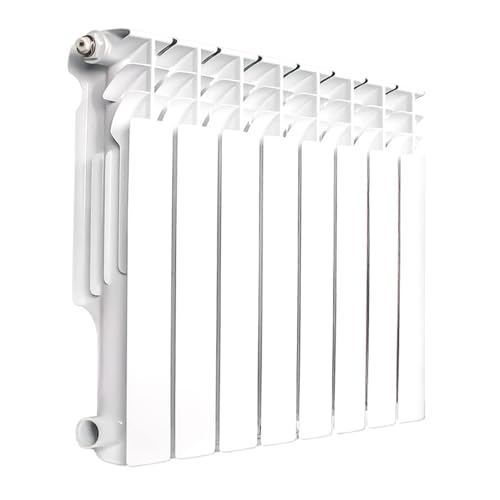
Best for: Buyers looking for an 8-panel option with a clearly stated system limitation. The AB radiator is listed at up to 4,616 BTU. It has aluminum construction, side air vents, and a baked-paint finish that the product description says is easy to clean.
The listing describes quiet operation and gives a maximum pressure of 2.0 MPa, with a recommended working pressure of 1.2–1.8 MPa. It also says the welded design underwent a 24-hour pressure test. Those figures can help buyers compare specifications, but a qualified installer should confirm that the radiator’s requirements match the home’s hydronic system.
Why it was selected: Its intermediate panel count and pressure details make it a useful comparison with the Q-Hillstar 8-panel model. Important limitation: The listing specifically says this is a hot water radiator and is not compatible with steam.
Q-Hillstar 6-Panel Compact Radiator

Best for: Buyers comparing a lower-output, narrower radiator. This 6-panel model measures 17.13 by 3.66 by 22.36 inches and is listed at up to 3,500 BTU. Its smaller stated width may suit a location where a wider 8- or 10-panel unit is difficult to place, provided its heat output is suitable for the room.
The radiator uses hot water supplied by a boiler or central heating system. The product description highlights quiet operation, side baffles, an aluminum body, and a baked-paint surface. It lists a water flow rate of up to 8.77 gallons per hour and pressure resistance of 174–261 PSI.
Why it was selected: It gives shoppers a 6-panel option with published dimensions and output. Limitation: Its lower listed BTU output makes it a less suitable starting point for buyers who need the highest output in this comparison.
Buying Guide: How to Choose a Vertical Hot Water Radiator
How many panels do you need?
Panel count is a useful first comparison, but it is not a complete sizing method. In this selection, the 6-panel models have lower listed output than the 8-panel and 10-panel options. Compare the manufacturer’s BTU figure with the heating requirement for the room, rather than choosing by panel count alone.
Room heat demand can vary with room dimensions, insulation, window area, ceiling height, outdoor climate, and the temperature of the water supplied by the heating system. A heating professional can calculate the required output and check whether a proposed radiator suits the system.
Will a hot water radiator work with your system?
These products are described as hydronic radiators that use circulating hot water. They are not standalone electric heaters. Check whether the home has a boiler or central heating system that can supply hot water to a wall-mounted radiator, and verify the connection arrangement before purchase.
Do not assume that a hot-water radiator can replace a steam radiator. The AB 8-panel listing explicitly says it is not compatible with steam. For other models, the supplied product details do not confirm steam compatibility, so ask the manufacturer or installer rather than inferring compatibility from appearance.
How should you compare BTU ratings?
BTU output is one way to compare stated heating capacity, but the figures should be treated as listed specifications, not guaranteed room results. The Q-Hillstar 10-panel model is listed at up to 5,800 BTU, while the AB 10-panel model is listed at up to 5,768 BTU. Their stated outputs are close; dimensions, pressure requirements, system fit, and installation needs may be more decisive.
Output can also vary with operating conditions. For example, the WiseWater product information in the supplied product data notes that actual field performance varies with system flow, insulation, and installation conditions. Check the specific model’s documentation and ask how its output rating applies to your system.
What measurements should you check?
Measure the intended wall area, including clearance for piping, valves, and service access. Compare the radiator’s full height, width, and depth with the available space. The selected Q-Hillstar models list a height of 22.36 inches and depth of 3.66 inches, with widths that vary by panel count.
Also consider where the radiator will sit in relation to furniture, curtains, doors, and walkways. A wall-mounted unit needs a secure installation and appropriate clearance. Confirm the mounting requirements and whether hardware is included; the product details supplied here do not establish that every model includes installation hardware.
Which material and finish details matter?
The selected Q-Hillstar and AB models use aluminum construction. Their listings describe aluminum as having high thermal conductivity and specify a baked-paint finish. The finish is described as easy to clean and resistant to peeling or corrosion, but routine care should follow the manufacturer’s instructions.
Compare materials based on the product specification and the home’s heating system, not on a general assumption that one material is always best. Ask an installer to check system water quality, pressure, and material compatibility where those factors apply.
What pressure specifications should you verify?
Pressure ratings matter because the radiator must operate within the limits of the heating system. The AB 10- and 8-panel models state a maximum pressure of 2.0 MPa and recommend a working range of 1.2–1.8 MPa. The Q-Hillstar models list pressure resistance of 174–261 PSI.
Do not compare pressure figures without checking whether they refer to maximum or recommended working pressure. Have an installer verify the system’s operating pressure and confirm the chosen radiator’s instructions. A pressure rating does not, by itself, establish suitability for a particular home.
Should you install it yourself?
Installation involves a connection to a hot-water heating system, so plumbing skill and local requirements matter. Before attempting a DIY installation, check the product instructions, mounting method, connection dimensions, and applicable building rules. If any of those details are unclear, use a qualified heating professional.
After installation, the system may need to be filled, checked for leaks, and balanced or adjusted. The supplied product features do not provide a complete installation procedure for these models. Do not rely on a product listing as a substitute for the model’s installation manual.
How can you choose between the listed models?
- Choose a 10-panel model if you need a higher listed output and have enough wall space. Compare the Q-Hillstar’s 5,800 BTU listing with the AB model’s 5,768 BTU listing.
- Choose an 8-panel model if you want an intermediate panel count. Compare stated output, dimensions, pressure information, and system compatibility.
- Consider the 6-panel Q-Hillstar if its lower listed output and narrower stated width align with the room’s requirements.
- Confirm hot-water versus steam compatibility before ordering. The AB 8-panel listing explicitly excludes steam use.
Frequently Asked Questions
What is a vertical hot water radiator?
A vertical hot water radiator is a wall-mounted heating unit that transfers warmth from circulating hot water into a room. The models covered here are described as connecting to a boiler or central heating system rather than operating as standalone electric heaters.
Are these radiators suitable for steam systems?
Do not assume they are. The AB 8-panel listing explicitly says it is not compatible with steam. The product details for the other selected models do not establish steam compatibility, so verify with the manufacturer or a heating professional.
Does a higher panel count always mean better heating?
No. More panels may correspond to a higher listed output among these models, but the right radiator depends on room heat demand, operating conditions, system compatibility, and available space. Match the output to a room-specific heat calculation.
Can these radiators heat a room without electricity?
The Q-Hillstar listings say the radiators use circulating hot water and do not need gas or electricity at the radiator itself. The boiler or central heating system that supplies hot water may still require its own energy source.
How do I know whether a radiator fits my wall?
Compare the product’s stated width, height, and depth with the available area, and allow for piping, valves, and installation clearance. Confirm mounting and connection details in the specific model’s instructions before purchase.
What does a BTU rating tell me?
A BTU rating indicates the product’s stated heat output under specified conditions. It helps compare models, but it does not guarantee that a radiator will heat a particular room. Room insulation, system flow, and installation conditions can affect results.