For shoppers searching for the safest space heaters associated with “2016,” the best choice is a heater with clearly stated tip-over and overheat protection, used according to its instructions. The five options below are current product listings, not a verified list of models released in 2016. The compact Amazon Basics heater suits small personal spaces, while the Lasko tower is better for oscillating warmth and the DR. Infrared Heater is designed for larger rooms. DREO options add adjustable direction or detailed temperature control.
| Product | Best for | Safety features listed |
|---|---|---|
| Amazon Basics Ceramic Heater | Compact personal heating | Tip-over and overheat protection |
| Lasko Ceramic Tower Heater | Oscillating room warmth | Overheat protection and cool-touch housing |
| DR. Infrared Heater DR-968 | Heating a large room | Tip-over and overheat protection |
| DREO Adjustable-Tilt Heater | Directing warmth up or down | Tip-over and overheat protection, safety plug |
| DREO Heater With Remote | Precise temperature settings | Tip-over detection, overheat protection, safety plug |
Amazon Basics Ceramic Space Heater

Best for: Someone who wants a small heater for a home office, desk area, or other personal space. Its listed dimensions are about 7.5 by 6.3 by 9.5 inches, and it weighs 3 pounds, making it comparatively easy to move between rooms.
This 1500-watt ceramic heater has three settings: high at 1500 watts, low at 900 watts, and fan only. Its non-oscillating design keeps the airflow directed rather than sweeping side to side. Listed safety features include tip-over protection, overheat protection, and a power indicator light.
Why it was selected: The listing explicitly names two commonly sought automatic protections and provides multiple operating modes in a compact format. Choose this if portability and simple controls matter more than broad room coverage.
Limitation: It does not oscillate, and the product details do not specify a room-size coverage estimate. It may be less suitable if you want warmth distributed across a larger area.
Lasko Ceramic Tower Heater With Remote
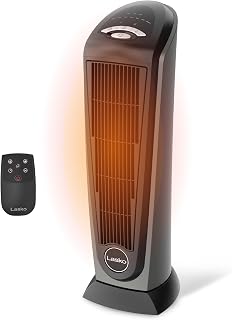
Best for: Buyers who want a taller heater with oscillation and remote-operated settings. The product description says its 1500-watt ceramic heat and wide oscillation are intended for medium-sized rooms.
The remote controls heat settings, oscillation, and a timer. The listed timer runs for up to seven hours. The description also identifies a self-regulating ceramic element, overheat protection, and cool-touch housing. It states that the heater is ETL-listed; check the product label and current documentation for details relevant to your purchase.
Why it was selected: This model combines named overheating protection with oscillation, remote controls, and a timer. It is a better fit than the compact Amazon Basics model when you want the heater to move warm air across a room without getting up to adjust it.
Limitation: The listing describes it for medium-sized rooms, not as a whole-home heating solution. A timer is not a substitute for following the manual’s instructions about when and where the heater may operate.
DR. Infrared Heater DR-968

Best for: Shoppers looking for a portable heater described as suitable for a large room. Its dual heating system combines an infrared quartz tube with a PTC element, and the listing gives an approximate output of 5200 BTU.
The DR-968 offers high and low settings, an automatic energy-saving mode, an infrared remote, and a 12-hour automatic shut-off timer. Its listed safety features include tip-over protection and overheat protection. The product description also reports a blower noise level of 39 dB.
Why it was selected: Its large-room positioning and dual heating system make it a useful comparison against compact ceramic models. Choose this if the intended space is larger and you want a remote and automatic shut-off timer.
Limitation: “Large room” is the listing’s description, not a precise coverage measurement. The heater is listed at 12.5 amps, so check the manual and the electrical requirements for your intended location.
DREO Space Heater With Adjustable Tilt

Best for: People who want to aim warm airflow at a particular height or seating position. The heater can be manually tilted through 0-, 20-, 40-, and 60-degree positions, according to the product details.
This 1500-watt model lists three modes, a thermostat, and a remote. The manufacturer describes its heating as delivering warm air in two seconds and lists a 10.5-feet-per-second air delivery figure. Safety details include tip-over protection, overheat protection, V0 flame-retardant materials, a safety plug, and ETL certification.
Why it was selected: Its adjustable tilt provides a clear alternative to fixed-direction designs, while the listing identifies several safety features. Choose it if directional comfort is a priority for a desk, chair, or floor-level position.
Limitation: Adjustable tilt is not the same as automatic oscillation. The product details do not give a specific room-coverage area, so avoid assuming it can heat an entire large room.
DREO Portable Heater With Remote

Best for: Buyers who value adjustable thermostat settings and remote control. The listing says its temperature range is 41 to 95 degrees Fahrenheit, adjustable in one-degree increments.
This heater uses a 1500-watt PTC system and a heat-funnel design. The product description claims warm-air reach up to 200% farther than traditional heaters; treat that as the manufacturer’s comparison rather than a guaranteed room-coverage figure. Listed safety details include a tilt-detection sensor, V0 flame-retardant materials, overheat protection, a safety plug, and ETL certification.
Why it was selected: It offers more specified thermostat adjustment than the other listed models, along with several named safety features. Choose it if fine temperature control and remote operation are more important than adjustable tilt.
Limitation: The listed temperature range does not establish how accurately the heater will maintain a particular room temperature under all conditions. The product details also do not specify room-size coverage.
Buying Guide: How To Choose A Safer Space Heater
Which safety features should a space heater have?
Start with the protections explicitly documented for the exact model. Tip-over protection is designed to respond if a heater is knocked over; overheat protection is intended to respond to excessive internal heat. Some listings also name cool-touch housing, a safety plug, or flame-retardant materials. These features can reduce certain risks, but they do not make a heater risk-free or replace careful use.
Check the heater’s label and instruction manual rather than relying only on a product title. Confirm what a feature does, when it activates, and whether the manufacturer provides specific placement or operating directions. Safety claims can vary between models or versions, so verify the details for the item you are considering.
What does “2016” mean when searching for a heater?
A search for “safest space heaters 2016” may reflect an older buying guide or a request for information from that year. The products in this comparison are the current listings supplied for this article; their listing details do not establish that they were available in 2016. If you need a heater that was sold or evaluated in a particular year, verify its model number and the date of the original documentation.
How much heat and room coverage do you need?
Match the heater to the space and the way you plan to use it. The Amazon Basics and DREO models listed here are 1500-watt heaters, while the DR-968 listing gives an approximate 5200-BTU output. The Lasko description positions its tower for medium-sized rooms, and the DR-968 is described as suitable for a large room. These descriptions are not directly interchangeable coverage measurements.
For personal warmth, a compact heater may be easier to position near a work area. For a shared room, oscillation or a design intended for larger spaces may be more useful. Review the manufacturer’s coverage guidance, room conditions, and electrical requirements before choosing. A portable space heater is generally intended to supplement, not automatically replace, a home’s primary heating system.
Should you choose a tower, compact, infrared, or tilting heater?
- Compact ceramic: Consider the Amazon Basics model if portability, a small footprint, and high, low, and fan-only settings are priorities.
- Oscillating tower: Consider the Lasko if you want remote control, side-to-side movement, and a timer.
- Infrared and PTC combination: Consider the DR-968 if its listed large-room positioning and dual heating system match your needs.
- Adjustable tilt: Consider the DREO tilt model if you want to direct airflow at different heights.
- Fine thermostat adjustment: Consider the other DREO model if its listed one-degree temperature increments are useful to you.
What safe-use practices matter after you buy?
Read and follow the exact heater manual. Keep the heater on a stable, level surface and maintain the clearance from furniture, bedding, curtains, paper, and other combustible materials specified by its manufacturer. Keep it away from water and do not block its air intake or outlet.
Use the power connection described in the manual and do not overload an outlet. Avoid using an extension cord or power strip unless the manufacturer explicitly permits it. Keep the heater out of walkways, where it could be bumped or tripped over, and supervise children and pets around it. Turn it off when leaving the area or going to sleep unless the instructions specifically allow that use.
How should you compare timers, remotes, and thermostats?
A remote improves convenience, but it does not change the heater’s basic safety requirements. A timer can limit a planned operating period, while a thermostat adjusts heating around a selected temperature. Neither feature guarantees safe placement or makes unattended operation appropriate. Compare controls based on how you will use the heater, then check the manual for their exact behavior.
Frequently Asked Questions
Are these heaters actually from 2016?
The supplied product details do not confirm that these models were released or sold in 2016. They are current product listings included for a search phrase that references that year.
Which listed heater is best for a small office?
The Amazon Basics heater is the most compact option in this comparison and weighs 3 pounds. Its listing includes high, low, and fan-only modes, plus tip-over and overheat protection.
Which option is described for a large room?
The DR. Infrared Heater DR-968 is described by its listing as suitable for a large room. Check the manufacturer’s coverage guidance for your specific room rather than treating that description as a precise measurement.
Do tip-over and overheat protection make a heater completely safe?
No. These features address particular hazards, but they do not eliminate risk. Follow the product manual, keep the heater clear of combustible materials, and use it only as directed.
Is a 1500-watt space heater suitable for every room?
No. Room layout, insulation, ceiling height, outdoor temperature, and the heater’s design can affect comfort. Compare the manufacturer’s coverage information and electrical requirements with the space where you plan to use it.
Can I leave a space heater running while I sleep?
Follow the manufacturer’s instructions for the specific model. If the manual does not clearly allow overnight operation, turn the heater off before sleeping. A timer or automatic shut-off feature does not replace those instructions.