If you need a compact electric water heater for a mobile home, the closest options in this list hold 18 gallons; there is no exact 20-gallon model. The GE 18-gallon plug-and-play model is best for a 120-volt connection, while the GE 18-gallon lowboy is better when installation height is limited. The ThermoMate offers adjustable temperature control and hard-wired installation. Confirm that any model is approved for your home’s location, plumbing, and electrical setup before buying.
| Product | Best suited for | Capacity and power details |
|---|---|---|
| GE 18-Gallon Plug and Play | Existing 120-volt supply and compact spaces | 18 gallons; 120 volts |
| GE 18-Gallon Lowboy | Installations with limited height | 18 gallons; 240 volts |
| ThermoMate 18-Gallon | Adjustable temperature and point-of-use use | 18 gallons; 120 volts; hard-wired |
| GE 40-Gallon Lowboy | Higher household hot-water demand | 40 gallons; two 5,500-watt elements |
| VEVOR 12-Gallon | One or two outlets with lower storage needs | 12 gallons; 120 volts; 1,600 watts |
GE 18-Gallon Plug-And-Play Electric Water Heater

Best for: Mobile-home owners seeking an 18-gallon tank that connects to a 120-volt supply, provided that the home’s electrical circuit and installation requirements match the unit.
GE describes this model as suitable for a single hookup or a small house, condo, or apartment. Its compact design is intended for space-limited locations, including kitchens, bathrooms, laundry rooms, cabins, garages, and sheds. The product information lists standard 3/4-inch NPT water connections and an adjustable thermostat.
Choose this model if an 18-gallon capacity is close enough to your target and you want the listed plug-and-play electrical connection. It may also work as a point-of-use heater or as a small-home supply, depending on demand and installation requirements.
Limitation: It holds 18 gallons, not 20, and its 120-volt connection does not establish that it is suitable for every mobile-home electrical setup. Check the manufacturer’s instructions and local requirements before installation.
GE 18-Gallon Lowboy Electric Water Heater
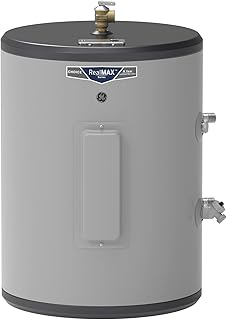
Best for: Buyers who need a compact tank with a lowboy profile because vertical clearance is restricted.
This GE model has an 18-gallon capacity, an adjustable thermostat, a drain valve, and side ports. The manufacturer identifies the lowboy shape as a way to fit spaces where height is a concern. Its product details describe it as suitable for a household of one or two people and note standard water and electrical connections for replacement installation.
Compared with the 120-volt GE model, this version is a better candidate when the installation calls for a lowboy form factor and the electrical supply is compatible with the listed 240-volt design. The drain valve is a useful feature to consider when planning maintenance or replacement access.
Limitation: The listed capacity is 18 gallons, and the product information does not confirm that it is approved for a particular mobile home. Verify voltage, dimensions, connections, and installation approval before purchase.
ThermoMate 18-Gallon Point-Of-Use Heater

Best for: Buyers who want an 18-gallon point-of-use tank with an adjustable thermostat and a compact, low-profile design.
The ThermoMate holds 18 gallons and is listed as a 120-volt, 1,500-watt hard-wired unit. Its product description gives a factory temperature setting of 125°F and says the built-in thermostat can be adjusted from 90°F to 150°F. The listed height is 25.5 inches. It is described for uses such as sinks, washing, dishwashers, and showers, and can be installed independently or as a booster in line with a larger hot-water source.
The product information also identifies an Incoloy-800 heating element and says the unit is UL listed. These are listed features, not a substitute for checking whether the product is approved for the intended mobile-home installation.
Limitation: This model is hard-wired rather than described as plug-and-play. Its 18-gallon capacity and stated shower duration are product claims; actual hot-water availability depends on use and installation conditions.
GE 40-Gallon Lowboy Electric Water Heater

Best for: Buyers whose hot-water needs are greater than an 18- or 20-gallon tank can meet and who have room and compatible services for a larger unit.
This GE lowboy has a 40-gallon capacity and two 5,500-watt heating elements. Its lowboy design is intended for spaces where height is limited. The listed first-hour rating is 63 gallons, measured through the DOE First Hour Rating, and the manufacturer describes it as suitable for households of two to four people.
This is not a near-20-gallon replacement. It is included as a higher-capacity comparison for households that prioritize stored hot water over a small footprint. Compare its dimensions and electrical requirements with the existing installation before considering it.
Limitation: Its capacity is double the target range, and its two 5,500-watt elements mean the electrical requirements need careful review. The provided information does not confirm mobile-home approval or compatibility with a particular site.
VEVOR 12-Gallon Point-Of-Use Heater

Best for: Singles or couples who need hot water for one or two outlets and can use less stored capacity than a 20-gallon tank provides.
This VEVOR tank holds 12 gallons and is listed as a 120-volt, 1,600-watt point-of-use heater. Its features include an LED display, knob control, side outlet, and a temperature- and corrosion-resistant enamel interior. The manufacturer also lists a 20-millimeter foam insulation layer and built-in dry-heating, overheating, and overpressure protections.
Choose it if compact storage and a small outlet count matter more than matching a 20-gallon target. The product description positions it for small apartments, studios, and remote water points, with use for showers, handwashing, and dishwashing.
Limitation: At 12 gallons, it stores less hot water than the 18-gallon alternatives. It may not meet demand for multiple users or simultaneous fixtures; verify the intended use and installation requirements.
Buying Guide: How To Choose A Mobile-Home Electric Water Heater
Is 18 gallons close enough to a 20-gallon target?
The options listed here include three 18-gallon models, one 12-gallon model, and one 40-gallon model. An 18-gallon tank is the closest listed size to 20 gallons, but capacity alone does not determine whether it will meet your needs. The number of occupants, shower length, incoming water temperature, and how many fixtures run at once all affect hot-water demand.
For a small household or a single point of use, an 18-gallon model may be worth comparing. For heavier simultaneous demand, do not assume that a tank of this size will provide enough hot water. Check the manufacturer’s usage information and consult a qualified installer if the demand is uncertain.
Which electrical connection should you check?
Match the water heater’s voltage and wiring requirements to the existing electrical supply. In this list, the GE plug-and-play and VEVOR models are listed as 120-volt units; the ThermoMate is listed as 120-volt hard-wired; the GE lowboy 18-gallon unit is 240 volts. The 40-gallon GE has two 5,500-watt elements, so its electrical requirements warrant particular attention.
Do not select a unit based on voltage alone. Confirm the circuit, wiring, breaker, and installation instructions with a qualified professional. A product’s electrical specifications do not prove that a given home is ready to support it.
Will the tank fit the available space?
Measure the installation area, including height, width, depth, and clearance needed for plumbing, electrical access, and servicing. A lowboy shape may help where height is limited, but the term does not guarantee that the unit will fit a particular cabinet or closet. Compare the manufacturer’s complete dimensions with the measured space.
Consider the route needed to bring the heater into the home and remove the old unit. Also confirm the location of water connections and whether side-port or other connection arrangements match the existing plumbing. The product descriptions identify some connection details, but not every dimension or site-specific fit requirement.
What should mobile-home buyers verify?
Ask the manufacturer or a qualified installer whether the exact model is approved for the intended mobile-home installation. Check applicable local codes, the home’s documentation, and any requirements for the installation location. The products’ descriptions mention small homes, compact spaces, or similar uses, but those descriptions do not confirm approval for every mobile home.
Also confirm the required temperature-and-pressure relief provisions, drainage arrangements, water connections, and electrical work specified in the installation manual. Use the manual and local requirements rather than assuming that an existing setup can be reused unchanged.
Should you choose a point-of-use heater or a whole-home unit?
A point-of-use heater is designed to serve a nearby fixture or a limited number of outlets. It can be a practical choice when hot water is needed in one location, but its stored capacity may be too small for several fixtures or a larger household. GE describes its 18-gallon plug-and-play model as capable of serving a single hookup or a small home, while other listed models are positioned for point-of-use applications.
Estimate how many fixtures the heater must serve and whether they will be used at the same time. If the heater is intended to serve the whole home, confirm that the model’s capacity and performance suit that demand instead of relying on the product category alone.
How do the listed choices compare?
- For 120-volt plug-and-play installation: Compare the GE 18-gallon plug-and-play model, while verifying that its connection requirements match the site.
- For limited height: Consider the GE 18-gallon lowboy, or compare the 40-gallon lowboy if more stored capacity is needed and the installation can support it.
- For thermostat adjustment: The ThermoMate lists a 90°F-to-150°F adjustment range; follow its instructions and applicable safety guidance.
- For lower capacity and one or two outlets: The VEVOR 12-gallon model is the smallest listed option.
- For greater hot-water demand: The GE 40-gallon model provides substantially more storage, but requires a separate review of space and electrical needs.
Frequently Asked Questions
Is an 18-gallon water heater the same as a 20-gallon model?
No. An 18-gallon tank has two fewer gallons of listed storage capacity. It is the closest option to 20 gallons among the products in this guide, but actual hot-water performance depends on the heater and how it is used.
Can I install any of these water heaters in a mobile home?
Not automatically. Confirm that the specific model is approved for the intended mobile-home installation and meets local requirements. Check the manufacturer’s instructions and consult a qualified installer before purchase or installation.
Which listed model uses a 120-volt connection?
The GE 18-gallon plug-and-play model and VEVOR 12-gallon model are listed as 120-volt units. The ThermoMate is also listed as 120 volts, but it is hard-wired. Verify all circuit and wiring requirements before choosing.
Which option is best when installation height is limited?
The GE 18-gallon lowboy and GE 40-gallon lowboy are both described as lowboy models for spaces where height is a concern. Measure the installation area and compare the full product dimensions before selecting either one.
Is the 12-gallon VEVOR suitable for a whole mobile home?
The product description positions it for small apartments, studios, and remote water points, and says it is designed for one or two outlets. Its 12-gallon capacity may not suit whole-home demand; verify expected use and performance requirements.
What should I measure before ordering?
Measure the available height, width, and depth, and check clearances for connections and maintenance. Confirm the water connection locations, electrical requirements, and installation approval against the product manual and the home’s existing setup.