The best forced air torpedo heater depends on your fuel preference, workspace size, and need for adjustable heat. The VEVOR 175,000-BTU model is suited to very large work areas, while the InoKraft 125,000-BTU propane heater offers adjustable output for jobsites and garages. For smaller spaces, the BILT HARD 85,000-BTU kerosene model provides a lower-output option. The L.B. White Tradesman 170 is a heavy-duty propane choice, and the BILT HARD 135,000-BTU model adds wheels for easier movement.
| Heater | Fuel | Listed output | Best suited for |
|---|---|---|---|
| VEVOR 175,000 BTU | Kerosene or diesel | 175,000 BTU | Large workspaces and fuel flexibility |
| InoKraft MAXHEAT MH125M | Propane | 75,000–125,000 BTU | Adjustable heat for larger garages or jobsites |
| BILT HARD 85,000 BTU | Multiple listed fuels | 85,000 BTU | Smaller work areas and extended operation |
| L.B. White Tradesman 170 | Propane | 125,000–170,000 BTU | Heavy-duty construction and shop use |
| BILT HARD 135,000 BTU | Kerosene or diesel | 135,000 BTU | Mobile heating with wheels and a handle |
VEVOR 175,000-BTU Kerosene Heater

Best for: Buyers who need high heat output for a large workspace and want a heater that can use either kerosene or diesel. VEVOR lists a 175,000-BTU output and a 13.2-gallon tank. Its product details describe use in workspaces, barns, workshops, farms, and other large areas.
The thermostat adjusts from 40°F to 110°F and displays room temperature. The heater is described as shutting off when the set temperature is exceeded, with separate overheat protection that activates at 176°F. A fuel gauge, low-fuel shutoff, pressure gauge, and dual fuel filters are also listed.
Why it was selected: Its output is the highest among the selected models, and the thermostat and fuel-monitoring features provide useful controls for sustained heating. Choose it if the space is large enough to need substantial output and you prefer a kerosene-or-diesel option.
Limitation: The manufacturer says to use only one fuel type at a time and recommends 1-K kerosene. Its large fuel capacity and high output may be more than needed for a small garage.
InoKraft MAXHEAT MH125M Propane Heater

Best for: Buyers who want adjustable propane heat for a garage, workshop, or jobsite. The MH125M offers a listed range of 75,000 to 125,000 BTU and is specified for areas up to 3,200 square feet. Its package includes a 10-foot hose and a 4.9-foot power cord.
The forced-air fan distributes heat across a wide area, and the product information describes an adjustable heat angle. Listed safety features include overheat auto-shutoff and automatic gas-leak cutoff. The manufacturer advises using the heater in a well-ventilated area.
Why it was selected: Its variable output gives buyers more control than a single-output heater in this comparison. Choose it if you want propane operation and expect to adjust heat for changing jobsite or garage conditions.
Limitation: It requires propane and a power connection, and the stated coverage is a product specification rather than a guarantee for every building. Check the manual’s operating and ventilation requirements for your specific setting.
BILT HARD 85,000-BTU Kerosene Heater
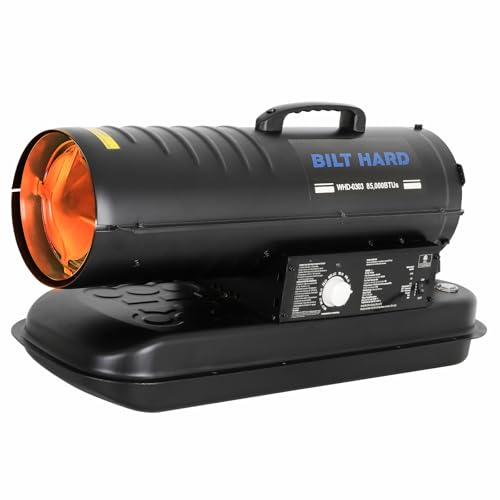
Best for: Buyers looking for a lower-output heater for a workshop, farm workspace, or other work area. BILT HARD lists 85,000 BTU, a 5-gallon fuel capacity, and up to nine hours of operation. The listing gives a heating-area figure of 2,200 square feet.
This model is listed for kerosene, filtered diesel number 1 and number 2, fuel oil number 1 and number 2, and Jet A fuel. The manufacturer recommends K1 kerosene for cleaner burning and performance. Features include a thermostat, indicator lamp, self-diagnostics, cord wrap, and steel construction.
Why it was selected: Compared with the higher-output options, it is a better fit for buyers who do not need 125,000 BTU or more. The listed operating duration and thermostat make it a practical candidate for work sessions where a lower heat output is suitable.
Limitation: Fuel use, run time, and heating coverage depend on operating conditions. The listing recommends K1 kerosene, so buyers planning to use another listed fuel should check the instructions for the correct fuel and operating procedure.
L.B. White Tradesman 170 Propane Heater

Best for: Buyers seeking a heavy-duty propane heater for demanding garage, shop, warehouse, or construction applications. The Tradesman 170 has an adjustable output of 125,000 to 170,000 BTU and is described as producing directional heat.
The listed design features include a heavy-duty combustion chamber and burner plate, electronic spark ignition, a corrosion-resistant exterior, and a diagnostic light. Its portable design is intended for transport between work areas, according to the product description.
Why it was selected: It combines high, adjustable heat output with features aimed at rugged work environments. Choose it if propane is your preferred fuel and the job requires output in the 125,000-to-170,000-BTU range.
Limitation: The supplied product information identifies this as an LP heater, so it is not the right pick for someone seeking a kerosene or diesel model. It also does not list a specific heating-area figure.
BILT HARD 135,000-BTU Heater With Wheels

Best for: Buyers who want a high-output kerosene or diesel heater that is easier to move around a work area. The model delivers a listed 135,000 BTU and has an 8-gallon fuel capacity. Its product information lists coverage up to 3,200 square feet and at least eight hours of operation.
It uses forced air to distribute heat and has an adjustable heat angle. The steel construction has a powder-coated finish, while the movable wheels, pull handle, and support frame are intended to help with transport and stability.
Why it was selected: It offers a middle ground between the 85,000-BTU model and the highest-output options. Choose it if you need more heat than a small-space heater provides and value wheels for moving the unit.
Limitation: The listing specifies 2-K kerosene or filtered diesel number 1 and number 2, while recommending 1-K kerosene. Confirm the manual’s fuel guidance before use, and consider whether the stated coverage matches your space and conditions.
Buying Guide: How To Choose A Forced Air Torpedo Heater
How much heat output do you need?
Start with the space you need to heat, then compare the heater’s BTU output and the manufacturer’s stated coverage. The products in this list range from 85,000 BTU to 175,000 BTU. A higher BTU rating indicates greater listed heat output, but it does not guarantee a particular indoor temperature. Insulation, outdoor temperature, ceiling height, air leakage, and the work being done can affect heating performance.
For a smaller work area, consider whether a lower-output model is sufficient rather than automatically selecting the largest heater. For a large or drafty space, compare the higher-output models and verify the coverage figures in the product information. Treat square-foot or cubic-foot coverage as a guide, not a universal promise.
Should you choose propane, kerosene, or diesel?
Choose a fuel type that fits your available supply, operating location, and preferred maintenance routine. The InoKraft and L.B. White models in this comparison are propane heaters. The VEVOR and BILT HARD models are listed for kerosene and/or diesel fuels, with fuel restrictions varying by product.
Do not assume that fuels are interchangeable between heaters. Follow the exact fuel requirements in the manual, including any filtering instructions. Some listed models recommend a particular kerosene type, and the VEVOR listing says to use only one fuel type at a time.
Is adjustable output important?
Variable-output models can be useful when you need to change heat levels rather than run at one stated output. The InoKraft MH125M and L.B. White Tradesman 170 list adjustable BTU ranges. The other selected models list a primary output and may offer other controls, such as a thermostat or adjustable heat angle.
A thermostat is useful for setting a target temperature where that feature is available. Compare the thermostat’s stated range and control behavior, and do not confuse a thermostat with a variable BTU range: one controls temperature around a set point, while the other specifies an output range.
What should you check for portability?
Think about whether the heater will stay in one location or move between work zones. Wheels and a handle can make a larger unit easier to reposition; the BILT HARD 135,000-BTU model lists both. Hose and cord lengths also affect where a propane heater can be placed in relation to its fuel source and electrical outlet. Confirm that the supplied lengths suit your planned setup.
What safety and ventilation details matter?
Forced-air torpedo heaters can involve combustion, hot surfaces, fuel, and electrical components. Read and follow the model’s instructions for ventilation, clearances, placement, fuel connection, and operation. Use a heater only in settings permitted by its manufacturer and applicable local requirements. Do not rely on a product title or a general “indoor/outdoor” phrase as a substitute for checking the manual.
Look for clearly described protections, such as overheat shutoff, low-fuel shutoff, gas-leak cutoff, or power-loss shutdown, but do not assume every model includes every feature. Keep the heater stable, use the specified fuel and connections, and stop using it if it is damaged or does not operate as directed.
Frequently Asked Questions
What is a forced air torpedo heater?
It is a portable heater that uses a fan to push heated air into a work area. Product types differ by fuel, output, controls, portability, and the environments in which the manufacturer permits operation.
Which heater in this list has the highest listed output?
The VEVOR model has the highest listed output at 175,000 BTU. The L.B. White Tradesman 170 offers an adjustable range up to 170,000 BTU.
Can a torpedo heater be used inside a garage?
Only use a specific heater in a garage if its manufacturer’s instructions permit that setting and the required ventilation and operating conditions can be met. Check the manual before use; do not assume every forced-air heater is suitable for enclosed spaces.
Can I use diesel in a kerosene torpedo heater?
Only if the specific model’s instructions list the diesel type you plan to use. Fuel compatibility varies, and some models recommend a particular kerosene type for operation.
Does a higher BTU rating always mean a better heater?
No. Higher output may be useful for a larger or more demanding space, but an oversized heater may not suit a smaller work area. Compare BTU output, listed coverage, fuel, controls, and the conditions where you will use it.
What is the difference between adjustable BTU output and a thermostat?
Adjustable BTU output describes a range of heat production. A thermostat lets the user set a target temperature and may control when the heater runs. A model can have one feature, both, or neither, so check its listed specifications.