The best air and water heating option depends on whether you need room heat, a water-to-air system component, or both air and water heat from one unit. The LSZQJ diesel heater is the listed option designed to provide both air and water heating. For a hydronic garage or workshop, compare the ALECOIL 50,000 and 100,000 BTU heaters; for a forced-air system, consider a water-to-air heat exchanger sized to fit your equipment.
| Product | Best suited for | Key detail |
|---|---|---|
| LSZQJ 7kW Diesel Water Heater | Vehicles and spaces needing air and water heat | 12V all-in-one diesel unit |
| ALECOIL 50,000 BTU Hydronic Heater | Garages and workshops | Overhead hydronic heating |
| ALECOIL 100,000 BTU Hydronic Heater | Larger heating demands | Higher stated BTU capacity |
| VEVOR 20×20 Water-to-Air Heat Exchanger | Forced-air heating systems | 20-by-20-inch exchanger |
| AB 12×15 Water-to-Air Heat Exchanger | Systems needing a smaller exchanger | 12-by-15-inch exchanger |
LSZQJ 7kW Diesel Water Heater

The LSZQJ is the most direct match for buyers searching for a combined air and water heater. Its listed features describe a 12V, all-in-one diesel unit that provides air heating and water heating, with seven adjustable levels.
Best for: RV users, semi-truck operators, and other buyers who need cabin or living-area warmth alongside heated water. The product is also described as suitable for garage heating and for warming engine coolant to support cold-weather starts.
- Provides both air heat and water heat in one unit.
- Has seven adjustable heating levels.
- Described for vehicle, garage, and engine-preheating uses.
Limitation: This is a 12V diesel unit, not a conventional household water heater or a ceiling-mounted hydronic heater. Check that its power and installation requirements suit the intended vehicle or space before choosing it.
ALECOIL 50,000 BTU Hydronic Heater
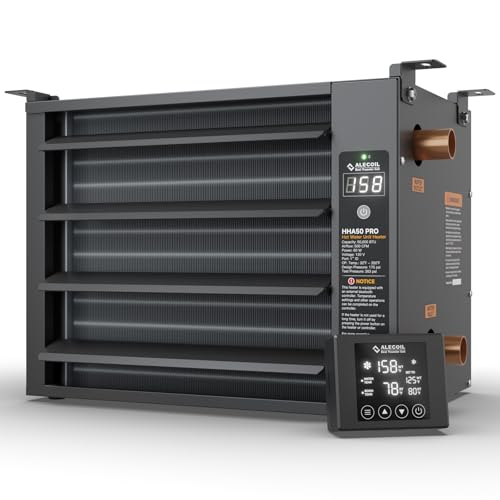
This ALECOIL model is a ceiling-mounted hydronic unit heater rated at 50,000 BTU. It uses a hot-water system or wood-burning boiler as its heat source and is intended for garages, workshops, and farm buildings.
Best for: Buyers seeking overhead room heat from an existing hot-water heating source. Its ceiling-mounted design keeps the unit off the floor, while the listed galvanized-steel construction and copper coil distinguish its materials.
The wall-mounted wireless controller offers three modes: monitoring water inlet temperature, maintaining room temperature, or operating both functions together. The product information says the remote has a direct line-of-sight range of up to 33 feet and requires a pre-installed power cable at its mounting location.
- 50,000 BTU stated capacity.
- Designed for hot-water systems or wood-burning boilers.
- Includes a wireless thermostat and remote control.
Limitation: It depends on a compatible hot-water heat source, and the remote installation requires the specified pre-installed power cable. Choose another type of heater if you do not have a hydronic source.
ALECOIL 100,000 BTU Hydronic Heater

The 100,000 BTU ALECOIL is the higher-capacity option in this pair of hydronic hanging heaters. Like the 50,000 BTU model, it is described for use with a hot-water system or wood-burning boiler in garages, workshops, and farm buildings.
Best for: Buyers whose heating requirements call for a higher stated BTU capacity than the 50,000 BTU model. Its overhead mounting saves floor space, and its wall-mounted wireless controller offers modes for monitoring inlet-water temperature, maintaining room temperature, or combining both.
- 100,000 BTU stated capacity.
- Galvanized-steel body and copper coil, according to the product details.
- Wireless remote with a stated line-of-sight range up to 33 feet.
Limitation: The higher BTU figure alone does not establish the right size for a particular building. Compare the heater with the space, heat source, and system requirements, and account for the controller’s stated power-cable requirement.
VEVOR 20×20 Water-To-Air Heat Exchanger

This VEVOR product is a water-to-air heat exchanger rather than a standalone heater. It transfers heat between a water circuit and moving air, so it is intended for integration into a suitable forced-air or other heating arrangement.
Best for: Buyers who need a larger-format exchanger for an outdoor wood furnace, residential heating or cooling, or forced-air heating. The listed dimensions are 20 by 20 inches, with three rows of 3/8-inch seamless copper tubes and 242 aluminum fins.
The product information states output of up to 160,000 BTU per hour. It also describes copper-brazed edges and contact points, epoxy-coated fins, and a stated operating-temperature range of -40 to 356°F.
- 20-by-20-inch format with three tube rows.
- Designed for water-to-air heat transfer.
- Listed output is up to 160,000 BTU per hour.
Limitation: An exchanger is a system component, not an all-in-one heater. Confirm its dimensions, connections, and capacity suit the planned equipment before purchase.
AB 12×15 Water-To-Air Heat Exchanger

The AB 12×15 exchanger is another component for transferring heat between water and air. Its smaller listed dimensions make it worth comparing when a 20-by-20-inch exchanger is not the appropriate fit for the available space or system design.
Best for: Buyers assembling a water-to-air heating or cooling setup with a boiler, solar panel system, or another suitable water source. Product details list a 67,500 BTU capacity and describe three rows of 3/8-inch seamless copper tubes with aluminum fins.
The exchanger has a steel shell, brazed edges and contact points, and epoxy-coated fins, according to the supplied features. The listing also describes the product as suitable for outdoor wood furnaces, residential heating and cooling, and forced-air systems.
- 12-by-15-inch format with 1-inch copper ports.
- Three rows of copper tubes and aluminum fins.
- Listed capacity of 67,500 BTU.
Limitation: It does not generate heat by itself. Confirm the exchanger’s dimensions, port arrangement, and stated capacity against the system design before selecting it.
Buying Guide: How To Choose An Air And Water Heater
Do you need one appliance to heat air and water?
If both functions must come from one unit, the LSZQJ is the product in this selection explicitly described as providing air heating and water heating. It is a 12V diesel model intended for vehicle and other listed uses. By contrast, the ALECOIL units provide room heat from a hot-water source, and the AB and VEVOR products transfer heat between water and air as system components.
Are you heating a garage or workshop?
For a space with an existing hot-water system or wood-burning boiler, compare the ALECOIL models. Their key difference in the supplied product information is stated output: 50,000 BTU versus 100,000 BTU. Do not choose based on capacity alone; consider the space and the heating system’s requirements.
Should you choose a standalone heater or an exchanger?
A standalone unit heater includes a fan and controls to deliver heat to a room, but the hydronic ALECOIL models need a hot-water heat source. A water-to-air exchanger is a component that requires a suitable water circuit and airflow arrangement. It does not replace the heat source or the rest of the system.
How should exchanger size and capacity be compared?
Start with the space available for installation and the exchanger’s dimensions. The listed options here are 20 by 20 inches and 12 by 15 inches. Compare the product’s stated capacity and port details with the system design; nominal dimensions and advertised output should not be treated as proof of fit or performance in every installation.
What installation details should you check?
Review the heat source, electrical needs, connection sizes, mounting position, and airflow before buying. The ALECOIL product details specify a pre-installed power cable requirement for the wall-mounted remote. For a water-to-air exchanger, verify the port arrangement and fit with the intended water and air systems. Consult qualified professionals when system design or installation is beyond your experience.
Frequently Asked Questions
What is the difference between an air heater and a water heater?
An air heater warms a space by heating air. A water heater heats water for use or for circulation through a heating system. Some equipment combines the functions, while a water-to-air exchanger transfers heat from circulating water into air.
Which product in this list heats both air and water?
The LSZQJ 7kW diesel heater is described as an all-in-one unit that provides air heating and water heating. The other listed products are hydronic room heaters or water-to-air exchanger components.
Can a water-to-air heat exchanger heat a room by itself?
No. An exchanger transfers heat between water and air, but it needs a suitable water heat source and an arrangement that moves air through it.
Which ALECOIL heater has the higher stated capacity?
The ALECOIL 100,000 BTU model has the higher stated capacity. The other model is rated at 50,000 BTU. Select based on system and space requirements rather than the rating alone.
What should I check before buying a hydronic heater?
Confirm that you have an appropriate hot-water heat source, that the heater’s stated capacity suits the application, and that mounting and control requirements can be met. Check the product details for any electrical or installation requirements.