Heaters that save on electricity are most useful when they let you warm the room you occupy, set a lower target temperature, or choose a lower heat setting. The DREO models offer precise thermostat control, while the DUMOS radiator has selectable wattage settings. The Lasko tower heater adds oscillation and a timer. These features can help manage use, but no electric resistance heater turns electricity into more heat per watt than another in a way that guarantees lower bills.
| Product | Best for | Electricity-saving feature |
|---|---|---|
| DREO portable heater with remote | Precise temperature control | Thermostat adjusts in 1°F increments |
| DUMOS oil-filled radiator | Lower selectable heat output | 600W, 900W, and 1500W settings |
| DREO Heater 319 | Quiet room heating | Oscillation and thermostat control |
| DREO ceramic heater | Quiet heating with a timer | Thermostat and scheduled shutoff |
| Lasko ceramic tower heater | Simple timer-based zone heating | Seven-hour timer and oscillation |
DREO Portable Heater With Precise Thermostat

This DREO heater is best for someone who wants fine control over the temperature in a frequently used room. Its thermostat range is listed as 41–95°F, adjustable in 1°F increments. That level of adjustment can help users avoid heating a room more than they need to, especially when using the heater for zone heating rather than trying to warm an entire home.
The heater uses a 1500W PTC system and a heat-funnel design. The product information says it circulates warm air farther than traditional heaters. It also includes a remote, a tilt-detection sensor, overheat protection, flame-retardant materials, and a safety plug. Those controls and protections make it a useful option for buyers who want adjustable heat with remote operation.
Choose this if: you want an adjustable thermostat and remote to manage comfort without repeatedly changing settings at the unit. Limitation: the listed maximum output is 1500W, so running it at full power for long periods can still use substantial electricity. Thermostat precision does not guarantee a particular bill reduction.
DUMOS Oil-Filled Radiator With Three Heat Settings
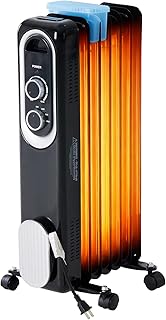
The DUMOS oil-filled radiator is best for buyers who want to select a lower wattage instead of always using a 1500W setting. It offers 600W, 900W, and 1500W heat modes and an adjustable thermostat. Selecting a lower setting can reduce the heater’s power draw while it is actively heating, though the room may warm more slowly or may not reach the same temperature in very cold conditions.
The listed suitable area is 10–15 square meters, making this option more appropriate for a modest bedroom or office than a large open space. The product is described as noiseless, which may suit buyers who prefer not to hear fan airflow. Safety features listed include a power indicator, overheat protection, and a tip-over safety switch.
Choose this if: selectable 600W and 900W modes are a priority, or you prefer a radiator-style heater without fan noise. Limitation: the product information describes a relatively small coverage area, so it may not be suitable as the sole heat source for a large room. Confirm that its stated area fits your space.
DREO Heater 319 for Quiet, Oscillating Heat

The DREO Heater 319 is best for buyers who want to heat a bedroom or office while keeping operating noise low. Its listed noise level is as low as 34 dB, and the unit has 70-degree oscillation. The product information also describes a 1500W PTC heating system and air circulation designed to distribute warmth beyond the immediate area in front of the heater.
Oscillation can spread heat across a room, which may make it easier to warm the area people are using rather than relying on a single fixed stream of air. The unit includes a remote and a 12-hour timer. Safety features listed include child lock, tip-over protection, overheat protection, flame-retardant material, and a safety plug; the product is described as ETL certified.
Choose this if: you value quiet operation, oscillation, and a timer for a bedroom or work area. Limitation: the listed heater output is 1500W. It does not provide the three lower wattage choices listed for the DUMOS radiator, so its electricity use depends on its heat settings, thermostat behavior, and operating time.
DREO Ceramic Heater With Thermostat and Timer

This DREO ceramic heater is best for buyers who want a quiet, timer-equipped heater for a room where they spend limited hours. It has a 1500W PTC ceramic element, a thermostat, and a 12-hour timer. The listed coverage is 270 square feet. A timer can help prevent unnecessary operation after the user leaves or goes to sleep, while thermostat control can stop the room from being heated continuously beyond the selected comfort level.
The product information lists noise at 34 dB and describes airflow designed to reduce wind noise. Safety details include tip-over protection, overheat protection, a 12-hour timer, and automatic power-off after 24 hours without interaction. The listing also warns users not to operate it with an extension cord and says to plug it directly into a wall outlet.
Choose this if: you want quiet ceramic heat, a stated coverage area, and timer-based control. Limitation: it is a 1500W heater, and the listing advises against using an extension cord. Follow the manufacturer’s placement and electrical-use instructions.
Lasko Ceramic Tower Heater With Remote
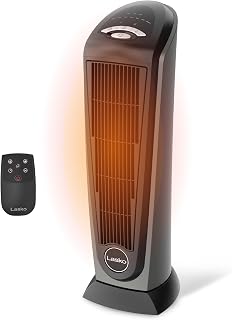
The Lasko tower heater is best for buyers who want straightforward controls for warming a medium-sized room. It has 1500W ceramic heat, wide oscillation, and a remote that operates the heat settings, oscillation, and timer. Its seven-hour timer is useful for setting a defined operating period instead of leaving the heater on indefinitely.
The product information lists a self-regulating ceramic element, overheat protection, cool-touch housing, and ETL listing. Oscillation can spread warmth across a broader area than a heater aimed in one direction. For electricity management, the timer is the clearest listed control: it helps limit how long the unit runs, but it does not independently determine the household’s energy cost.
Choose this if: you want remote-operated oscillation and a seven-hour timer for a bedroom or home office. Limitation: the listed output is 1500W, and the product information does not state a precise thermostat range or a lower wattage mode. Buyers seeking fine temperature increments or multiple power levels may prefer another option.
Buying Guide: How to Choose a Heater That Uses Less Electricity
Can a space heater actually save on electricity?
An electric resistance space heater converts electricity into heat at the point of use. A 1500W unit running at full power uses about 1.5 kilowatt-hours of electricity per hour of continuous operation. Actual use can vary if the heater cycles on and off or operates at a lower setting. The potential household savings come mainly from heating one occupied room and lowering the central thermostat, not from assuming that one resistance heater produces more heat from the same electricity.
Whether zone heating lowers a bill depends on the home, the central heating system, weather, room insulation, electricity rates, and how long the space heater runs. If a portable heater runs for many hours while the central system continues heating the whole home, total electricity or fuel use may increase rather than decrease.
Which controls matter most for energy use?
- Thermostat: A thermostat helps maintain a target temperature and can reduce unnecessary continuous heating. A narrow adjustment range, such as the DREO model’s listed 1°F increments, offers more precise setting choices, but does not by itself guarantee savings.
- Wattage settings: Lower wattage reduces power draw while the heater operates at that setting. The DUMOS radiator lists 600W, 900W, and 1500W choices. Lower output may take longer to warm a room.
- Timer: A timer can limit operation to the hours you need warmth. Compare the timer duration with your routine, and avoid relying on it as a substitute for safe operation.
- Oscillation: Oscillation distributes airflow across more of a room. It may improve comfort in different spots, but it does not automatically reduce the electricity used to produce heat.
How should you match a heater to the room?
Use the product’s stated coverage as a starting point, not a guarantee. The DUMOS listing describes a 10–15-square-meter area, while the DREO ceramic model lists 270 square feet. Room height, drafts, insulation, outside temperature, and open doorways affect heating needs. A heater that is too small may run for a long time without making the room comfortable; a larger heater can also consume more electricity if operated continuously at high output.
What should you check for safe operation?
Choose a heater with relevant safety features such as tip-over and overheat protection, and follow the instructions supplied with the specific model. Place the unit on a stable surface with clear space around it, and keep it away from water and combustible materials. The DREO ceramic heater listing specifically says not to use an extension cord. Plug a heater into an appropriate wall outlet as directed by its manufacturer, and do not leave it running unattended unless the product instructions explicitly support the intended use.
How can you estimate running cost?
Check the heater’s wattage and your electricity rate. Multiply the kilowatt rating by the number of hours it runs to estimate kilowatt-hours, then multiply that amount by your cost per kilowatt-hour. For example, a 1500W heater uses 1.5 kWh for each hour it runs continuously at full power. A thermostat-controlled heater may cycle, so actual energy use can be lower than this full-power estimate. Use your utility bill’s rate for a more relevant calculation.
Frequently Asked Questions
What wattage space heater uses the least electricity?
A heater’s lower wattage setting draws less power while it is running than a higher setting. Among these products, the DUMOS radiator lists a 600W setting. It may take longer to warm a room at that output, and the amount of electricity used also depends on operating time.
Is a 1500W heater expensive to run?
A 1500W heater uses 1.5 kWh per hour when operating continuously at full power. Multiply that figure by the number of hours used and your electricity rate to estimate the energy cost. Thermostat cycling and lower heat settings can change actual use.
Do oil-filled radiators use less electricity than ceramic heaters?
Not necessarily. Both types use electricity to produce heat, and wattage and run time are more useful for estimating energy use than heater style alone. The DUMOS radiator’s selectable 600W and 900W modes are a practical distinction in this product group.
Can a space heater lower my heating bill?
It may help if you heat only an occupied room and turn down central heating where practical. Savings are not guaranteed; long operating hours or running the heater alongside whole-home heating can increase total energy use.
Is a thermostat important on an energy-saving heater?
Yes. A thermostat lets you set a comfort target and can help prevent unnecessary heating. It is most useful when paired with sensible run times and a setting that is no warmer than needed.