The best electric water heater for a home depends on household size, available space, hot-water demand, and electrical capacity. The Rheem 50-gallon model is suited to larger households, while GE’s 40-gallon unit is a practical choice for many families of two to four. For smaller spaces, consider GE’s 18-gallon plug-and-play model; for app-based controls, look at GE’s 30-gallon Wi-Fi heater. The Rheem RTEX-24 is the tankless option for buyers who want on-demand hot water and have the electrical service for a 24 kW unit.
| Product | Best for | Type |
|---|---|---|
| Rheem PROE50 M2 RH95 | Households of three to five | 50-gallon tank |
| GE 40-Gallon Tall | Families of two to four | 40-gallon tank |
| GE 30-Gallon Wi-Fi | Remote temperature and schedule control | 30-gallon tank |
| GE 18-Gallon Plug and Play | Small homes and limited spaces | 18-gallon tank |
| Rheem RTEX-24 | On-demand hot water and space savings | Tankless |
Rheem PROE50 M2 RH95 50-Gallon

Best for: Households of three to five people that need a conventional storage tank. The listed product information also identifies homes with three or more bathrooms as a suitable use case.
This 50-gallon Rheem model is a residential electric tank heater with an automatic thermostat, an anode rod, and an enhanced-flow brass drain valve. Its relatively space-conscious design may be useful when replacing an existing heater, although buyers should compare the unit’s actual dimensions with the available installation area before purchasing.
Why it stands out: Its stated household range makes it a larger-capacity choice than the 30- and 40-gallon tanks in this guide. Choose it if a smaller tank may not cover multiple occupants’ everyday hot-water needs.
Limitation: A 50-gallon tank still stores a finite amount of hot water. Heavy use can exceed the available supply until the water reheats, and the listing does not provide electrical specifications beyond 18.75 amps. Confirm installation requirements with a qualified professional.
GE 40-Gallon Tall Electric Water Heater

Best for: Families of two to four who want a standard-size tank with a stated first-hour rating for planning peak demand.
GE lists a true 40-gallon capacity and a 57-gallon first-hour rating. The first-hour rating describes how much hot water a heater can deliver during its first hour of use, combining stored hot water with water reheated during that period. The model uses two 4,500-watt heating elements at 240 volts and requires 25 amps, according to the product information.
Why it stands out: It offers more stated storage capacity than the 30-gallon GE model while being identified for a smaller household than the Rheem 50-gallon model. It also has an adjustable thermostat and a rust-proof brass drain valve.
Limitation: This is a tall tank, so it may not fit in a low-clearance utility area. Its listed electrical requirements should be checked against the home’s wiring and circuit capacity before installation.
GE 30-Gallon Smart Water Heater

Best for: Buyers who want a smaller storage tank with app-connected temperature and schedule controls.
This 240-volt GE heater has a true 30-gallon capacity, a digital display, and built-in Wi-Fi powered by SmartHQ. The listed features include remote temperature adjustment, vacation-mode scheduling, and notifications. GE reports a 60-gallon first-hour rating, measured using the Department of Energy’s first-hour-rating method.
Why it stands out: Its connected controls give owners more ways to manage settings than the other storage-tank options listed here. It may suit a household that values scheduling or wants to adjust settings without using controls at the heater.
Limitation: A 30-gallon tank stores less water than the 40- and 50-gallon models. The first-hour rating is not the same as the tank’s storage capacity, so compare the household’s peak hot-water use with both figures before choosing.
GE 18-Gallon Plug-and-Play Heater

Best for: Small homes, apartments, cabins, or an individual hot-water hookup where a compact tank is a priority.
The GE unit holds 18 gallons and operates on a 120-volt supply. Its listed features include an adjustable thermostat, standard 3/4-inch NPT water connections, and a plug-and-play installation approach using existing plumbing. GE describes it as suitable for a single hookup or for a small house, condo, or apartment.
Why it stands out: It uses a lower-voltage connection than the 240-volt storage models in this guide and is designed for places where a larger tank may be difficult to fit. Its compact format also makes it a candidate for utility areas such as laundry rooms, garages, or sheds, if the installation location is appropriate.
Limitation: Its 18-gallon capacity is the smallest among the tank models selected. It may not be a good match for a household with simultaneous showers, laundry, and dishwashing demands.
Rheem RTEX-24 Electric Tankless Heater
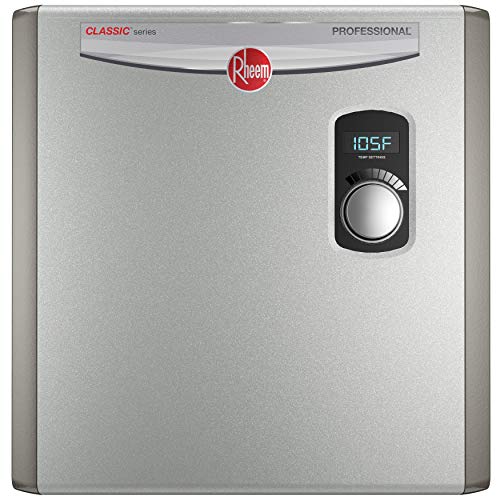
Best for: Homeowners seeking on-demand hot water in a compact unit and able to meet the model’s electrical requirements.
The Rheem RTEX-24 is a 24 kW, 240-volt tankless electric water heater. The product information lists output of up to 5.9 gallons per minute and says it can serve multiple fixtures when properly sized and professionally installed. Unlike a storage heater, a tankless unit heats water as it flows through the appliance rather than keeping a tank of hot water ready.
Why it stands out: Its tankless design saves the floor space a storage tank would occupy. Choose it if space is limited and the desired flow rate suits the home’s simultaneous hot-water demand.
Limitation: The stated maximum flow rate does not guarantee that the unit can deliver that rate at every incoming water temperature or for every household use. Rheem advises verifying electrical requirements and sizing before installation; professional assessment is important.
Buying Guide: How to Choose an Electric Water Heater
Should you choose a tank or tankless model?
A storage-tank heater holds a supply of heated water for household use. It is often easier to compare by tank capacity and first-hour rating. When that supply is used, the heater needs time to recover. Tankless heaters heat water on demand and can save storage space, but their output is limited by flow rate, incoming water temperature, and the unit’s capacity.
Choose a tank if you want a stored reserve and can accommodate its size. Consider tankless if space savings and on-demand operation matter more, and the home’s electrical system can support the unit. Tankless capacity should be checked against the number of fixtures likely to run at once.
How much capacity does a household need?
Household size is a starting point, not a complete sizing method. Shower length, bathing habits, laundry, dishwashing, and overlapping use all affect demand. The listed products offer different reference points: the Rheem 50-gallon model is described for three to five people, the GE 40-gallon model for two to four, and the GE 18-gallon model for small homes or a single hookup.
For tank models, compare both the gallon capacity and first-hour rating when that information is available. Gallons describe the amount held in the tank; the first-hour rating estimates delivery over an hour of use. Do not treat the two measurements as interchangeable.
Will the heater fit the installation space?
Measure the available height, width, and depth, and allow room for plumbing and service access. A tall tank may not fit under low ceilings, while a low-profile or compact unit may work better in a constrained utility area. Tankless models typically take up less floor space, but still need an appropriate mounting location and access for installation and maintenance.
Check the product’s complete dimensions and connection details before ordering. The listed features describe some models as space-conscious or compact, but those descriptions do not replace measuring the actual installation area.
What electrical requirements should you check?
Match the heater’s voltage, wattage, and amperage requirements to the home’s electrical service. The selected GE 30-gallon model is listed at 240 volts; the GE 40-gallon model uses two 4,500-watt elements at 240 volts and requires 25 amps. The GE 18-gallon model is listed for a 120-volt supply. The Rheem tankless model is 24 kW at 240 volts.
Do not assume that an existing circuit can support a replacement or a tankless upgrade. Have an electrician or qualified installer verify the circuit, wiring, and local installation requirements.
Are smart controls or simple controls more useful?
Wi-Fi controls can be helpful if you want to adjust temperature, set a vacation schedule, or receive notifications through an app. The GE 30-gallon model lists these SmartHQ features. A standard adjustable thermostat may be sufficient if you prefer local controls and do not need remote scheduling. Smart features do not change the basic need to size the heater for household demand.
What should you verify before installation?
- Confirm the heater’s dimensions, plumbing connections, voltage, wattage, and circuit needs.
- Compare tank capacity and first-hour rating with peak household use.
- Check whether a replacement unit fits the existing location and connections.
- Ask a qualified installer about required electrical, plumbing, and local code work.
- For a tankless model, verify expected flow at the home’s incoming water temperature and the number of fixtures used at once.
Frequently Asked Questions
Is a 40-gallon electric water heater enough for a family?
The GE 40-gallon model is listed for households of two to four people and has a 57-gallon first-hour rating. Whether it is enough depends on usage patterns, especially how many showers or appliances run at the same time.
What is the difference between tank capacity and first-hour rating?
Tank capacity is the amount of water stored in the heater. First-hour rating estimates the hot water the unit can supply during its first hour of use, including water reheated during that time. The two figures describe different aspects of performance.
Does a tankless water heater provide unlimited hot water?
No. A tankless heater does not depend on a stored tank, but it has a maximum flow and heating capacity. If simultaneous demand exceeds that capacity, it may not deliver the desired temperature and flow to every fixture.
Can a 120-volt water heater replace any existing electric heater?
No. The GE 18-gallon model is listed for a 120-volt supply, but it is not automatically a substitute for a 240-volt heater. Confirm the home’s electrical setup, hot-water demand, and plumbing arrangement before choosing a replacement.
What should I consider when replacing a water heater?
Check the existing unit’s capacity, dimensions, electrical requirements, plumbing connections, and installation location. A replacement should also suit household demand. Have a qualified professional verify that the selected unit and the home’s systems are compatible with the intended installation.