The best oil-fired torpedo heater depends on the area you need to heat and how often you can refuel. The Dayton 75,000 BTU model is best for smaller spaces, while its 125,000 BTU version offers a middle ground. For larger areas, consider the Dayton 170,000 BTU or VEVOR 215,000 BTU heater. The VEVOR 125,000 BTU model is another option for buyers seeking a portable forced-air design with adjustable temperature.
| Heater | Listed Output | Listed Coverage | Best Suited For |
|---|---|---|---|
| Dayton 75,000 BTU | 75,000 BTU | 1,700 sq. ft. | Smaller work areas |
| Dayton 125,000 BTU | 125,000 BTU | 2,900 sq. ft. | Mid-size spaces |
| Dayton 170,000 BTU | 170,000 BTU | 4,000 sq. ft. | Larger spaces |
| VEVOR 125,000 BTU | 125,000 BTU | Not listed | Portable heating with adjustable temperature |
| VEVOR 215,000 BTU | 215,000 BTU | Not listed | High-output heating |
Dayton 75,000 BTU Oil-Fired Torpedo Heater

This Dayton model is listed with a 75,000 BTU output, a 5-gallon tank, fuel consumption of 0.57 gallons per hour, and coverage of up to 1,700 square feet. Among the listed heaters, it has the lowest output and smallest tank, making it the most appropriate choice when a higher-capacity unit may be unnecessary.
Best for: Buyers heating a smaller garage, workshop, or work area who want a lower-output option within this selection. Its listed coverage makes it easier to compare with the larger Dayton models.
Why it was selected: It provides a clear lower-capacity reference point for comparing heater output, tank size, fuel use, and stated coverage. The listed consumption rate can also help buyers estimate how frequently they may need to refuel during operation.
Limitation: The 5-gallon tank is smaller than the tanks on the other listed Dayton models. At the stated 0.57 gallons per hour, actual runtime will depend on operating conditions and how continuously the heater runs.
Choose this model if its stated coverage matches the area you need to heat. Avoid selecting solely by square footage: insulation, outdoor temperatures, ceiling height, and air leakage can affect heating needs.
Dayton 125,000 BTU Oil-Fired Torpedo Heater

The Dayton 125,000 BTU heater is listed with a 10-gallon tank, a consumption rate of 0.95 gallons per hour, and coverage of up to 2,900 square feet. It sits between the 75,000 and 170,000 BTU Dayton models in output and listed coverage.
Best for: Buyers who need more stated heating capacity than the 75,000 BTU model provides but do not need the largest Dayton unit. The 10-gallon tank is also larger than the 5-gallon tank on the smaller Dayton heater.
Why it was selected: This model offers a useful middle option for comparing capacity and fuel use. Its stated coverage of 2,900 square feet is higher than the smaller Dayton model’s 1,700-square-foot figure, while its output remains below the 170,000 BTU unit.
Limitation: Its listed fuel consumption is higher than the 75,000 BTU model’s, so buyers should account for fuel use when estimating operating needs. The stated coverage is a product specification, not a guarantee for every building or weather condition.
Choose this heater if your space falls between the listed coverage figures of the smaller and larger Dayton options. Compare its 0.95-gallon-per-hour rate with your expected daily runtime before choosing a tank size.
Dayton 170,000 BTU Oil-Fired Torpedo Heater

This Dayton heater is listed at 170,000 BTU, with a 13-gallon tank, a fuel consumption rate of 1.30 gallons per hour, and coverage of up to 4,000 square feet. It has the highest output and largest stated coverage among the three Dayton models in this selection.
Best for: Buyers who need a higher-output heater for a larger work area. Its listed coverage of 4,000 square feet is the largest stated coverage among the products compared here.
Why it was selected: It is the higher-capacity Dayton option and provides specific figures for output, tank size, fuel consumption, and coverage. Those details help buyers compare its heating capacity with the 75,000 and 125,000 BTU models.
Limitation: Its stated consumption rate of 1.30 gallons per hour is the highest among the Dayton models listed. A larger tank does not eliminate the need to plan fuel supply, especially if the heater will operate for extended periods.
Choose this unit if the smaller Dayton models do not provide enough stated coverage for your intended area. Avoid treating the 4,000-square-foot figure as universal; building conditions and the environment can change the heat required.
VEVOR 215,000 BTU Forced-Air Heater
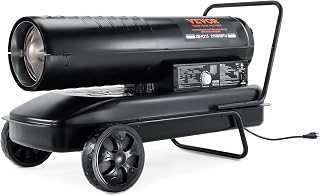
The VEVOR forced-air heater is listed at 215,000 BTU and has a 13.2-gallon tank. Its product name describes it as a portable diesel and kerosene space heater and lists a thermostat, wheels, and a handle. No square-foot coverage figure or fuel-consumption rate is provided in the supplied product information.
Best for: Buyers who prioritize high listed output and want a heater described as portable, with wheels and a handle. The listed thermostat may also suit buyers looking for a temperature-control feature.
Why it was selected: It has the highest stated BTU output in this selection and combines that output with a relatively large listed tank. Its named fuel types and portability features distinguish it from the Dayton products in the comparison.
Limitation: The supplied details do not state a coverage area or fuel-use rate, so it is harder to compare operating needs directly with the Dayton models. Confirm fuel requirements and operating instructions in the product documentation before use.
Choose this model if high listed output and the named portability features are priorities. Do not assume that its coverage or runtime matches a heater with a similar tank or BTU rating; those figures are not supplied here.
VEVOR 125,000 BTU Portable Torpedo Heater

This VEVOR forced-air heater is listed at 125,000 BTU. Its product name describes it as a kerosene and diesel heater for settings such as jobsites, garages, warehouses, workshops, construction areas, and outdoor heating. It also identifies wheels and adjustable temperature as features. The supplied details do not state tank capacity, fuel consumption, or square-foot coverage.
Best for: Buyers looking for a 125,000 BTU portable heater with adjustable temperature and wheels. It may be a better fit than the Dayton 125,000 BTU model for shoppers who specifically value those named features.
Why it was selected: It offers the same stated BTU output as the Dayton 125,000 BTU heater, providing a direct output comparison between brands. Its listed adjustable temperature and wheels offer additional selection points.
Limitation: The available product details do not provide a tank size, consumption rate, or coverage figure. Buyers cannot use the supplied specifications alone to compare runtime or recommended area with the Dayton model.
Choose this heater if its portability and temperature-adjustment features suit your needs. Check the full product documentation for fuel, tank, and operating details before deciding.
Buying Guide: How to Choose an Oil-Fired Torpedo Heater
How much heating output do you need?
Start with the size and conditions of the space, then compare the listed BTU output and coverage. In this selection, the Dayton models list coverage figures of 1,700, 2,900, and 4,000 square feet. The VEVOR models list 125,000 and 215,000 BTU outputs, but the supplied information does not state their coverage areas.
Coverage figures are useful for initial comparisons, not guaranteed performance in every building. A drafty space, high ceiling, cold weather, or limited insulation may require more heat than a better-sealed area of the same floor size. Follow the manufacturer’s guidance for sizing and use.
Should you prioritize a larger tank or lower fuel use?
Tank capacity and fuel consumption work together to determine how often refueling may be needed. The Dayton specifications give both figures: the 75,000 BTU model has a 5-gallon tank and uses 0.57 gallons per hour; the 125,000 BTU model has a 10-gallon tank and uses 0.95 gallons per hour; and the 170,000 BTU model has a 13-gallon tank and uses 1.30 gallons per hour.
These figures allow an approximate comparison, but they do not guarantee a specific runtime. Actual consumption can depend on operating conditions and how continuously the heater runs. The supplied details do not give a fuel-use rate for either VEVOR product.
Which features matter for moving the heater?
Both VEVOR product names mention wheels, and the 215,000 BTU model also lists a handle. These details may matter if the heater must be repositioned around a work area. The supplied Dayton product names do not specify comparable mobility features, so check each product’s complete listing and documentation rather than assuming a feature is present or absent.
What fuel and operating details should you verify?
The VEVOR product names identify kerosene and diesel. The Dayton names describe the heaters as oil-fired but do not specify fuel details in the information provided here. Before purchasing, confirm the allowed fuel types, electrical requirements, startup and shutdown instructions, maintenance needs, and any other operating limits in the manufacturer’s documentation.
Can an oil-fired torpedo heater be used indoors?
Do not assume that “indoor” or “workshop” wording means a heater is safe to operate in an enclosed or occupied space. Direct-fired forced-air heaters can produce combustion byproducts. Follow the product manual and applicable safety instructions for ventilation, placement, and use, and do not operate a heater where its instructions prohibit use.
Frequently Asked Questions
What is the best oil-fired torpedo heater for a smaller space?
The Dayton 75,000 BTU model is the smallest-output option here and is listed for coverage of up to 1,700 square feet. Choose it only if its stated capacity suits your space and conditions.
Which heater has the highest listed BTU output?
The VEVOR forced-air heater is listed at 215,000 BTU, the highest output among these five products. Its supplied details do not include a coverage figure or fuel-consumption rate.
Which Dayton model has the largest tank?
The Dayton 170,000 BTU model has the largest listed Dayton tank at 13 gallons. The VEVOR 215,000 BTU model lists a 13.2-gallon tank, the largest specified tank in this selection.
Which product provides the clearest fuel-use information?
The three Dayton models list fuel consumption rates. The VEVOR product details supplied here do not include a rate, so compare its full documentation if fuel use is a deciding factor.
Can the listed square-foot coverage guarantee a warm workspace?
No. A listed coverage figure is a comparison point, not a guarantee. Insulation, air leakage, ceiling height, outside temperature, and heater placement can all affect the result.