The best gas water heater depends on where you need hot water and how many fixtures you use at once. For a large home, the Rheem outdoor model offers the highest listed flow rate; the ThermoMate and APUS are indoor natural-gas options for residential use. The Amzgachfktch portable model is better suited to camping, RVs, and cabins. Compare fuel type, installation location, flow rate, and required water pressure before choosing.
| Product | Best for | Listed capacity |
|---|---|---|
| Rheem RTG Series | Large homes needing an outdoor unit | 7.0 GPM; 160,000 BTU/hr |
| ThermoMate CZ422NG | Indoor residential use | Up to 5 GPM; 102,000 BTU |
| APUS Natural Gas Tankless | Multiple fixtures and precise controls | 4.42 GPM; 95,000 BTU |
| VEVOR Gas Tankless | Buyers wanting a display and temperature control | 100,000 BTU/hr |
| Amzgachfktch Portable | Outdoor trips and off-grid use | 1.58 GPM; 40,000 BTU/hr |
Rheem RTG Series Outdoor Tankless Heater
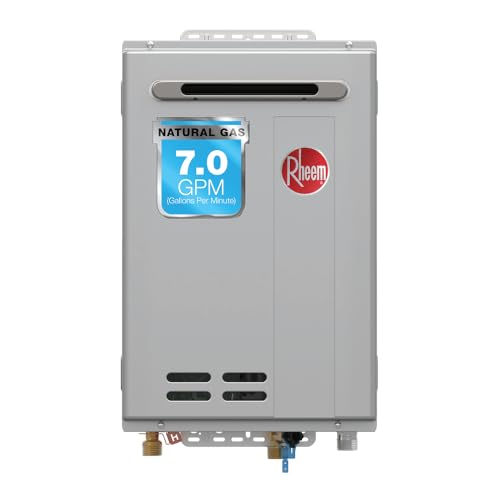
The Rheem RTG Series is a natural-gas, non-condensing tankless water heater designed for outdoor installation. Its listed maximum output is 160,000 BTU per hour, with a flow rate of 7.0 gallons per minute at a 35°F temperature rise. The product information describes capacity for two to three simultaneous showers, making it the highest-flow option in this selection.
Best for: Larger households with multiple bathrooms that want an outdoor-mounted whole-house unit. Its outdoor installation removes the need for indoor venting, according to the product details. The listed 0.82 Uniform Energy Factor and claimed energy savings versus a 50-gallon electric tank may also interest buyers comparing operating efficiency.
Consider: This model is specified for natural gas and outdoor installation, so it is not a fit for buyers who need propane or an indoor unit. A qualified installer should assess the home’s gas supply, demand, and installation requirements.
ThermoMate CZ422NG Indoor Natural Gas Heater

The ThermoMate CZ422NG is an indoor natural-gas tankless water heater rated for up to 5 GPM and 102,000 BTU. The product information says it can supply two showers simultaneously while maintaining 105°F water under a stated 65°F inlet-water condition. Its flow sensor and control chip are described as adjusting heating frequently to maintain temperature consistency.
Best for: Homes seeking an indoor natural-gas option for bathrooms and kitchen use. The listed flow rate is lower than Rheem’s 7.0 GPM, but this unit may suit households whose expected demand is closer to two showers than several fixtures at once. It also lists a UEF of 0.81 and an oxygen-free copper heat exchanger.
Consider: The simultaneous-shower statement is tied to the specified inlet-water condition; actual output depends on incoming water temperature and household demand. The unit is for natural gas, not a general-purpose propane replacement.
APUS Natural Gas Tankless Water Heater
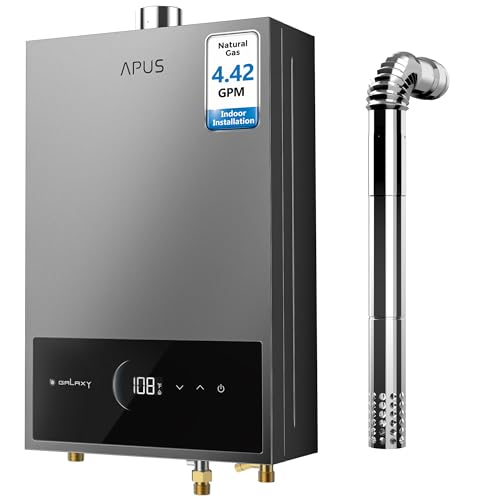
The APUS indoor natural-gas model is rated at 95,000 BTU and up to 4.42 GPM. Its listed temperature range is 95°F to 140°F, with a touchscreen and temperature control that the product description says holds water within ±1°F of the set point. A stated 0.66 GPM low-flow start is intended to help the unit activate at lower flow.
Best for: Buyers who value adjustable temperature settings and a low-flow start for a home with several hot-water outlets. The product information describes use for two showers and one sink, though actual capacity depends on temperature rise and simultaneous demand. It also lists an oxygen-free copper heat exchanger, 0.81 UEF, and anti-freeze protection.
Consider: The advertised 4.42 GPM is not a guarantee of that flow at every temperature rise. Confirm that the unit’s natural-gas fuel, indoor installation requirements, and output match the home before purchase.
VEVOR Gas Tankless Water Heater

The VEVOR gas tankless water heater is listed at 100,000 BTU per hour. Its product details emphasize smart temperature control, a large LED screen, and a touch panel that displays water temperature and operating status. The listed temperature-control accuracy is ±1°F.
Best for: Buyers who want visible operating information and straightforward temperature adjustments. The display can help users check the indicated temperature and status while operating the heater. Its 100,000 BTU rating places it between several residential models in this comparison, but the supplied details do not give a GPM figure.
Consider: The product information provided does not specify flow rate, fuel subtype, or detailed installation conditions. Check the full manufacturer and listing specifications before comparing it with units that publish GPM and installation location.
Amzgachfktch Portable Outdoor Propane Heater

This portable outdoor model is rated at 40,000 BTU per hour and 1.58 GPM. It is designed for propane and includes a foldable handle, shower head, gas regulator, garden-hose adapter, and installation hardware, according to its product details. The listed dimensions are 11.8 by 5.3 by 17.3 inches, and the stated weight is 12 pounds.
Best for: Campers, RV users, and cabin owners who need portable hot water rather than a whole-house supply. Its compact format and included accessories are the main reasons to choose it over the residential units in this guide.
Consider: The unit requires at least 2.5 PSI of water pressure to start. The product information warns that lower pressure can prevent startup or cause fluctuating temperatures. It is an outdoor portable option, not a substitute for a high-capacity household heater.
Buying Guide: How to Compare Gas Water Heaters
What type of gas and installation do you need?
Start by checking the fuel listed for the heater. Natural-gas and propane models are not automatically interchangeable. The Rheem, ThermoMate, APUS, and VEVOR product names or descriptions identify natural gas for the first three residential options, while the Amzgachfktch model is a portable propane heater. Verify the exact fuel and connection requirements before ordering.
Next, match the installation location. The Rheem is specifically designed for outdoor installation, while ThermoMate and APUS are described as indoor models. Portable heaters are intended for outdoor use. Indoor and outdoor gas appliances have different installation needs; follow the manufacturer’s instructions and local codes, and consult a qualified professional where appropriate.
How much flow rate does your household need?
GPM, or gallons per minute, indicates water flow under stated operating conditions. Estimate which fixtures may run at the same time, such as showers, sinks, and appliances. Add their expected flow demands, then compare that total with the heater’s output at the temperature rise your home requires.
Do not compare maximum GPM figures without checking their conditions. Rheem lists 7.0 GPM at a 35°F temperature rise. ThermoMate lists up to 5 GPM, APUS lists up to 4.42 GPM, and the portable Amzgachfktch unit lists 1.58 GPM. The VEVOR details supplied here give a BTU rating but no GPM figure, so more specification checking is needed for a direct capacity comparison.
What does BTU capacity tell you?
BTU per hour describes heating input capacity, but it does not alone determine how many fixtures a heater can serve. Water temperature rise, incoming-water temperature, flow rate, and appliance design all affect delivered hot water. Use the manufacturer’s capacity tables and installation documentation to check whether a model can meet peak demand in your climate.
A heater that works for one or two occupants may not serve a busy household with multiple showers running. Conversely, a high-capacity whole-house unit may be unnecessary for a cabin or occasional outdoor use. Choose based on actual simultaneous demand rather than the largest number in a listing.
Should you choose a tankless model?
Tankless heaters warm water as it flows instead of storing a tank of heated water. That can provide on-demand hot water, but performance still depends on the heater’s capacity and the water temperature rise. Tankless models may require suitable gas supply, venting or outdoor placement, and professional installation. Compare the full installation scope, not only the appliance specifications.
Efficiency figures can help when comparing models, but they do not establish total operating cost by themselves. The Rheem listing gives a 0.82 UEF, while ThermoMate and APUS each list 0.81. Actual energy costs depend on usage, local fuel rates, installation, and household conditions.
What should you check before buying a portable unit?
For portable propane heaters, check the intended location, water-pressure requirement, flow rate, included accessories, and setup instructions. The Amzgachfktch model requires at least 2.5 PSI to start. If a water source cannot provide that pressure, the heater may fail to start or provide inconsistent temperatures, as its listing warns.
Portable outdoor units are not automatically appropriate for indoor bathrooms or permanent whole-house installations. Follow the specific product instructions, use the correct fuel connection, and observe all safety and local requirements. Do not assume that an included hose, adapter, or regulator makes every installation suitable.
Which features are worth comparing?
- Temperature controls: APUS lists a touchscreen and a 95°F–140°F range; VEVOR lists an LED display and touch panel.
- Freeze protection: ThermoMate and APUS list anti-freeze features. Check the operating conditions and winterization instructions for any model.
- Safety protections: Product descriptions list features such as flame-out, overheat, or dry-burn protection. Confirm the complete safety details in the manufacturer documentation.
- Space and placement: Compare indoor versus outdoor design, mounting location, and required clearances before purchase.
- Service and installation: Confirm local code requirements, gas-line capacity, water connections, and installer availability.
Frequently Asked Questions
Which gas water heater in this list has the highest stated flow rate?
The Rheem RTG Series has the highest stated flow rate at 7.0 GPM, specified at a 35°F temperature rise. Actual output depends on operating conditions and household demand.
Which option is designed for camping or RV use?
The Amzgachfktch portable propane heater is described for outdoor use, including camping, RVs, cabins, boats, and barns. It produces a listed 1.58 GPM and requires at least 2.5 PSI of water pressure to start.
Can a natural-gas heater use propane?
Do not assume a natural-gas model can use propane. Check the exact manufacturer specifications and approved fuel configuration. The products in this guide identify different fuel types, so matching the heater to the available supply is essential.
Does a higher BTU rating always mean more hot water?
No. BTU capacity is only one factor. Flow rate, incoming-water temperature, required temperature rise, and the heater’s design also affect how much hot water it can deliver.
Is a tankless gas water heater suitable for a whole house?
It can be, if its flow and heating capacity meet the home’s peak simultaneous demand and the installation is appropriate. Compare fixture demand with manufacturer capacity data and have gas and installation requirements assessed before buying.
What should I verify before buying a gas water heater on sale?
Confirm fuel type, indoor or outdoor placement, GPM at relevant temperature rises, BTU capacity, water-pressure needs, included components, installation requirements, and local code compliance. A sale does not make a mismatched model suitable for the home.