New-style water heaters include compact electric tankless units, whole-home gas models, point-of-use heaters, and portable immersion heaters. For multiple fixtures in a small or medium home, compare the two 18 kW electric models; for higher simultaneous demand, consider the 199,000 BTU gas model. The 3,000 W unit is better suited to a single sink or small point of use, while the immersion heater is for temporary water heating—not household plumbing.
| Product | Best suited for | Key distinction |
|---|---|---|
| NOVIEEX 18 kW Electric | Apartments and small-to-medium homes | Up to 4.9 GPM; specified electrical requirements |
| Garvee 18 kW Electric | Homes needing digital temperature control | Self-modulating power and adjustable display |
| 3,000 W 110 V Point-of-Use | One nearby sink or limited-use space | Compact wall-mounted design |
| MIZUDO 199,000 BTU Gas | Higher-demand households with gas service | Listed 10.3 GPM maximum flow |
| 2,000 W Immersion Heater | Temporary bucket or outdoor water heating | Portable device, not a plumbing-system heater |
NOVIEEX 18 kW Electric Tankless Water Heater

Best for: A small or medium home, condo, or apartment where an electric tankless unit is intended to serve two or three water-use points. It was selected for its stated 18 kW output and listed maximum flow of 4.9 GPM.
The unit is designed for 240 V service and has a slim wall-mounted profile measuring 11.14 inches wide, 15.86 inches high, and 3.18 inches deep. Its product description lists 3/4-inch NPT water connections and says the unit can supply multiple fixtures. Actual hot-water capacity depends on incoming water temperature, flow, and household demand; the listed maximum flow should not be treated as guaranteed at every temperature rise.
Important limitation: The listed electrical setup calls for a maximum current of 75 A, two 40 A double-pole circuit breakers, and two sets of 8 AWG wire with ground. Have a qualified electrician verify the service and installation requirements before purchase. Choose this model only if the home’s electrical system can support it.
Garvee 18 kW Electric Tankless Heater

Best for: Buyers who want an 18 kW electric tankless option with a digital temperature display and self-modulating power. The product description positions it for medium-sized homes, apartments, and townhouses serving two or three fixtures.
Its display is described as adjustable from 86°F to 140°F, allowing users to set and monitor the target temperature. The listing says self-modulating technology changes power output in response to hot-water demand. It also describes stainless-steel construction and lists overheat, anti-freeze, and leak-prevention protections, along with ETL certification.
Compared with the NOVIEEX model, this is the more display- and control-focused option based on the supplied product details. Both are 18 kW electric units, so electrical capacity and installation suitability remain important selection checks.
Important limitation: The provided feature information does not specify the required breaker, wire size, or maximum flow rate. Confirm those details with the manufacturer and a qualified electrician rather than assuming they match another 18 kW heater.
3,000 W 110 V Point-of-Use Heater
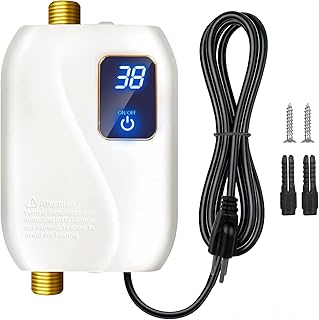
Best for: A buyer seeking a compact, wall-mounted heater for a limited point of use, such as a nearby kitchen or bathroom sink. Its listed 110 V supply and 3,000 W rating distinguish it from the higher-power 240 V models.
The listing describes stainless steel and ABS materials, an LED display, and temperature readings in Fahrenheit or Celsius. It states that the unit can raise water temperature by 82°F at 0.3 GPM and 131°F at 0.5 GPM. Those figures are tied to the stated low flow rates, so this is not a like-for-like substitute for a whole-home heater serving several fixtures.
The product description also lists water-and-electricity isolation, leakage and dry-boil protection, automatic shutoff for overheating or inactivity, and an IPX4 waterproof rating. It describes the unit as ETL standard compliant; buyers should check the product documentation for the precise certification details needed for their installation.
Important limitation: The low stated flow rates make this a better fit for localized use than simultaneous showers and household fixtures. Confirm that the intended plumbing and electrical installation match the manufacturer’s instructions.
MIZUDO 199,000 BTU Natural Gas Tankless Heater

Best for: A busy household with natural gas service and several potential hot-water uses. The product listing describes a 199,000 BTU indoor unit with a maximum flow of 10.3 GPM and positions it as a whole-home option for multiple bathrooms and other fixtures.
The stated temperature range is 95°F to 149°F, with a default setting of 107°F. The listing claims temperature control within ±1°F and a low-flow activation point of 0.53 GPM. It also describes Wi-Fi and app control, anti-freeze features, and CSA certification. Its higher stated flow makes it a different category from the 18 kW electric models, but actual delivery varies with inlet-water temperature and concurrent demand.
Important limitation: This is an indoor natural-gas appliance, not a direct replacement for an electric tankless unit. Verify gas supply, venting, installation clearances, and local code requirements with a qualified professional before choosing it.
2,000 W Portable Immersion Water Heater

Best for: Temporary heating of water in a bucket or other suitable container for camping or outdoor use. It was selected as a portable alternative, not as a conventional home water heater.
The device is rated at 2,000 W and 110–125 V AC. The supplied details describe a stainless-steel 304 protective guard and an LCD thermometer. The product listing names buckets, bathtubs, hot tubs, pools, and camping showers as possible uses, but users must follow the device instructions and confirm that the particular container and use are suitable.
Important limitation: Safety depends on correct operation. The instructions say the heater must be fully immersed before use, must not be touched while operating, should not run continuously for more than three hours, and must be unplugged before removal. Do not treat it as a permanently installed plumbing appliance.
Buying Guide: How To Choose A New-Style Water Heater
Do you need whole-home heating or one-point hot water?
Start by listing the fixtures that may need hot water at the same time. A whole-home heater must be sized for peak simultaneous demand, not just the number of people in the household. The MIZUDO listing describes a higher-flow gas model for multiple outlets. The 18 kW electric units are positioned for two or three fixtures, while the 3,000 W unit has much lower stated flow figures and is better considered for localized use.
Portable immersion heaters serve a different purpose. They heat water in a container rather than supplying a home’s plumbing. Do not compare their wattage or intended use directly with a tankless unit.
Should you choose electric or natural gas?
Electric tankless models may suit homes where the electrical service can support their substantial power requirements. Check voltage, breaker requirements, conductor size, and available panel capacity before buying. For the NOVIEEX model, the supplied requirements are specific and should be reviewed by a qualified electrician.
A gas tankless heater requires an appropriate gas supply and venting arrangement. The MIZUDO is described as an indoor natural-gas model, so gas-line capacity, venting, installation location, and local code are essential checks. Choose by what the home can safely support, not by fuel preference alone.
How much flow rate do you actually need?
Flow rate is measured in gallons per minute, but a maximum GPM figure alone does not determine whether a heater will meet your needs. Heating water more sharply can reduce the flow available at the desired temperature. Incoming water temperature, season, fixture flow, and simultaneous use all affect performance.
Estimate the fixtures likely to run together and compare that demand with the manufacturer’s sizing guidance. Do not assume that a product’s maximum flow applies at every temperature rise. If sizing is uncertain, ask a qualified plumber or the manufacturer to evaluate the household’s conditions.
What installation details should you verify?
- Electrical supply: Confirm voltage, circuit breakers, wire specifications, grounding, and panel capacity for electric models.
- Fuel and venting: For gas models, verify gas-line capacity, venting, clearances, and applicable local requirements.
- Water connections: Check connection type, plumbing layout, and installation location against the product documentation.
- Indoor or outdoor placement: Follow the model’s designated installation environment and instructions.
- Professional review: Use a qualified installer where required, especially for high-power electrical or gas appliances.
Which controls and protections matter?
A digital display can make temperature setting and monitoring more direct. The Garvee listing describes a digital display and self-modulating operation; the MIZUDO listing describes app control and temperature control. These features do not remove the need to size and install the heater correctly.
Review the specific safety features listed for the model, such as overheat protection or anti-freeze protection. Treat product descriptions as a starting point and consult the instruction manual for what each feature does, its limits, and required maintenance.
How should you compare operating needs?
Tankless heaters heat water on demand, so they do not store a large tank of heated water. However, energy use and comfort depend on how much hot water is drawn, the temperature rise required, and the appliance’s operating characteristics. A self-modulating feature is described for the Garvee model, but actual household energy costs cannot be determined from the product details alone.
Also consider maintenance access, local service availability, and the manufacturer’s care instructions. Keep the appliance’s installation and maintenance requirements in view when comparing a compact design with a conventional tank system.
Frequently Asked Questions
What is a new-style water heater?
The term can refer to newer configurations such as tankless electric or gas heaters, point-of-use units, and portable immersion heaters. They differ in fuel, output, installation needs, and whether they connect to household plumbing.
Can an 18 kW electric tankless heater serve a whole home?
It depends on incoming water temperature, desired temperature rise, electrical capacity, and simultaneous demand. The listed 18 kW models are positioned for two or three fixtures, but a household should confirm sizing with the manufacturer or a qualified installer.
Is the 3,000 W heater suitable for multiple showers?
The supplied information gives low flow figures of 0.3 and 0.5 GPM. It is better evaluated as a limited point-of-use heater, not assumed to serve multiple showers.
Does a 10.3 GPM rating guarantee that a gas heater supplies every fixture at once?
No. Maximum flow is not a guarantee for every temperature rise or combination of fixtures. Actual output depends on incoming water temperature, desired output temperature, gas supply, and concurrent demand.
Can an immersion heater replace a tankless water heater?
No. The listed immersion heater heats water in a container and is intended for temporary use. It does not function as a plumbed whole-home water heater.
Should I install a high-power tankless heater myself?
Review the product’s installation instructions and local requirements. The NOVIEEX listing specifically advises consulting a qualified electrician, and gas appliances also require suitable fuel and venting. Professional installation helps confirm that the home’s systems can support the appliance.