The best electric hot water on-demand system depends on whether you need hot water at one sink or several fixtures. The APUS 4500W is designed for a single point of use, while the ORBEK 14kW lists capacity for multiple points under suitable conditions. For larger residential demand, compare the two 27kW models, and consider the ThermoMate 3500W 120V unit when evaluating a compact sink heater. Confirm electrical capacity and hot-water flow requirements before choosing.
| Product | Best suited for | Key consideration |
|---|---|---|
| ORBEK 14kW | Two or three points of use | Requires a 240V, 60-amp two-pole breaker |
| APUS 4500W | One sink or similar outlet | Not intended for whole-house use |
| ThermoMate 3500W 120V | Small sink-heater applications | Product details provided here are limited |
| 27kW WiFi model | Buyers comparing high-output electric units | Verify electrical requirements and capacity |
| ThermoMate 27kW | Residential shower demand | Lists a 114-amp draw |
ORBEK 14kW Electric Tankless Water Heater

The ORBEK is best for a household seeking an electric on-demand unit for more than one point of use. Its listed output is up to 3.38 gallons per minute, and the product information says it can serve two or three points, such as a bathroom and kitchen. Actual usable flow depends on conditions including incoming water temperature and the amount of hot water drawn at once.
The unit operates at 240 volts. The listed installation requirements include a 60-amp two-pole breaker, one set of 6 AWG wires, 1/2-inch NPT water connections, and a household panel with at least 150 amps of total current capacity. These are important prerequisites to verify with a qualified installer before purchase.
- Best for: Buyers who need more capacity than a single-sink point-of-use heater.
- Why it was selected: Its stated flow and multi-point-use positioning make it relevant to small-home or limited-fixture demand.
- Limitation: It has significant electrical requirements and should not be selected without confirming panel capacity and installation needs.
The listing describes water-electricity separation technology and on-demand operation. Treat energy-savings statements as manufacturer claims; actual electricity use depends on household usage and operating conditions.
APUS 4500W Point-of-Use Heater

The APUS 4500W is best for one sink or another low-flow application, rather than a whole house. It runs on 220–240 volts and has an adjustable temperature range of 85–131°F, according to the product information. The compact body measures approximately 8.7 by 6.5 by 2.6 inches, making it suited to an under-sink or nearby-wall installation where space is limited.
The product uses self-modulating operation: it activates when water flows and adjusts power in response to flow and temperature conditions. The listing says hot water can begin reaching the outlet in about three seconds under suitable inlet-temperature and flow conditions. This does not mean the plumbing outlet will deliver hot water instantly in every installation.
- Best for: A kitchen, bathroom, laundry, or handwashing sink that needs local hot water.
- Why it was selected: Its clearly stated single-outlet purpose and compact dimensions make its intended use easy to assess.
- Limitation: The manufacturer says it is not intended for whole-house or multiple-bathroom use.
The listing reports up to 99.8% thermal efficiency. That figure is a product claim, not a guarantee of a particular household’s energy savings; inlet temperature, flow, setpoint, and usage affect consumption.
ThermoMate 3500W 120V Sink Heater
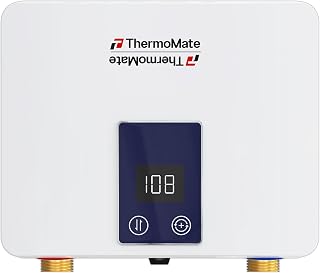
This ThermoMate model is listed as a 3500W, 120V, 29.2-amp electric tankless heater with a temperature display. Its name describes it as a small on-demand unit for a kitchen or bathroom sink faucet. It is a candidate for buyers comparing compact sink heaters, but the supplied product information does not include a detailed flow rate, temperature range, dimensions, or installation requirements.
- Best for: Buyers investigating a small 120V point-of-use option for a sink.
- Why it was selected: Its stated voltage, wattage, and sink-focused product name address a distinct use case from the larger 240V models.
- Limitation: The available details are too limited to establish its capacity or suitability for a particular flow rate. Check the full manufacturer specifications before choosing it.
The product name also states that it is ETL certified. Verify the listing and applicable installation instructions for the exact model before purchase or installation.
27kW WiFi Electric Tankless Heater

This 27kW, 240V electric tankless model is best considered by buyers comparing higher-output systems. Its product name identifies WiFi capability and ETL certification. The supplied information does not specify its gallons-per-minute output, required breaker size, wiring, or the number of fixtures it can serve, so those details need to be checked before comparing it with a lower-output unit.
- Best for: Shoppers seeking a high-wattage 240V option and interested in a WiFi feature.
- Why it was selected: Its 27kW rating fills the higher-output category in this comparison.
- Limitation: The available feature data does not establish flow capacity or electrical installation requirements.
The listing identifies the product as ETL certified. Confirm certification details, installation specifications, and whether the electrical service can support the unit with a qualified electrician.
ThermoMate 27kW Residential Heater
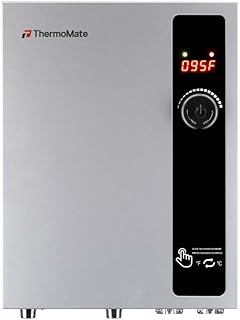
The ThermoMate 27kW model is best suited to shoppers comparing residential electric tankless heaters for shower use. Its product name lists 240 volts, up to 6.4 gallons per minute, self-modulating operation, and a 114-amp draw. The maximum flow figure should not be treated as guaranteed at every temperature rise: incoming water temperature and desired outlet temperature affect how much hot water a unit can deliver.
- Best for: Buyers evaluating a high-output electric model for residential shower demand.
- Why it was selected: It provides a stated flow figure and electrical draw, useful comparison details that are absent from some listings.
- Limitation: The listed 114-amp draw is a major electrical planning consideration; verify circuit and panel requirements before purchase.
Compare its 6.4 GPM claim with the flow needed for the fixtures you expect to run simultaneously. Confirm the manufacturer’s temperature-rise data and installation instructions for your location and water conditions.
Buying Guide: Choosing an Electric On-Demand Water Heater
Do you need a point-of-use or whole-home system?
A point-of-use heater serves a nearby outlet, such as one sink. It can be a practical option when the goal is local hot water and the application has modest flow. The APUS is explicitly described for a single point of use, while the 3500W ThermoMate is named for sink-faucet applications. Neither should be assumed to provide whole-home capacity based on wattage alone.
A higher-output system is more appropriate to investigate when multiple fixtures or a shower need hot water. However, “whole-home” suitability depends on the required flow, incoming water temperature, desired temperature rise, and electrical service. A product’s maximum GPM is not a guarantee of that flow at every temperature setting.
How much flow do your fixtures require?
List the fixtures likely to run at the same time and estimate their combined hot-water flow. A shower running alone presents a different demand from a shower and kitchen faucet operating together. Compare that combined demand with the heater’s flow at the temperature rise your home needs, not just a headline maximum.
Cold incoming water requires more heating to reach a chosen outlet temperature. That can reduce the flow a tankless heater can deliver at the target temperature. Check manufacturer performance charts or specifications for your climate and incoming-water conditions whenever available.
Can your electrical panel support the unit?
Electric tankless heaters can require substantial electrical capacity. Check voltage, amperage, breaker requirements, conductor size, and available panel capacity in the installation instructions. The ORBEK listing, for example, specifies a 240V supply, a 60-amp two-pole breaker, 6 AWG wiring, and at least 150 amps of total panel capacity. The ThermoMate 27kW product name lists a 114-amp draw.
Do not select a heater based only on whether the home has a 240V outlet. Have a qualified electrician determine whether the service and panel can support the model and whether installation changes are needed. Electrical requirements vary by product.
What do wattage and self-modulation tell you?
Wattage indicates the heater’s electrical power rating, but it does not tell you the exact hot-water flow available under your conditions. A higher wattage can support more heating capacity, while the final delivery rate still depends on temperature rise and flow. Compare complete specifications rather than assuming two units with similar wattage perform identically.
Self-modulation means the heater adjusts its power according to operating conditions, as described for the APUS and ThermoMate 27kW models. It does not eliminate the need to size the heater correctly or ensure that the electrical supply meets the product requirements.
Which installation details should you confirm?
- Voltage, amperage, breaker configuration, and wiring requirements
- Required water connections and permitted installation location
- Minimum and maximum flow rates, if specified
- Temperature range and performance at your incoming-water temperature
- Whether the unit is designed for one outlet, a shower, or multiple fixtures
- Any required professional installation or local code checks
When product information is incomplete, ask the manufacturer or seller for the installation manual and performance data before buying. Avoid assuming a product is interchangeable with another model based on its name or power rating alone.
Frequently Asked Questions
Are electric tankless water heaters truly instant?
They heat water on demand rather than storing a tank of heated water. A listing may describe a short time for heating to begin, but hot water still has to travel through the plumbing to the outlet. Actual delivery depends on the system and installation.
Can a small electric tankless heater serve a whole house?
Not necessarily. A small point-of-use model may be designed for one sink only. Check the product’s stated application, flow performance, and electrical requirements before considering it for multiple fixtures.
Is a higher GPM rating always better?
No. Maximum GPM is only useful when considered alongside temperature rise and incoming-water temperature. Compare the flow the heater can sustain at the outlet temperature your household needs.
Will an electric tankless system lower my electricity use?
It may avoid standby heat loss associated with storing hot water, but household savings are not guaranteed. Electricity use depends on hot-water demand, incoming-water temperature, selected setpoint, flow, and the existing system.
Should I install an electric tankless heater myself?
Electrical and plumbing work may require professional installation and must meet applicable local requirements. Follow the specific manufacturer’s instructions and have a qualified professional verify panel capacity, wiring, and water connections.