The best residential gas water heater depends on fuel type, installation location, and how many fixtures may need hot water at once. The Rheem indoor model suits many-bathroom homes needing up to 7.0 GPM, while the compact ThermoMate is better for lower-demand households. The GASLAND and Rinnai natural-gas units offer higher stated capacity, and the outdoor Rheem is an option when an exterior installation is appropriate. Compare the specifications and installation requirements below before choosing.
| Product | Fuel and installation | Stated flow or capacity | Best suited for |
|---|---|---|---|
| ThermoMate CZ422NG | Natural gas, indoor | Up to 5 GPM; 102,000 BTU | Smaller hot-water loads |
| Rheem RTG Indoor | Natural gas, indoor | 7.0 GPM at 35°F rise; 160,000 BTU | Families with multiple bathrooms |
| GASLAND Gasmart E | Natural gas, indoor | Up to 7.6 GPM; 199,000 BTU | Higher-demand homes seeking a compact unit |
| Rinnai RE199iN | Natural gas, indoor | Up to 9.8 GPM stated | Large households needing whole-home service |
| Rheem RTG Outdoor | Natural gas, outdoor | 7.0 GPM at 35°F rise; 160,000 BTU | Homes suited to exterior installation |
ThermoMate CZ422NG: Best for Smaller Loads

The ThermoMate CZ422NG is an indoor natural-gas tankless water heater rated for up to 5 GPM and 102,000 BTU. It is best for households with moderate hot-water demand that want a compact, on-demand unit rather than a storage tank. The listed flow is lower than the 7.0–9.8 GPM figures of the larger models in this comparison, so it is a better fit when fewer fixtures are likely to run simultaneously.
Its listed features include a smart flow sensor, temperature control specified at ±1°F, and an oxygen-free copper heat exchanger. The manufacturer states up to 98% thermal efficiency and a 0.81 UEF. The product information also lists CSA certification and safety protections, including freeze, flame-out, overheat, and pipe-blockage protection.
- Best for: Smaller households or homes with lower simultaneous hot-water needs.
- Why it was selected: It is a natural-gas indoor option with clearly stated flow, input, and safety features.
- Limitation: Its 5 GPM maximum is below the listed capacity of the larger whole-house options; actual flow depends on incoming water temperature and demand.
Rheem RTG Indoor: Best for Multi-Bathroom Homes

This Rheem indoor model is rated at 160,000 BTU and 7.0 GPM at a 35°F temperature rise. The manufacturer describes it as suitable for two to three simultaneous showers, making it a stronger candidate than the ThermoMate for homes with several bathrooms or overlapping hot-water use. Its non-condensing design and wall-mounted form are intended for indoor installation.
Rheem lists a 0.82 Uniform Energy Factor and says the unit can save up to 34% on energy costs compared with a 50-gallon electric tank heater. It uses a direct-vent system, so installation needs to account for the required venting arrangement. The stated performance depends on temperature rise, so 7.0 GPM should not be treated as a guaranteed flow rate under every climate and inlet-water condition.
- Best for: Households that need more flow than a small-capacity unit and have a suitable indoor installation location.
- Why it was selected: Its 7.0 GPM rating at a specified temperature rise makes the capacity claim easier to compare.
- Limitation: It is an indoor direct-vent model, so it requires a compatible venting plan and qualified installation.
GASLAND Gasmart E: Best for Compact High Output
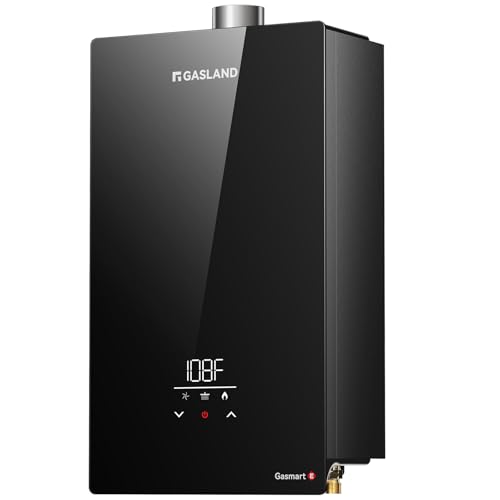
The GASLAND Gasmart E is an indoor natural-gas tankless heater with 199,000 BTU input and up to 7.6 GPM listed in its product name. It is best for buyers looking for a higher-output unit in a wall-mounted, space-saving form. The listing describes it as a whole-house model and says its compact design can suit spaces such as closets, basements, or laundry rooms, subject to installation requirements.
GASLAND lists CSA certification, multiple safety features, and a 0.8 UEF. The product information also claims 34% greater energy efficiency than a 50-gallon tank heater and lower NOx emissions; these comparisons are manufacturer-provided, so buyers should review the stated comparison basis. Confirm the unit’s flow performance for the household’s local winter inlet-water temperature before selecting it.
- Best for: Homes needing a higher stated flow rating and an indoor wall-mounted format.
- Why it was selected: It combines a listed 199,000 BTU input with up to 7.6 GPM and a compact design.
- Limitation: The stated maximum flow is not a promise of that output at every temperature rise or with every combination of fixtures.
Rinnai RE199iN: Best for Large Households

The Rinnai RE199iN is a 199,000 BTU, indoor natural-gas tankless heater designed for whole-house use. The listing states up to 9.8 GPM and describes support for multiple fixtures, including showers, laundry, and a dishwasher. This makes it a candidate for large households with higher simultaneous demand, provided the home’s gas supply, venting, and water conditions support the installation.
Its features include an LED display with diagnostic codes and service reminders, a compact wall-mounted design, and on-demand heating intended to reduce standby energy loss. The product information lists a limited warranty of 15 years on the heat exchanger, five years on parts, and one year on labor. A Rinnai Controlr module for Wi-Fi monitoring is sold separately, and a version with built-in recirculation is identified separately.
- Best for: Large homes that need substantial whole-house hot-water capacity.
- Why it was selected: It offers a high BTU input, natural-gas fuel, and features aimed at diagnostics and service.
- Limitation: The listing contains inconsistent flow figures: the name and main feature state 9.8 GPM, while another feature sentence says 7.6 GPM. Confirm the correct rating and sizing with the seller or installer.
Rheem RTG Outdoor: Best for Exterior Installation
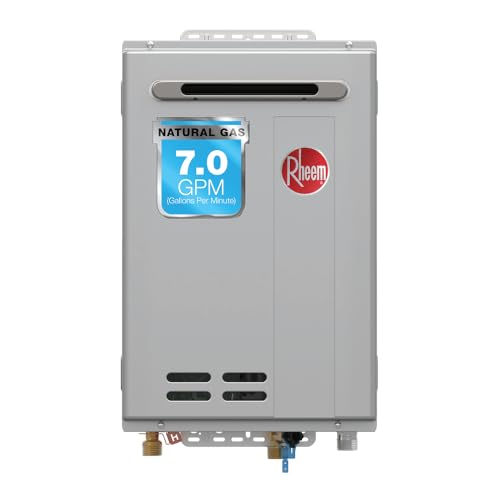
This outdoor Rheem model shares the indoor version’s listed 160,000 BTU input and 7.0 GPM flow at a 35°F temperature rise. It is best for a home where the unit can be installed outside according to local code and manufacturer requirements. Its key distinction is installation location: the manufacturer says outdoor installation eliminates the need for indoor venting.
The unit is non-condensing, wall-mounted, and has a metal cabinet. Rheem lists a 0.82 UEF and says the heater can serve two to three simultaneous showers at the stated performance conditions. Outdoor placement can free indoor space, but suitability depends on climate, exposure, clearances, and local installation rules. Check those details before choosing it over the indoor model.
- Best for: Homes with an appropriate exterior mounting location and a preference to keep the heater outdoors.
- Why it was selected: It provides a clear alternative to the indoor Rheem with the same stated flow and input figures.
- Limitation: It is specifically designed for outdoor installation, so it is not the right choice when the heater must be located indoors.
Buying Guide: How to Choose a Residential Gas Water Heater
Natural gas or propane: Which fuel does your home use?
Match the heater to the fuel supply at the home. The five models above are natural-gas units. A propane model is not automatically interchangeable with a natural-gas model; choose only a unit specified for the home’s fuel and have installation requirements confirmed by a qualified professional.
How much hot water does your household use at once?
Estimate peak demand by listing the fixtures likely to run together, such as showers, a dishwasher, and laundry. Compare that demand with the heater’s flow rating at a relevant temperature rise. A maximum GPM figure without its temperature-rise conditions can be misleading: the colder the incoming water, the more heating work the unit must do to reach the target temperature.
The ThermoMate’s up-to-5-GPM rating is lower than the higher-output options. Rheem specifies 7.0 GPM at a 35°F rise. GASLAND lists up to 7.6 GPM, while the Rinnai listing has conflicting flow figures that should be verified before purchase. Do not size a heater by household size alone; local inlet-water temperature and simultaneous use matter.
Should you choose an indoor or outdoor model?
An indoor heater needs an installation location and venting arrangement that meet the manufacturer’s instructions and local code. The Rheem indoor option specifically lists a direct-vent system. An outdoor heater can avoid indoor venting, but the exterior location must be appropriate for the unit and local conditions. The outdoor Rheem is intended for exterior installation; do not assume an indoor unit can be placed outdoors.
What do BTU, GPM, and UEF tell you?
- BTU input: Indicates the heater’s rated fuel input. Higher input can support greater heating demand, but does not by itself establish the delivered flow at a particular temperature rise.
- GPM: Describes water flow. Check whether the rating is tied to a stated temperature rise and compare it with peak household demand.
- UEF: A standardized efficiency measure. Compare UEF values among models, while remembering that actual energy use depends on household usage and installation.
What installation details should be checked?
Before buying, have a qualified installer review gas-line capacity, venting or outdoor placement, required clearances, electrical needs, condensate requirements if applicable, and local permits or codes. The provided product information does not establish that any particular model will fit an existing setup. Replacing a tank heater with a tankless unit may require changes to the home’s gas, vent, or water connections.
Which features are worth comparing?
Look at safety protections, freeze protection where relevant, temperature controls, diagnostic displays, and service access. Some models list protections against overheating or flame-out, while the Rinnai lists diagnostic codes and reminders. Compare the exact features in each product listing rather than assuming every gas heater includes the same controls or protection functions.
Frequently Asked Questions
Are tankless gas water heaters suitable for whole-house use?
Yes, some are designed for whole-house service, but the right model depends on peak flow demand, incoming water temperature, and installation capacity. Check the unit’s flow rating at the expected temperature rise.
Can a tankless gas heater supply two showers at once?
It depends on the heater’s output and the showers’ flow rates and temperatures. The Rheem models state support for two to three simultaneous showers under their specified conditions; actual performance varies with water temperature and demand.
Is a higher GPM rating always better?
No. A high maximum rating does not guarantee that flow at the temperature rise required in a particular home. Compare conditions, peak fixture use, and local winter inlet-water temperature.
Does an outdoor gas water heater need indoor venting?
The outdoor Rheem listing says outdoor installation eliminates venting. It still must be installed in an allowed exterior location according to the manufacturer’s instructions and local codes.
Can I replace a tank water heater with a tankless model myself?
Do not assume an existing setup is ready for a tankless replacement. Gas supply, venting, mounting, electrical connections, and code requirements may differ. Have a qualified installer assess the site.
Which model should I choose for a smaller household?
The ThermoMate CZ422NG is the lower-capacity option in this comparison, with up to 5 GPM and 102,000 BTU listed. Confirm that its output meets the household’s actual simultaneous hot-water demand.