For longer warmth between reloads, choose a stove with a firebox suited to larger logs and controls for managing airflow; the Comfort Glow listing specifically says it fits 22-inch logs, while the KUNGKA tent stove lists a 2–4-hour burn per load. The Cleveland Iron Works model is listed for heating up to 900 square feet, but its supplied details do not state burn time. The five picks below serve different indoor-heating, cooking, and portable-camping needs.
| Product | Best suited for | Burn-time information provided |
|---|---|---|
| Comfort Glow Cast Iron Wood Stove | Indoor heating with longer logs | Extended burns claimed; no duration stated |
| KUNGKA Portable Hot Tent Stove | Winter tent camping | 2–4 hours per hardwood load |
| Cleveland Iron Works Single Burn Rate Stove | Heating a space listed up to 900 sq. ft. | Not stated |
| ZAWAYINE Indoor Wood-Burning Stove | Heating and cooking | Not stated |
| AVOFOREST Hot Tent Stove | Portable outdoor heating and cooking | Not stated |
Comfort Glow Cast Iron Wood Stove

Best for: Buyers seeking an indoor stove that accommodates longer logs and retains heat. The listing says this compact cast iron heater fits logs up to 22 inches and heats spaces up to 900 square feet.
The larger stated log capacity is relevant to extended burn planning because it gives buyers the option to use longer pieces than a stove designed for shorter logs. The product description also says the heavy-duty cast iron construction provides heat retention. It includes a cooking surface and a 6-inch flue collar, according to the listing.
Why it was selected: Among the listed products, this one makes the clearest connection between log size and extended burns. It is a practical indoor-heating option for someone comparing firebox capacity, heat retention, and a cooking surface.
Limitation: The listing does not give a burn duration, fuel-efficiency figure, or detailed installation requirements. A 22-inch log capacity does not guarantee a specific number of hours; actual burn time depends on fuel, airflow, and operating conditions.
KUNGKA Portable Hot Tent Stove

Best for: Winter campers, hunters, and ice fishers who need a portable stove and a stated burn-time estimate. The listing reports 2–4 hours per load using hardwood logs.
Its listed features include a borosilicate glass door for viewing the fire, an adjustable air vent, a chimney damper, and a removable ash tray. The seven-section stainless steel chimney reaches 6 feet, and the listing gives its diameter as 2.24 inches. Wind ropes, ground nails, and a rain cap are also listed.
Why it was selected: This is the most direct match for shoppers searching specifically for burn-time information in a portable tent stove. The stated 2–4-hour range offers a useful comparison point, while the air controls let users adjust fire intensity. The listing also states that it was tested to -20°F and describes heating a 200-square-foot tent; these are product claims, not a guarantee for every setup.
Limitation: A 2–4-hour burn per load is not an overnight burn without reloading. The chimney diameter and tent stove-jack fit should be checked against the intended shelter before purchase.
Cleveland Iron Works Single Burn Rate Stove

Best for: Buyers comparing indoor stoves by stated heating coverage and listed approval information. The product details say it heats up to 900 square feet and is EPA listed and approved.
The product name identifies this as a single burn rate stove. That label makes it important to distinguish this model from stoves whose listings describe adjustable burn control. The provided details also state that it comes with a one-year warranty.
Why it was selected: Its stated coverage makes it a relevant option for shoppers choosing a stove for a defined indoor area. It also offers a concise set of product details for comparison: single burn rate, up-to-900-square-foot heating coverage, EPA listing and approval, and a one-year warranty.
Limitation: The supplied information does not specify a burn duration, log length, firebox capacity, or air-control features. Choose it based on verified specifications for your space, not an assumption that “single burn rate” means a particular number of hours.
ZAWAYINE Indoor Wood-Burning Heating Stove

Best for: Buyers who want a stove for heating and cooking, especially for a cabin, workshop, or outdoor shelter. The listing describes a steel combustion chamber and a cooktop with three opening sizes for different pot bases.
The supplied features describe two removable stove rings, creating openings of 10.83, 7.48, and 4.13 inches. The listing says its grates support coal, firewood, branches, and wood chips. It also lists six chimney pipes totaling 19.7 feet, two elbows, and heat-retardant mesh around the smoke pipe.
Why it was selected: This model is a useful comparison for buyers who value cooking capability and a listed chimney kit as well as heat. The included pipe sections and adjustable cooktop openings distinguish it from the indoor heaters described primarily by room coverage.
Limitation: No burn duration, heating-area figure, or fuel-consumption data is provided. The product information describes use in several settings, but buyers should verify local rules, installation requirements, and safe clearances before indoor operation.
AVOFOREST Hot Tent Wood Stove
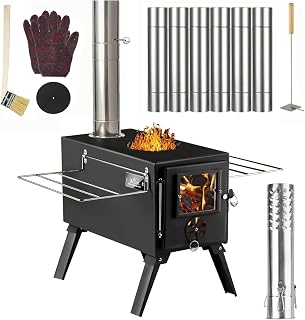
Best for: Campers and outdoor users looking for a small wood stove for heating and cooking. The product name describes a hot tent stove with seven stainless chimney pipes and use for activities such as ice fishing and hunting.
Why it was selected: It adds a portable outdoor option to a list otherwise weighted toward indoor heating and a tent stove with a stated burn duration. Buyers who need a compact camp setup may find this category more relevant than a room-heating model.
Limitation: The supplied product information does not include detailed features beyond the product name, nor does it state burn time, stove dimensions, chimney length, or heating capacity. Confirm those details with the current listing before deciding whether it meets your needs.
Buying Guide: How To Choose A Long-Burn Wood Stove
What does “long burn time” mean for a wood stove?
Burn time is the period a stove can maintain useful heat from a fuel load before it needs more wood. It varies with log species and moisture, log size, firebox capacity, airflow, chimney draft, and the heat output setting. A product’s stated hours are most useful when the listing also specifies the fuel and load conditions. In this selection, only the KUNGKA listing gives a duration: 2–4 hours per load using hardwood logs.
Which product details matter most for longer burns?
- Firebox and log capacity: Larger or longer logs can reduce how often wood must be added, but capacity alone does not prove a specific burn duration. Comfort Glow lists a maximum log length of 22 inches.
- Airflow controls: Adjustable vents or a damper can help regulate the fire. KUNGKA lists both an adjustable air vent and a chimney damper; the Cleveland stove is identified as single burn rate.
- Fuel guidance: Compare the recommended wood type and condition. KUNGKA’s stated duration is specifically tied to hardwood logs.
- Heat retention: Construction material can affect how a stove holds and releases heat, but it should not be treated as a substitute for a published burn-time specification.
Should you choose an indoor stove or a tent stove?
Start with where the stove will be installed. Indoor stoves are intended for home or building heating and require an appropriate flue and installation. Tent stoves are designed around portable outdoor use and must work with a compatible stove jack and chimney arrangement. Do not assume that a stove described for tents or outdoor use is suitable for a house. Follow the manufacturer’s installation instructions and applicable local codes.
How much heating coverage do you need?
Use the listed square-foot figure as a starting point, not a guarantee of performance. The Cleveland Iron Works and Comfort Glow listings each state coverage up to 900 square feet. Actual heating needs depend on insulation, ceiling height, climate, layout, and the stove’s operation. A stove that is too small may struggle to heat a space; one that is too large may be difficult to operate at a comfortable output.
What should you check before buying?
- Look for an explicitly stated burn duration and the conditions behind it.
- Check maximum log length and firebox capacity if listed.
- Confirm chimney diameter, pipe sections, and required installation parts.
- Review heating-area claims against your room or shelter, not just the product name.
- For cooking, verify the cooktop design and whether your cookware will fit.
- For indoor use, verify the model’s approvals and installation instructions; do not infer safety from a marketing phrase alone.
Frequently Asked Questions
Which listed stove has the clearest stated burn time?
The KUNGKA hot tent stove lists a 2–4-hour burn per load using hardwood logs. The other product details provided here do not state a burn duration.
Does a stove that fits longer logs always burn longer?
No. Log capacity can support a longer fuel load, but actual burn time also depends on wood type and moisture, airflow, chimney draft, and operating conditions. The Comfort Glow listing says it fits 22-inch logs but gives no number of burn hours.
Which option is listed for heating up to 900 square feet?
The Cleveland Iron Works Single Burn Rate Stove and the Comfort Glow Cast Iron Wood Stove are both listed to heat up to 900 square feet. These are manufacturer-stated coverage figures, not guarantees for every building.
Can a portable tent stove be used indoors at home?
Do not assume that a tent stove is suitable for residential indoor installation. Check the manufacturer’s intended-use instructions, local requirements, and the stove and chimney specifications before use.
What should I buy if I need cooking and heating?
The ZAWAYINE listing specifically describes both heating and cooking, with three cooktop opening sizes. The Comfort Glow listing also mentions a cooking surface, while the AVOFOREST product name describes outdoor heating and cooking.