For measuring air draft and pressure, a manometer is the most directly relevant tool: the Dwyer Mark II provides a wall-mounted liquid scale, while the HT-1890 is a handheld digital differential-pressure meter. The Arithmetix anemometer measures air velocity rather than pressure. The other listed gauges measure woodworking height or bore size, not draft, so they are included only as alternatives for those separate tasks—not as draft meters.
| Product | Best suited for | What it measures |
|---|---|---|
| Dwyer Mark II 25 | Stationary air-pressure checks | Pressure in inches of water column |
| HT-1890 | Portable differential-pressure readings | Differential pressure |
| Arithmetix MS6252A | Air-velocity checks | Air speed and temperature |
| Wixey WR25 | Router-table and saw setup | Tool height |
| QWORK telescoping set | Checking holes and bores | Bore diameter by transfer measurement |
Dwyer Mark II 25 Liquid Manometer

Best for: A fixed location where users need to monitor low air pressure or check air-filter performance. This is the most directly relevant draft-measurement option in the list because it is an inclined-vertical liquid manometer intended for air-velocity and filter-performance applications, as well as general-purpose measurement.
The Mark II 25 has a stated range of 0–3 inches of water column and 3% accuracy. It can mount on a vertical surface, and its built-in spirit level helps with leveling. Leakproof O-ring seals and an overflow tank are designed to reduce the risk of fluid loss.
Choose this if you want a wall-mounted liquid instrument with a visible scale. Limitation: it is not a handheld digital meter, and the listed range is limited to 0–3 inches of water column.
HT-1890 Handheld Digital Manometer

Best for: Users who need a portable digital differential-pressure meter and prefer a backlit display. The HT-1890 offers 11 selectable measurement units, making it useful when a task or report calls for a particular unit.
Its feature list also describes minimum, average, and maximum readings, plus a relative time clock for tracking pressure changes. These functions make it a different choice from the Dwyer liquid manometer: it emphasizes digital readout and selectable units rather than a wall-mounted liquid scale.
Choose this if portability, display visibility, and unit selection matter. Limitation: the supplied product details do not specify its measurement range or accuracy, so confirm those requirements before relying on it for a particular measurement task.
Arithmetix MS6252A Digital Anemometer
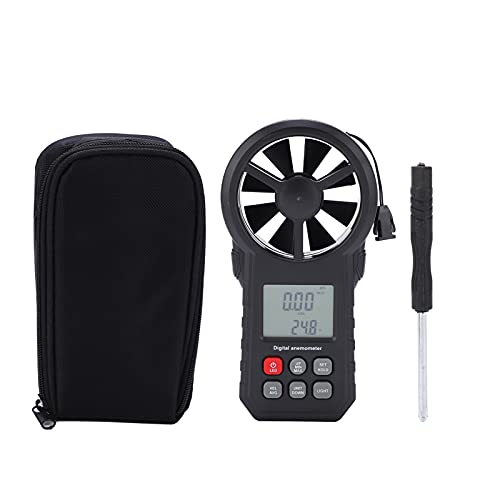
Best for: Measuring air velocity when the question is how fast air is moving, rather than what pressure difference is present. The MS6252A is a handheld anemometer with airspeed units that include meters per second, knots, and miles per hour.
The product is described as having an ABS exterior and an integrated temperature sensor with a stated monitoring range of -10 to +45 degrees Celsius. That makes it a distinct tool from either manometer: velocity readings and pressure readings are related to airflow but are not interchangeable measurements.
Choose this if your task specifically calls for airspeed. Limitation: it is not presented as a differential-pressure manometer, so it should not be selected as a direct substitute when a draft-pressure reading is required.
Wixey WR25 Digital Height Gauge

Best for: Woodworkers setting router-table cutter depth or table-saw blade height. This product is not a draft gauge; it is included as a separate type of measurement device from the supplied product list.
The WR25 measures from 0 to 3.2 inches (0–83 mm), with the feature description stating accuracy within a thousandth of an inch. It supports fractions or millimeters, has magnetic feet for positioning, and includes a locking rule feature for repeatable measurements. ABS and INC modes provide preset and zero-set measurement options.
Choose this if you need a compact tool-height gauge for woodworking setup. Limitation: its intended measurements concern cutter and blade height, not air pressure, draft, or airflow.
QWORK Telescoping Bore Gauge Set

Best for: Users who need to inspect internal bore or hole sizes, not measure air draft. This six-piece telescoping set is the closest relevant option in the supplied list for mechanical dimension checks, but it serves a different measurement purpose from a manometer.
The listed range is 5/16 to 6 inches (8 to 150 mm). The gauges are described as carbon steel with chrome plating and include a knurled locking knob and holding area for adjustment and handling.
Choose this if you need to transfer a bore measurement for a separate dimensional check. Limitation: it does not read air pressure or velocity, and the measurement range is stated for bore sizes rather than draft conditions.
Buying Guide: How To Choose A Draft Measurement Device
Do you need pressure, differential pressure, or air velocity?
Start by identifying the quantity required. A manometer measures pressure; a differential-pressure meter compares pressure between two points. An anemometer measures air velocity. Although each can be useful when investigating airflow, the readings answer different questions. Choose the instrument that matches the measurement in the procedure or specification you are following.
Would a liquid or digital manometer fit the job?
A liquid manometer such as the Dwyer Mark II 25 gives a direct visual reading and is designed for mounting on a vertical surface. Its listed range is 0–3 inches of water column. A handheld digital unit such as the HT-1890 offers a backlit display and multiple selectable units. The HT-1890 details provided here do not state range or accuracy, so verify those figures if they are essential to the job.
Check units and measurement range
Confirm that the device supports both the units and the range needed for your application. The Dwyer product is specified in inches of water column, while the HT-1890 lists 11 selectable units without naming them in the supplied details. Do not assume the device covers a particular pressure range or unit until its specifications confirm it.
Consider where measurements will be taken
A wall-mount instrument is suited to a fixed monitoring point. A handheld device is more practical when readings are taken at different locations. Display lighting may matter in dim work areas, while a visible liquid column may suit users who want a non-digital scale. Match the form to the measurement setup rather than treating portability as a proxy for accuracy.
When is an anemometer the better choice?
Choose an anemometer when the required result is airspeed. The Arithmetix MS6252A lists measurements in meters per second, knots, and miles per hour. It should not replace a manometer when the task requires a pressure or pressure-difference reading. Use the instrument type called for by the work instructions.
Which listed gauges are not draft meters?
The Wixey WR25 measures woodworking tool height, and the QWORK telescoping set measures internal bore dimensions. Neither is designed to measure air pressure or velocity. Their inclusion here reflects the supplied product selection, not suitability for draft measurement. For an air-draft purchase, focus on the manometer options and confirm their specifications against the required task.
Frequently Asked Questions
What device is used to measure air draft pressure?
A manometer is used to measure air pressure or pressure difference. The Dwyer Mark II 25 is a liquid manometer with a listed 0–3-inch water-column range; the HT-1890 is a handheld digital differential-pressure meter.
Is an anemometer the same as a manometer?
No. An anemometer measures air velocity, while a manometer measures pressure. Airflow assessments may involve either measurement, but one instrument does not automatically replace the other.
What does inches of water column mean?
Inches of water column is a pressure unit commonly used for low-pressure air measurements. The Dwyer Mark II 25 lists a range of 0–3 inches of water column.
Which option is suited to a fixed monitoring location?
The Dwyer Mark II 25 is the listed wall-mount option. Its built-in spirit level helps with leveling, and its construction includes O-ring seals and an overflow tank intended to reduce fluid-loss risk.
Can the Wixey height gauge measure airflow?
No. The Wixey WR25 is designed for woodworking tasks such as setting router-table cutter depth and table-saw blade height. It does not measure air pressure or air velocity.