For most households, a tank water heater is the simpler choice when an existing tank system meets demand and predictable installation costs matter; a tankless model is worth considering when saving space and heating water on demand are priorities. The products below are electric tankless options, ranging from small point-of-use units to higher-output models. The “2017” in the search phrase may refer to older comparison information; this guide focuses on the listed products and current buying considerations, not 2017 model specifications.
| Product | Best suited for | Key listed detail |
|---|---|---|
| WINTEMP 9kW | Small sinks and low-flow use | Up to 2.2 GPM; 240V hardwired |
| ORBEK 14kW | Several low-demand points of use | Up to 3.38 GPM; 240V |
| 110V 3000W unit | Compact, single-use applications | Temperature rise varies by flow |
| 14kW 240V unit | Shoppers comparing a 14kW option | Listing provides limited specifications |
| Westinghouse 11kW | Buyers interested in Wi-Fi features | 240V; Wi-Fi listed |
WINTEMP 9kW Electric Tankless Heater

This 240V, 9kW model is best for a small sink, office breakroom, or other low-flow point of use. Its listed maximum output is 2.2 gallons per minute, and the product description says its adaptive controls adjust heating power according to incoming water temperature and flow. It is also described as a possible booster heater.
Choose this unit if you want on-demand electric hot water for a limited application rather than a whole-house system. Its self-modulating operation is intended to reduce power use as flow falls and enter standby when hot water is not being requested. The listing also describes water-electricity separation intended to help limit scale and corrosion.
Installation caution: The stated requirements are a 240V supply, a 40-amp double-pole breaker, 8 AWG wiring, hardwired installation, and 1/2-inch NPT water connections. Verify the electrical panel and installation requirements before purchasing. Its stated flow capacity may not suit simultaneous high-demand uses.
ORBEK 14kW On-Demand Water Heater

The ORBEK 14kW unit is best for buyers seeking more listed flow than a small point-of-use heater provides. The product states a maximum of 3.38 GPM and describes use at two to three points of use, such as a bathroom and kitchen. Actual hot-water flow depends on incoming water temperature and the temperature rise needed, so the maximum figure should not be treated as a guaranteed flow in every home.
Choose this model if you need an electric tankless option for more than one low-demand outlet and have the electrical capacity for its stated requirements. The listing specifies 240V, a 60-amp two-pole breaker, 6 AWG wiring, and 1/2-inch NPT water connections. It also describes on-demand operation and water-electricity separation intended to reduce scale and corrosion.
Installation caution: The listing says the household breaker panel should have total current capacity of at least 150 amps. Have a qualified professional assess the panel, wiring, and expected simultaneous demand. Avoid choosing it solely on the advertised maximum GPM.
110V 3000W Compact Tankless Heater
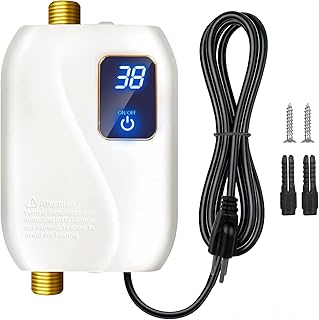
This 110V, 3000W heater is best for buyers looking for a compact wall-mounted unit for a limited application, such as a kitchen sink or another small hot-water demand. Its listing gives different temperature rises at different flows: 82°F at 0.3 GPM and 131°F at 0.5 GPM. That relationship matters: higher flow generally leaves less time and power available to raise water temperature.
The unit has an LED display and allows Fahrenheit or Celsius selection by holding the power button. The description lists protections for leakage, dry boiling, overheating, inactivity, and water-and-electricity isolation. It also describes an IPX4 waterproof rating and says the product qualifies for ETL standards; confirm applicable installation requirements for your location and application.
Installation caution: The stated flow and temperature-rise figures are for low flow, so this is not the best choice if you expect several outlets or a strong shower supply. Confirm the intended plumbing setup and electrical circuit before buying.
14kW 240V Electric Tankless Heater

This product is best for shoppers comparing another 14kW, 240V electric tankless option. The supplied listing identifies its power rating and voltage, but does not provide further feature details in the product information available here. It therefore cannot be compared reliably with the ORBEK model on flow rate, breaker size, wiring, controls, or intended number of outlets.
Choose this listing only after checking the complete product specifications and installation instructions. It is included because its stated 14kW, 240V configuration is relevant to buyers comparing electric on-demand heaters, not because the available information establishes that it outperforms other models.
Information caution: Verify maximum GPM at your required temperature rise, electrical requirements, water connections, and safety information before purchase. Do not assume that another 14kW heater’s specifications apply to this unit.
Westinghouse 11kW Wi-Fi Tankless Heater

The Westinghouse model is best for buyers who specifically want to compare an electric tankless unit advertised with Wi-Fi. The supplied product name also identifies it as an 11kW, 240V model and lists ETL and a gray finish. No flow-rate, circuit, wiring, or connectivity details were provided in the product information for this comparison.
Choose this product if Wi-Fi is a feature you want to investigate and you are prepared to confirm what the connection controls and what electrical setup is required. Its 11kW rating is lower than the listed 14kW options, but wattage alone does not establish the amount of hot water available under your home’s conditions.
Information caution: Check the full manufacturer specifications for GPM, temperature rise, breaker and wire requirements, and Wi-Fi functions. The available listing details are not enough to assess whole-house suitability.
Tankless Vs. Tank Water Heaters: What Is the Difference?
A tank water heater stores a volume of heated water in an insulated tank. It can supply hot water from that reserve, but the available amount is limited by tank capacity and how quickly the unit reheats water. Once the reserve is depleted, users may need to wait for more hot water.
A tankless heater warms water as it passes through the unit. It does not rely on a stored tank of hot water, but its output is limited by heating capacity and the temperature rise required. A unit with a low maximum flow may not serve multiple high-demand fixtures at once.
Tankless models can reduce the space used by a storage tank and avoid keeping a tank of water hot between uses. However, installation can require electrical or fuel-system changes, and an electric model may need substantial circuit capacity. A tank model may be a more straightforward replacement when existing connections and household demand suit it.
Neither type is automatically the better choice for every home. Compare the complete installed system, household peak demand, utility costs, available space, and maintenance needs rather than judging by the heater’s label alone.
Buying Guide: How to Choose Between Tankless and Tank
How much hot water does your household use at once?
Start with simultaneous demand, not just the number of people in the home. List the fixtures likely to run together, such as a shower and kitchen faucet. For a tankless model, compare the combined flow with the unit’s output at the temperature rise your location requires. A maximum GPM claim without its conditions may not predict performance in colder incoming water.
A storage tank’s capacity and recovery rate also matter. A large tank may cover a busy period better than a small one, while a small tankless heater may run short of output even though it heats water continuously. Match the equipment to your peak use.
Can your electrical panel support an electric tankless heater?
Electric tankless units can require high-current circuits. For example, the listed WINTEMP model specifies a 40-amp double-pole breaker and 8 AWG wiring; the ORBEK specifies a 60-amp two-pole breaker and 6 AWG wiring. These are model-specific requirements, not general rules for every heater.
Ask a qualified electrician to check available panel capacity, circuit requirements, wire sizing, and local code considerations before selecting a model. A heater that cannot be supported by the home’s electrical system may require additional work or may not be an appropriate choice.
What temperature rise and flow rate do you need?
Flow rate tells you how much water can pass through a heater, while temperature rise tells you how much the unit can warm that water. A unit may deliver a smaller temperature increase at a higher flow. Compare performance figures at a realistic incoming-water temperature and desired outlet temperature.
For point-of-use applications, low-flow units may be suitable for a single sink. For multiple fixtures, look for clear specifications covering expected flow and installation requirements. Do not assume that units with the same kilowatt rating perform identically.
Is tankless worth the installation trade-off?
Tankless systems can save floor or closet space and avoid storing a large volume of hot water. On-demand heating may also reduce energy used to keep stored water warm, depending on the household’s use and system efficiency. Those potential advantages should be weighed against purchase, installation, and any electrical upgrades.
A tank system may be attractive when the existing setup works, replacement simplicity matters, or a stored reserve fits the household’s usage pattern. Compare estimates for the complete installation and consider future operating costs rather than evaluating the equipment alone.
What maintenance and installation details should you verify?
Check the manufacturer’s installation instructions, water connections, electrical requirements, and any maintenance recommendations. Water conditions and scale can affect equipment over time. The listed products describe design features intended to limit scale or corrosion, but those descriptions do not replace model-specific maintenance instructions.
Confirm whether the product is intended for a single sink, a booster role, several points of use, or broader demand. If the listing does not provide key information such as GPM, temperature rise, and required circuit size, obtain it before purchase rather than inferring it from another product.
Should you replace a working tank with tankless?
Not necessarily. If a tank heater reliably meets demand and replacing it is the priority, a similar storage system may be the more direct path. Consider tankless when space, on-demand operation, or a particular use case justifies the system and installation changes. For a new selection, compare total household demand and installed requirements first.
Frequently Asked Questions
Does a tankless water heater provide unlimited hot water?
It can heat water on demand, but it does not provide unlimited flow. The unit can only heat water within its capacity. If several fixtures draw more flow than it can heat adequately, water temperature or usable hot-water output may fall.
Is a tankless heater always more energy-efficient?
No single efficiency result applies to every home. Tankless units avoid maintaining a stored tank of hot water, but actual energy use depends on equipment, installation, utility rates, water use, and operating conditions. Compare system-specific information and expected household demand.
Can a 9kW electric tankless heater serve a whole house?
The listed WINTEMP 9kW model is described for small sinks, breakrooms, point-of-use applications, and booster use, with a maximum stated flow of 2.2 GPM. Its listing does not establish whole-house capacity. Compare its output with your home’s simultaneous demand and required temperature rise.
Why does an electric tankless heater need a large breaker?
Electric tankless heaters draw power while heating flowing water, and higher-output models can require substantial current. Required breaker and wire sizes differ by model. Follow the product’s specifications and have a qualified professional assess the home’s electrical supply.
Does the year 2017 determine which water heater to buy?
No. A year in a search phrase may point to older advice or a past model year, but the choice should be based on current product specifications, household demand, installation requirements, and local conditions. Verify that any model you consider is the version and specification currently offered.