The best slim electric wall heater depends on whether you want quiet, low-wattage warmth or faster heat with remote and app controls. The ENVI panel is best for silent, targeted comfort; EconoHome suits buyers seeking a 400-watt convection panel; and DREO’s models are better for airflow, oscillation, and smart controls. Compare the listed dimensions, heating style, control options, and installation needs before choosing a wall-mounted heater.
| Product | Best for | Standout feature |
|---|---|---|
| ENVI Plug-in Panel Heater | Quiet, targeted warmth | Fanless convection and wall-sense sensor |
| DREO Smart Electric Wall Heater | App and voice controls | Manual oscillation and ECO mode |
| JNDRO Wall-Mounted Heater | Adjustable coverage | Three oscillation angles and 24-hour timer |
| EconoHome Panel Heater | Low-wattage panel heating | 400-watt convection design |
| DREO Smart Wall Heater, 1500W | Wide room coverage | 120-degree oscillation and smart scheduling |
ENVI Plug-In Electric Panel Wall Heater

Best for: Buyers who want quiet, steady supplemental warmth in a specific area, especially where fan noise or air movement is undesirable. Its fanless “Stack Convection” design is the main reason to choose it over oscillating wall heaters.
The ENVI is a low-wattage panel heater intended for targeted indoor comfort. It uses convection rather than a fan, so it does not blow dust and allergens around the room. The product information also says its design helps maintain humidity, which may appeal to people concerned about dry indoor air during winter.
- A wall-sense safety sensor cuts power if the heater is removed from the wall.
- The casing is described as operating at about 90°F.
- An auto-dimming power light is designed to reduce nighttime distraction.
- The listing describes a two-minute installation and plug-in use.
Choose this model if quiet operation and a fanless design matter more than directed airflow. It is described as supplemental or targeted heating, so avoid treating it as a guaranteed replacement for central heating throughout a home. The supplied features do not state a room-size rating.
DREO Smart Electric Wall Heater

Best for: Buyers who want a wall-mounted heater with multiple control methods and moving airflow. This model is a better fit than a fanless panel when remote adjustments, app access, Alexa voice commands, or manual oscillation are priorities.
The heater uses a PTC heating system and an airflow design listed at 11.5 feet per second. Its 30-degree manual oscillation lets users direct the warm air, while the stated noise level is 28 dB. ECO mode lets the user set a preferred room temperature, and the app includes temperature calibration.
- Control it with the included remote, the DREO app, or Alexa voice commands.
- Adjust the display lighting through the control options.
- Use the ECO mode for temperature-based operation.
Choose this product if smart controls and directed airflow are more useful than completely silent, fanless heat. Its airflow and oscillation mean it is not the same type of heater as a convection-only panel. The supplied product information does not provide dimensions or a room-size rating, so check those details if a very specific slim profile or coverage area is essential.
JNDRO Wall-Mounted Space Heater

Best for: Buyers who want to spread warm air across a wider area and adjust the heater from across the room. Its three selectable oscillation angles distinguish it from the DREO model with 30-degree manual oscillation and the fixed, fanless panel options.
The JNDRO heater has an ECO thermostat mode that adjusts heating power according to ambient temperature. Its listed temperature range is 41°F to 95°F. The remote controls temperature, timer, fan speed, and oscillation angle, while an LED display shows current settings.
- Select 60-, 90-, or 120-degree oscillation.
- Set the 24-hour timer using the remote.
- Use ECO mode to help maintain a selected temperature.
Choose this model if adjustable coverage and a timer are key requirements. The remote requires two AAA batteries, which are not included. The listing describes the heater as suitable for warming large areas but does not give a specific square-foot coverage figure, so compare the manufacturer’s current guidance with your room size before buying.
EconoHome 400-Watt Wall Heater Panel

Best for: Buyers looking for a low-wattage convection panel with a stated room-size recommendation. The product is listed as 400 watts and intended for rooms up to 120 square feet, making its stated electrical draw and coverage easier to compare with higher-wattage models.
The panel measures 23.5 by 23.5 inches and is listed for 120-volt power at 3.33 amps. Its thermostat temperature range is 41°F to 86°F. The heater mainly warms air through convection currents, with some radiant heat, and includes a heat reflector. The listing says it may be hard-wired.
- Listed for indoor rooms up to 120 square feet.
- Includes overheat protection, according to the product features.
- The exterior casing becomes warm during operation.
Choose EconoHome if the 400-watt rating and stated coverage align with your needs. Its 23.5-inch square panel is not necessarily the narrowest choice for a tight wall space. The product information says the casing is warm and describes the heater as suitable for adults only, so consider that limitation in homes with children or pets.
DREO Smart Wall Heater, 1500W
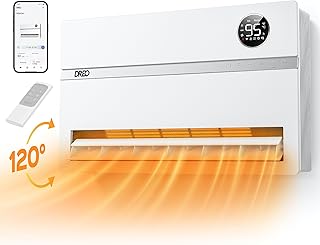
Best for: Buyers who prioritize broad oscillating airflow, scheduling, and connected controls. This model is a better match than a simple panel heater when distributing warm air across a room and controlling the schedule remotely are important.
The 1500-watt DREO heater has 120-degree oscillation. Its PTC ceramic heating system offers a listed temperature range of 41°F to 95°F, with temperature settings described as accurate to 1°F. Users can schedule heating hours in the DREO app and use voice control through Alexa or Google Home.
- Set schedules through the app.
- Adjust settings remotely through the DREO app.
- Use Alexa or Google Home voice control.
- Choose from the listed 41°F to 95°F temperature range.
Choose this product if wide oscillation and smart-home controls matter more than a low-wattage panel design. Its 1500-watt rating is substantially higher than the 400-watt EconoHome panel, so compare electrical requirements and heating needs rather than assuming the two are interchangeable. The provided features do not specify room coverage or product dimensions.
Buying Guide: How to Choose a Slim Electric Wall Heater
Do you want a flat panel or a heater with moving airflow?
A panel-style heater can be a practical choice when you want a wall-mounted form and steady, targeted warmth. The ENVI uses fanless convection, while EconoHome describes a convection panel that also provides some radiant heat. These designs differ from oscillating models, which move warm air through a room.
For adjustable airflow, compare the listed oscillation ranges. The JNDRO offers 60-, 90-, and 120-degree settings. One DREO model has 30-degree manual oscillation, while the 1500-watt DREO lists 120-degree oscillation. A wider angle can distribute moving air over a broader sweep, but it does not establish a specific room-size capacity.
How much space does the heater need on the wall?
Check the dimensions before choosing a heater for a narrow wall, a space behind furniture, or a location with nearby fixtures. EconoHome lists dimensions of 23.5 by 23.5 inches, so its panel may not fit every definition of slim. Dimensions are not included in the supplied information for the other four products. Confirm the current product measurements and required installation clearances before purchase.
Also consider where the heat will be useful. A targeted panel may suit one frequently occupied area, while an oscillating heater may be preferable when you want moving air directed across a larger portion of a room. Do not infer a heater’s exact coverage from its shape or oscillation angle alone.
Which controls and temperature settings matter to you?
For basic temperature management, compare the listed thermostat features and ranges. EconoHome lists 41°F to 86°F, while the JNDRO and the 1500-watt DREO list 41°F to 95°F. The DREO model with ECO mode also describes temperature calibration through its app. These specifications can help narrow the choice, but they do not indicate that every heater uses the same thermostat behavior.
If remote access matters, the DREO models include app controls and voice-control options; the first lists Alexa, and the 1500-watt model lists Alexa and Google Home. The JNDRO includes a remote with timer, temperature, fan-speed, and oscillation controls. The ENVI is a simpler option in the provided feature list, focused on quiet operation and its wall-sense sensor.
Should you prioritize quiet operation or faster air movement?
The ENVI is the clearest match for buyers who want fanless, silent operation. The DREO model with 11.5-feet-per-second airflow lists a noise level of 28 dB, but it is still an airflow-based heater rather than a fanless panel. Consider whether quiet operation during sleep or a moving stream of warm air is more important in the room where the heater will be installed.
For sensitive households, compare safety details instead of relying on general labels. ENVI lists a sensor that cuts power if the heater is removed from the wall. EconoHome lists overheat protection but also notes that its casing becomes warm and describes it as suitable for adults only. Read current installation and operating instructions for any model, particularly where children or pets may be present.
What electrical and installation details should you check?
Match the heater’s electrical specifications to the intended outlet or installation method. EconoHome lists 400 watts, 120 volts, and 3.33 amps, and says the unit may be hard-wired. The other listed products do not include comparable electrical specifications in the supplied feature descriptions. Verify the manufacturer’s instructions and applicable requirements rather than assuming a wall heater can use any outlet or wiring setup.
Finally, separate listed capabilities from broad savings claims. Wattage helps describe electrical consumption while a heater is operating, but actual household energy use depends on use time, settings, room conditions, and other heating sources. Choose a model based on its stated specifications and how you plan to use it, not on an unsupported expectation of a particular bill reduction.
Frequently Asked Questions
What is the best slim electric wall heater for quiet operation?
The ENVI is the strongest match in this selection for quiet operation because its listed design is fanless and uses convection. It is intended for targeted indoor warmth, and the supplied information does not state a room-size rating.
Which wall heater has the lowest listed wattage?
The EconoHome panel is listed at 400 watts. The ENVI is described as low-wattage, but its specific wattage is not included in the supplied features, so a direct numerical comparison cannot be made from this information.
Which model offers the widest listed oscillation?
The JNDRO lists selectable 60-, 90-, and 120-degree oscillation, and the 1500-watt DREO lists 120-degree oscillation. The DREO smart heater with large-room wording lists 30-degree manual oscillation.
Which heaters include app or voice control?
Both DREO models list app control and voice control. The DREO smart electric wall heater lists Alexa, while the 1500-watt DREO lists Alexa and Google Home compatibility.
Can a wall heater replace central heating?
These products are described as indoor or targeted space heaters, and the ENVI listing says it can supplement or replace central heating. Whether any single heater can heat an entire home depends on the building, room layout, heater capacity, and installation. Check the manufacturer’s coverage guidance for the specific model.