The best electrical heat tape for frozen pipes depends on pipe length, temperature exposure, and whether you want a thermostat or self-regulating cable. MAXKOSKO is best for short-to-medium runs with automatic temperature control; Frost King’s cables suit buyers who need a simple, fixed-length kit; WABUPD offers a long cable with mounting retainers; and OutPipe is designed for a 100-foot installation. Match cable length and installation method to your pipe, and follow the product instructions and local electrical requirements.
| Product | Best For | Listed Features |
|---|---|---|
| MAXKOSKO 6-foot cable | Automatic control on shorter runs | Self-regulating, built-in thermostat |
| Frost King HC9A | Fixed 9-foot pipe runs | 120V, 7W per foot |
| WABUPD 80-foot cable | Longer runs and varied outdoor uses | 120V, 8W per foot, thermostat |
| OutPipe 100-foot kit | Long installations needing self-regulation | Self-regulating, mounting tape included |
| Frost King HC3A | Short pipe sections | 120V, 7W per foot |
MAXKOSKO Self-Regulating Heat Tape

Best for: Homeowners who want a shorter pipe-heating cable with automatic temperature control. This model includes a 6-foot heating cable and a 3-foot power cord. The product listing says the cable is rated at 5 watts per foot and is intended to help maintain water flow down to -40°F.
Its self-regulating design adjusts output in response to temperature, and the built-in thermostat is listed as switching on at 38°F. The stated installation options include straight tracing, spiraling, or overlapping. Check the instructions before choosing a layout, since permitted installation methods can vary by product and pipe.
Choose this if automatic control and a defined short cable length are priorities. The listing describes an included 3-foot cord, so check that the outlet location and cable reach will work for your setup. It is not the best fit if your measured pipe run requires substantially more than 6 feet of heating cable.
Frost King HC9A 9-Foot Heating Cable

Best for: A measured pipe section that suits a fixed 9-foot cable. Frost King lists this kit as a 120-volt heating cable rated at 7 watts per foot. The product information says it is designed for metal and plastic water pipes and can keep water flowing down to -40°F.
The fixed length makes it easier to compare with a specific pipe run than a cable sold in many possible lengths. Before purchasing, measure the pipe section that needs protection and check the manufacturer’s installation instructions for how much cable the layout requires. Pipe length and heating-cable length are not always identical when the instructions call for a particular routing pattern.
Choose this model if a 9-foot kit matches your application and you prefer a straightforward fixed-length option. Its limitation is the set length: it may not cover a longer run, while a shorter pipe may not need this much cable. The supplied features do not specify self-regulating operation, so do not assume it has that feature.
WABUPD 80-Foot Pipe Heat Cable
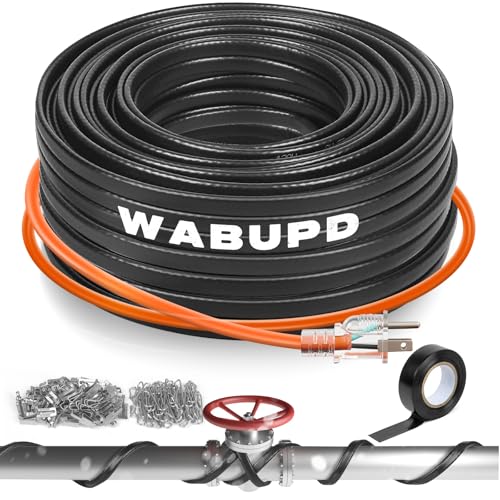
Best for: Longer pipe runs or buyers considering cable for several listed winter uses. The product listing specifies an 80-foot cable, 120-volt operation, and 8 watts per foot. It also lists a thermostat, a 5-foot plug wire with an indicator light, and automatic on-and-off operation. The stated cold-weather limit is -46°F.
WABUPD describes the cable for water pipes and also mentions uses such as gutters, roofs, barns, and other outdoor or agricultural settings. Those applications may require different installation details, so confirm that the instructions permit the intended use. Metal retainers are included according to the listing to help keep the heater attached.
Choose this if the 80-foot length fits a planned installation and the listed thermostat and retainers suit your needs. The long cable may be excessive for a small exposed section. Its listed 8-watt-per-foot output is a useful comparison point, but it should not be treated as a substitute for checking the required circuit load and installation directions.
OutPipe 100-Foot Self-Regulating Kit

Best for: Buyers planning a long pipe installation who want self-regulating cable and mounting tape in the kit. OutPipe lists a 100-foot heat-trace cable, a factory-connected LED plug, and mounting tape. The listing describes the cable as suitable for residential, commercial, and industrial pipe-freeze protection.
The manufacturer states a 500-watt output at 120 volts and gives a current figure of 4.2 amps at 50°F. Because electrical load and conditions matter, use the product’s instructions and electrical specifications to determine whether the circuit is appropriate. The self-regulating design is described as adjusting output based on temperature.
Choose this if the long cable length and included mounting tape match your installation plan. It may be a poor fit for a short pipe section, where most of the cable length would be unnecessary. The provided features do not state a specific minimum operating temperature, so compare the complete product documentation with the expected conditions at your site.
Frost King HC3A 3-Foot Heating Cable

Best for: Short, exposed pipe sections where a 3-foot cable is sufficient. Frost King lists the HC3A as a 120-volt, 7-watt-per-foot heating cable for metal and plastic water pipes. Its listed performance claim is that it keeps water flowing down to -40°F.
A short cable can make sense for a localized vulnerable section, such as a brief exposed span, provided the installation instructions and pipe layout support that use. Compare the required cable route with the pipe’s length before buying; the heater may need to follow a specific route rather than simply cover the same distance as the pipe.
Choose this over a longer fixed-length kit when your measured application is small. The main limitation is its reach: it is not intended to cover an extended pipe run. The listed features do not describe a thermostat or self-regulating function, so verify control requirements in the complete instructions instead of assuming automatic temperature control.
Buying Guide: How To Choose Heat Tape For Frozen Pipes
How much heating cable do I need?
Measure the pipe section that is exposed to freezing temperatures, then consult the cable’s installation instructions to determine the required route and length. Do not assume that a cable should be cut to match the pipe, or that extra cable can be doubled back. Some products have specific rules for spacing, spiraling, overlapping, and securing the heater.
For a short, localized risk area, a 3-foot or 6-foot model may be easier to match to the job. A 9-foot option covers more pipe, while 80-foot and 100-foot cables are intended for much longer layouts. These lengths are product options, not guarantees of coverage for a particular pipe configuration.
Should I choose self-regulating cable or thermostat control?
Self-regulating cable is described by its manufacturers as adjusting heat output according to temperature. MAXKOSKO and OutPipe list self-regulating designs. MAXKOSKO also specifies a built-in thermostat that turns on at 38°F. WABUPD lists automatic thermostat operation, but the provided information does not specifically identify its cable as self-regulating.
Do not treat these terms as interchangeable. A thermostat switches heating according to its sensing conditions, while self-regulation describes a cable’s output response. Check the complete instructions for where the thermostat senses temperature, how the product is controlled, and whether additional controls are needed. The listed Frost King features provide wattage and temperature claims but do not specify self-regulating operation.
What wattage and voltage should I compare?
The products here list 120-volt power. Their stated heating rates differ: Frost King lists 7 watts per foot, MAXKOSKO lists 5 watts per foot, and WABUPD lists 8 watts per foot. OutPipe gives a 500-watt output at 120 volts for its 100-foot kit. These figures help compare products, but they do not establish which model is appropriate for every climate or pipe.
Follow the product’s electrical instructions and check that the intended outlet and circuit suit the cable. Avoid using a wattage figure alone to decide whether a cable can protect a particular pipe. Insulation, exposure, pipe material, installation layout, and local requirements can affect the setup.
Can heat tape be used on metal and plastic pipes?
Frost King specifically lists its HC3A and HC9A cables for metal and plastic water pipes. For other products, confirm the approved pipe materials in the full instructions before installation. Do not infer material compatibility just because a product is described as a pipe heater.
Also check whether the instructions require insulation, specify a particular attachment method, or restrict contact with certain materials. Use only the recommended fastening and insulation approach. Improvised installation can interfere with heat transfer or create a safety issue.
What should I check before installing?
- Confirm the cable is intended for the pipe material and location where it will be used.
- Read the complete instructions for cable routing, spacing, fastening, and permitted insulation.
- Check the cable length, power-cord length, voltage, wattage, and thermostat details.
- Inspect the pipe and cable, and do not install a damaged product.
- Follow local electrical requirements and consult a qualified electrician if the circuit or installation is uncertain.
Heat tape is freeze protection, not a repair for a pipe that is already frozen or leaking. If a pipe is frozen, follow safe thawing guidance and avoid open flames. If there is damage or uncertainty, contact a qualified plumbing or electrical professional.
Frequently Asked Questions
Does electrical heat tape keep pipes from freezing at -40°F?
Several products in this selection list operation or freeze protection down to -40°F, while WABUPD lists a lower temperature limit. These are manufacturer claims. Actual protection depends on correct installation, power availability, pipe conditions, and the product’s stated instructions.
Can I overlap heat tape on a pipe?
Only if the specific product’s instructions permit it. MAXKOSKO lists overlapping as an installation option, but that detail should not be applied to other cables without checking their directions.
Is self-regulating heat tape always on?
Self-regulating cable adjusts its output based on temperature, according to the listed product descriptions. That is different from assuming the cable has a thermostat or that it uses no electricity. Review the product’s controls and electrical specifications.
Can I use roof heat cable on water pipes?
Do not assume a cable marketed for roofs is suitable for pipes. Check its product documentation for the intended application and approved installation method. Some listings mention both pipe and roof uses, but each use still needs to follow the manufacturer’s instructions.
How do I choose between a 3-foot and 9-foot cable?
Measure the vulnerable pipe section and check the required routing method. A 3-foot cable is a better starting point for a short section; a 9-foot model provides more cable for a longer layout. Neither length is suitable if it does not match the installation instructions and pipe route.
Should I insulate a pipe after installing heat tape?
Follow the cable manufacturer’s directions for insulation and approved materials. Do not cover a heating cable unless the instructions allow it, because insulation requirements differ by product and installation.