To get hot water without gas, choose an electric point-of-use heater for sink water or an electric hot water dispenser for cups and cooking. The 110V, 3000W tankless models below are best suited to low-flow sinks, not showers; the NutriChef dispenser is better for tea, coffee, and instant meals. Compare the intended use, electrical requirements, flow limits, and installation details before choosing a unit.
| Product | Best For | Type |
|---|---|---|
| 110V 3000W Tankless Heater With Digital Display | Low-flow sink use with temperature display | Under-sink tankless heater |
| DOYXC 110V Mini Tankless Heater | Compact point-of-use hot water | Under-sink tankless heater |
| 3000W Tankless Heater With Flow Guidance | Sink users who need clear flow limits | Point-of-use tankless heater |
| 3000W Wall-Mounted Sink Heater | Buyers who want specified mounting details | Point-of-use tankless heater |
| NutriChef 5.2 Qt Hot Water Dispenser | Hot water for beverages and meals | Countertop dispenser |
110V 3000W Tankless Heater With Digital Display
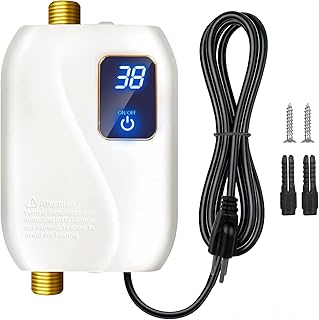
This electric tankless heater is designed to provide hot water at a point of use, such as a kitchen or bathroom sink. Its 110V, 3000W configuration and compact wall-mounted design make it an option for buyers seeking hot water without a gas connection and without storing heated water in a tank.
The product information gives temperature-rise figures of 82°F at 0.3 gallons per minute and 131°F at 0.5 gallons per minute. It has an LED display and allows the display to switch between Fahrenheit and Celsius by holding the power button for six seconds. Listed protections include leakage protection, dry-boil protection, overheating shutoff, and automatic power-off during inactivity.
- Best for: Low-flow sink use where the user wants a temperature display and a compact wall-mounted unit.
- Why it was selected: Its listed temperature-rise information and display provide useful details for comparing point-of-use heaters.
- Limitation: The stated temperature rise depends on water flow. It is not a substitute for a high-flow whole-house or shower heater.
DOYXC 110V Mini Tankless Heater

The DOYXC mini heater is a compact 110V electric option for supplying hot water near a sink. Its product description says it can provide hot water in three to five seconds and lists a maximum temperature of 55°C, or 131°F. The wall-mounted design is intended to save space, and the LCD display shows operating information.
Listed safety features include an IPX4 water-resistance rating, leakage protection, dry-burning protection, and automatic power-off when the unit is not working. The product description identifies kitchens, bathrooms, apartments, RVs, and camping among possible settings. Before choosing it for a mobile or recreational setup, check the installation and electrical requirements against the specific location.
- Best for: A buyer looking for a small point-of-use heater for handwashing or other sink tasks.
- Why it was selected: The compact format, LCD display, and stated safety features make it a practical candidate for localized hot-water needs.
- Limitation: The listing does not provide the same flow-based temperature-rise figures as some alternatives here, so confirm whether its output suits your expected water flow.
3000W Tankless Heater With Flow Guidance

This 3000W, 110V electric heater is intended for on-demand hot water at a kitchen or bathroom sink. Its product information lists a temperature rise of 82°F at 0.3 gallons per minute and 131°F at 0.5 gallons per minute. The LED display can show Fahrenheit or Celsius, with the setting changed by holding the power button for six seconds.
The compact, wall-mounted format may suit a location with limited space. A particularly useful detail in the listing is its clear warning that the unit is not suitable for shower use. It says a shower normally requires at least 1.8 gallons per minute, well above the flows cited for this heater.
- Best for: Sink users who want explicit flow and temperature-rise guidance before choosing a low-flow heater.
- Why it was selected: The product data makes its intended sink use and shower limitation especially clear.
- Limitation: Do not select it to supply a standard shower; its stated flow range is too low for that purpose.
3000W Wall-Mounted Sink Heater

This 110V, 3000W tankless unit is explicitly described as a sink-only heater. Its performance depends on water flow: reducing the flow increases the output temperature. The listing says it is not intended for high-volume shower use, making the application limits straightforward for buyers comparing electric hot-water options.
The unit is designed for vertical wall mounting and measures 7.8 by 4.3 by 2.6 inches. Its listed connections are 1/2-inch NPT steel ports, and mounting hardware is included. The product information also lists automatic system shutoff, a dry-fire cutoff, and an IPX4 rating. Review the connection and mounting details before purchase to confirm they match the intended installation.
- Best for: Buyers who want a sink-focused heater with specified dimensions, port size, and mounting orientation.
- Why it was selected: Its installation details and explicit flow-control guidance help set expectations for a point-of-use unit.
- Limitation: It is for sink applications, requires flow control, and is not intended for a high-volume shower.
NutriChef 5.2 Qt Hot Water Dispenser

The NutriChef is a countertop electric hot water dispenser rather than a plumbing-connected tankless heater. Its 5.2-quart capacity, boil function, and ability to maintain hot water are suited to serving hot water for tea, coffee, and instant meals. It plugs in and offers air-pump, electric-pump, and touch-cup dispensing functions.
This type of appliance can provide hot water without gas for kitchen tasks, but it does not deliver hot water through a sink faucet. The product information lists a thermal safety cutoff to help prevent dry boiling and a child safety lock on the lid. Its countertop format is relevant when the goal is convenient hot water for drinks or food rather than a replacement for a household water heater.
- Best for: Households that need hot water for beverages, instant meals, or serving guests.
- Why it was selected: It is a gas-free option for everyday hot-water needs that do not require plumbing or faucet delivery.
- Limitation: It is a countertop dispenser, not a sink heater or whole-home water-heating system.
Buying Guide: How To Choose Hot Water Without Gas
Do you need hot water at a sink or for drinks?
Start by identifying where the hot water must come out. A point-of-use tankless heater connects to a water line and serves a fixture such as a sink. A countertop dispenser heats and holds water for cups or cooking, but it does not supply a faucet. These are different appliance types, even though both use electricity instead of gas.
Choose a sink heater when the need is warm or hot water from a faucet. Choose a dispenser when the need is water for tea, coffee, or instant food. If you need hot water at multiple fixtures or throughout a home, compare whole-house electric water heaters rather than assuming a compact sink unit can serve every outlet.
Can a 110V, 3000W heater supply a shower?
Do not assume a small 110V, 3000W point-of-use heater can provide shower-level flow. The listings describe these products primarily for sinks, and one explicitly says it is not suitable for showers, citing a typical flow need of at least 1.8 gallons per minute. The temperature rise of a tankless heater also changes with water flow and incoming water temperature.
For a shower or several fixtures, look for a system designed and rated for that demand. Verify the required voltage, circuit, flow rate, and installation conditions for the specific product. A compact heater’s stated maximum temperature does not mean it can sustain that temperature at every flow rate.
What electrical and installation details should you check?
- Confirm that the product’s voltage and power requirements match the intended location and available electrical service.
- Check whether the unit requires wall mounting, a particular orientation, or specific plumbing connections.
- Compare the stated port size and installation instructions with your existing plumbing.
- Follow the manufacturer’s requirements and consult a qualified professional if the electrical or plumbing work is outside your experience.
- For RVs or camping, verify that the power source and installation setup meet the heater’s requirements before relying on it.
Product descriptions can mention safety features such as dry-fire protection, leakage protection, or automatic shutoff. Those features do not replace correct installation or use according to the manufacturer’s instructions. Check the complete product documentation for requirements that may not appear in a short listing.
How should flow rate and temperature rise affect your choice?
Tankless heaters warm water as it passes through the unit. In general, the amount of temperature rise available depends on how quickly water flows and how cold the incoming water is. For example, the first and third products list different temperature-rise figures at 0.3 and 0.5 gallons per minute. Use those figures as product-specific guidance, not as a guarantee of identical output in every home.
If you need hotter water from a low-flow unit, the listing for the fourth product says reducing water flow increases output temperature. That tradeoff means a slower stream may be necessary. Consider the task: handwashing may tolerate lower flow, while rinsing dishes or filling a container may take longer.
Is a tankless heater better than a hot water dispenser?
Neither type is universally better. A tankless heater serves water through a fixture and can reduce the wait for hot water at that point of use. A countertop dispenser keeps a supply of hot water available for drinks and food, with no faucet connection described in its product information. Decide based on delivery method, location, and how much water you use at a time.
What should you compare beyond the product name?
Read the intended application, flow guidance, temperature data, power requirements, dimensions, mounting orientation, and plumbing connections. Look for stated limitations, especially shower restrictions. Also distinguish a product’s safety features from claims about installation suitability: a compact design does not by itself establish that a unit fits every sink cabinet, electrical circuit, or plumbing layout.
Frequently Asked Questions
What is the simplest way to get hot water without gas?
For a sink, consider an electric point-of-use heater if its electrical and plumbing requirements fit the location. For drinks and cooking, a plug-in hot water dispenser is another electric option.
Can a small electric tankless heater replace a gas water heater?
Not necessarily. The compact products here are described for point-of-use or sink applications. They should not be treated as whole-house replacements unless the manufacturer specifically rates a model for that use and the home’s demand.
Will a 110V mini heater work for a shower?
The products listed here are not presented as shower heaters. One listing explicitly warns against shower use and cites the higher flow commonly required. Choose equipment rated for shower demand instead.
Does an electric hot water dispenser connect to a sink?
The NutriChef product is described as a countertop dispenser with several ways to dispense hot water. Its listing does not describe it as a plumbing-connected faucet heater.
Why does the water temperature change when flow changes?
A tankless unit heats water as it passes through. The product listings show that temperature rise is linked to flow, so higher flow can reduce the available rise while lower flow can increase it.
What should I verify before buying an under-sink heater?
Check voltage and power requirements, mounting position, dimensions, plumbing connections, flow limits, and the product’s intended use. Confirm that the installation conditions match the manufacturer’s instructions.