The best water-based radiant floor heating option depends on whether you need a hydronic distribution panel or a water heater that may serve as a heat source. The Warming Systems panel is best for buyers seeking a preassembled system with expansion and air-separation components; the Floorheat panels suit buyers who want prebuilt zone equipment. The Westinghouse and Rheem products are water heaters, not complete radiant-floor systems, so confirm their suitability with a qualified installer before selecting one.
| Product | Best suited for | Product type |
|---|---|---|
| Warming Systems 2-Zone Panel | Buyers seeking an assembled panel with listed system components | Hydronic control panel |
| Floorheat 2-Zone Panel | Buyers prioritizing a preassembled, space-saving distribution panel | Hydronic control panel |
| Floorheat Essential Series Panel | Buyers seeking an assembled, pressure-tested panel | Hydronic control panel |
| Westinghouse 7.9 GPM Tankless Heater | Buyers considering a gas water heater as a possible heat source | Tankless water heater |
| Rheem 3.5 kW Point-of-Use Heater | Buyers needing hot water at one small fixture | Point-of-use water heater |
Warming Systems 2-Zone Hydronic Panel

This preassembled hydronic panel is designed to distribute heat through radiant-floor, space-heating, or snow-melt applications. Its listed components include a high-efficiency UPSe15-58 pump, expansion tank, and air separator. The manufacturer says the panel can control one to four hydronic zones, despite the product name specifying two zones, so buyers should confirm the configuration they need.
Best for: Homeowners or installers seeking an assembled panel with several named hydronic components and room for system expansion. The listing says it can work with a water heater and glycol systems, and identifies 1-inch copper boiler connections and ¾-inch copper manifold connections.
Why it stands out: The panel is described as easy to fill and flush, with thermostat, boiler, supply, and return connections to make. The manufacturer also offers engineering support.
Limitation: This is a distribution and control panel, not a complete floor-heating installation. Buyers still need to plan the heat source, tubing, controls, and system design. Verify connection sizes and zone arrangement before ordering.
Floorheat 2-Zone Distribution Panel
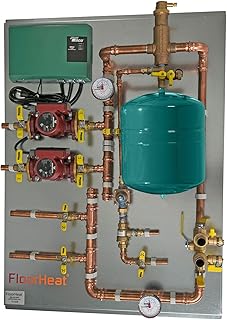
This preassembled hydronic distribution panel is intended for underfloor, home, and space-heating applications. The listing emphasizes convenience, energy-efficient radiant heating, and a space-saving layout. Its two-zone designation makes it a candidate for buyers planning separate heating areas, provided the panel’s actual connections and controls match the project design.
Best for: Buyers who want a professionally designed, preassembled distribution panel and place value on a compact layout. Compared with purchasing separate distribution components, an assembled panel can reduce on-site sourcing and assembly work.
Why it was selected: It directly addresses hydronic radiant-floor distribution and is specifically presented as a two-zone panel for home heating. That makes it more relevant to water-based floor heating than a standalone water heater.
Limitation: The supplied feature information does not list the included pump, valves, connection sizes, or other component specifications. The listing also says a direct phone number is required for delivery. Confirm the exact package contents and delivery requirements before purchase.
Floorheat Essential Series 2-Zone Panel

The Essential Series is a preassembled hydronic distribution panel for radiant-floor heating. The product information says it is pressure-tested before shipment and includes integrated pumps, valves, gauges, and control components. Those features may help reduce the work of sourcing and assembling individual parts on site.
Best for: Buyers who want a prebuilt panel with listed integrated components and a two-zone configuration. It is a better fit than a standalone water heater when the main purchase need is hydronic floor-heating distribution equipment.
Why it was selected: The stated application is radiant floor heating, and the listing identifies several included component types rather than describing only a heat source. Preassembly and pressure testing are also explicit product features.
Limitation: The provided details do not state connection dimensions, pump specifications, or the exact control arrangement. A direct phone number is required for delivery. Verify the panel’s specifications and compatibility with the project’s heat source and tubing before purchase.
Westinghouse 7.9 GPM Gas Tankless Heater

This indoor natural-gas tankless water heater is listed at 180,000 BTU and up to 7.9 gallons per minute. Its features include Wi-Fi app and voice control, remote status monitoring and fault alerts, and temperature control from 95°F to 149°F. The manufacturer describes it as a whole-home hot-water product for multiple fixtures.
Best for: Buyers researching a gas-fired water heater that might be considered as a heat source in a hydronic system. Its listed output and controls may be relevant to a system-design discussion, but they do not establish that it is suitable for a particular radiant-floor installation.
Why it was selected: It is a water heater rather than a radiant control panel, making it relevant only to buyers comparing potential hot-water sources. The listed temperature range and flow rate are useful starting points for checking system requirements.
Limitation: The product is not described as a dedicated radiant-floor boiler or as including hydronic distribution equipment. Do not assume it can be connected directly to floor tubing; ask a qualified professional to verify application, controls, and system requirements.
Rheem 3.5 kW Point-Of-Use Heater

This 120-volt electric tankless water heater is a point-of-use product rated at 3.5 kW, with listed flow up to 0.5 gallons per minute. The manufacturer identifies small, single-fixture uses such as a basement sink, garage workshop, or outdoor kitchen. It also advises buyers to confirm the electrical requirements and choose the correct size.
Best for: Buyers looking for on-demand hot water at one small fixture, not shoppers seeking a complete radiant-floor heating system. Its stated low flow and point-of-use purpose distinguish it from larger home-heating equipment.
Why it was selected: It is one of the supplied water-heating products, but its listed application is narrow. Including it helps distinguish a small fixture heater from equipment intended to distribute heat across a floor.
Limitation: The listing does not describe it as a radiant-floor heat source. Its maximum listed flow is 0.5 GPM, and suitability for a hydronic heating loop should not be assumed. Check electrical requirements and consult a qualified installer for any proposed heating application.
Buying Guide: Choosing Water-Based Radiant Floor Heating Equipment
Water-based radiant floor heating, also called hydronic radiant heating, circulates heated water through tubing installed in or beneath a floor. A working system involves more than a heater: it may require a heat source, distribution equipment, tubing, controls, and a design suited to the building. The products above include three distribution panels and two water heaters, which serve different roles.
Do you need a hydronic panel or a water heater?
A hydronic control or distribution panel manages the movement and control of heated water through zones. A water heater produces hot water. A panel does not necessarily include the heat source or floor tubing, and a water heater does not automatically provide the pumps, valves, controls, and distribution required for radiant floors.
Start by identifying which part of the system is missing. If the project needs zone distribution, compare the three panels. If it needs a heat source, determine the required output and operating conditions with a qualified installer. Do not treat a point-of-use water heater as a radiant panel.
How many heating zones do you need?
Zones allow separate areas to be controlled independently, but the correct number depends on the floor plan and system design. The products here are identified as two-zone panels, while the Warming Systems description also says the panel can control one to four zones. Confirm the exact model configuration and included controls rather than relying on the product title alone.
More zones can add control flexibility, but they also affect equipment selection and installation planning. Ask whether the panel supports the intended room layout and whether the required thermostats and zone components are included.
Which panel features should you compare?
- Included components: Check whether the listing names a pump, expansion tank, air separator, valves, gauges, and controls. The supplied descriptions vary in how much detail they provide.
- Connections: Compare connection sizes with the planned boiler or heat source, manifold, and piping. The Warming Systems listing gives specific copper connection sizes; the other provided descriptions do not.
- Preassembly and testing: The Floorheat Essential Series listing states that its panel is preassembled and pressure-tested. The other panel descriptions also emphasize preassembly, but details differ.
- System fluid: The Warming Systems listing says the panel is compatible with glycol systems. Confirm fluid requirements for any other equipment directly with its manufacturer or installer.
- Delivery and support: Both Floorheat listings say a direct phone number is required for delivery. The Warming Systems listing describes manufacturer engineering support.
Can a tankless water heater heat a radiant floor?
Do not assume that a tankless water heater is suitable for a radiant-floor loop because it can produce hot water. The supplied Westinghouse listing describes a whole-home gas water heater, while the Rheem listing describes a low-flow point-of-use heater for one fixture. Neither supplied description identifies the product as a complete radiant-floor system.
Before choosing a water heater for hydronic heating, ask a qualified professional to confirm that its capacity, temperature range, controls, and installation requirements match the project. The system may need additional equipment, and the exact requirements depend on the design.
What should you verify before buying?
- Confirm the heating area, number of zones, and intended use, such as floor heating or snow melt.
- Ask which components are included and which must be purchased separately.
- Match panel connection dimensions to the planned piping and heat source.
- Check the manufacturer’s requirements for delivery, installation, and system fluid.
- Have a qualified installer review the design before connecting a water heater to a hydronic loop.
These checks help prevent a common purchasing mistake: buying a heater when the project needs a distribution panel, or buying a panel without confirming that it matches the heat source and system layout.
Frequently Asked Questions
What is a water-based radiant floor heater?
It is a hydronic heating system that circulates heated water through tubing in or beneath the floor. A complete installation typically requires a heat source and equipment to distribute and control the water.
Is a hydronic control panel the same as a boiler?
No. A hydronic control panel distributes or controls water in a heating system. A boiler or other heat source heats the water. Check the panel listing to see which components are included.
Which listed product is most clearly intended for radiant floors?
The three hydronic panels are explicitly described for radiant heating or radiant-floor applications. The Westinghouse and Rheem products are described as water heaters, not complete radiant-floor systems.
Can I use the Rheem point-of-use heater for a radiant floor?
The supplied listing identifies it for small, one-fixture applications and does not describe it as a radiant-floor heat source. Its suitability for a hydronic loop is not established by the provided product information.
What should I check when choosing a two-zone panel?
Confirm the actual number of supported zones, included pumps and controls, connection sizes, system-fluid requirements, and compatibility with the planned heat source and tubing. Ask the manufacturer or installer about details not stated in the listing.
Does a preassembled panel include everything for installation?
Not necessarily. Preassembly can reduce component sourcing and on-site assembly, but the listed products do not all specify every part needed for a complete installation. Verify the package contents and identify any separate equipment required.