No listed thermostat is confirmed as a 40-amp model. The Dr. Infrared Heater DR-001 is rated for up to 28 amps, while the Cadet is rated for up to 22 amps at 240 volts and the YeloDeer for up to 20 amps. The Robertshaw and Honeywell listings do not provide an amp rating in the supplied details. These products may suit lower-rated electric-heating circuits, but do not treat them as 40-amp replacements. Verify the thermostat’s marked rating and your heater requirements before choosing.
| Product | Best suited for | Listed capacity information |
|---|---|---|
| Dr. Infrared Heater DR-001 | Higher-capacity listed option with manual temperature scales | Up to 28A; not 40A |
| Robertshaw 802 | Replacement shoppers considering baseboard or radiant heat | Amp rating not supplied |
| Honeywell T410A1013 | Two-wire thermostat replacement needs | Amp rating not supplied |
| YeloDeer 4-Wire Manual | Electronic control at up to 20A | Up to 20A; not 40A |
| Cadet Double Pole | Baseboard, wall, or convector heaters within its listed limits | Up to 22A at 240V; not 40A |
Dr. Infrared Heater DR-001 Wall Thermostat
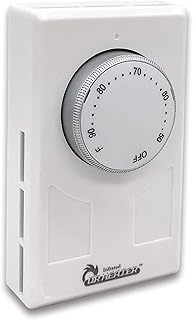
Best for: Buyers who need a higher-capacity option among the products listed and want a flush-mounted wall thermostat. Its stated maximum is 28 amps, so it is not a 40-amp thermostat.
The DR-001 supports single- or double-pole wiring and lists operating capacities of 3,360 watts at 120 volts, 5,824 watts at 208 volts, 6,720 watts at 240 volts, and 7,756 watts at 277 volts. The supplied specifications identify the thermostat as a 28-amp model. It includes Celsius and Fahrenheit control dials, with temperature scales of 5–32°C and 41–90°F, respectively.
The wall-mount design sits flush against the wall. It may be a better fit than lower-amperage options when a compatible heating load falls within its stated rating. Choose it only if its voltage, wiring configuration, and amp rating match the heater and circuit.
Limitation: Its 28-amp maximum is below the 40 amps requested. Do not use it for a 40-amp load.
Robertshaw 802 DPST Thermostat

Best for: Shoppers comparing replacement thermostats for electric baseboard or radiant heating systems. The listing highlights broad replacement potential, bimetal sensing, and J-box compatibility.
This DPST line-voltage thermostat uses bimetal temperature sensing, with stated control accuracy of plus or minus 2°F. The product details say it can replace many available electric heat models and is suitable for baseboard or radiant electric heating systems. J-box compatibility is also listed as an installation feature.
It may be worth considering when those system types and installation details match the replacement job. However, the supplied information does not state the thermostat’s amperage, supported voltage, or wattage. Those are essential checks for a buyer searching for a 40-amp thermostat.
Limitation: Do not assume it is rated for 40 amps—or for a particular circuit—without confirming the rating on the product documentation or device label.
Honeywell T410A1013 Baseboard Thermostat

Best for: Buyers replacing a compatible two-wire, wall-mounted line-voltage thermostat. The listed T410A application makes it relevant to a specific replacement need rather than a confirmed high-amperage installation.
The product details say the T410A1013 can replace virtually any two-wire T410A line-voltage wall thermostat. It has six-inch color-coded leads to support installation, and the listing identifies a long-lasting Micro Switch mechanism. These details may help a buyer compare it with an existing two-wire thermostat.
Check the original thermostat’s model, wiring arrangement, and electrical ratings before selecting a replacement. The supplied product information does not state an amp or watt rating, so it cannot establish that this thermostat is suitable for a 40-amp load.
Limitation: The listing describes a two-wire replacement application, but does not provide the amp rating needed to assess a 40-amp installation.
YeloDeer 4-Wire Manual Thermostat
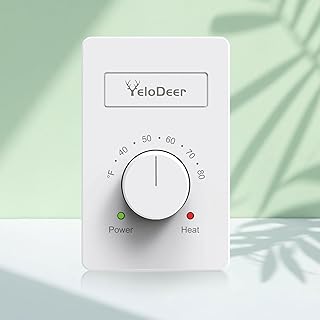
Best for: Buyers seeking electronic temperature control for a 120- or 240-volt heating system within a 20-amp maximum. It is not a 40-amp choice.
The YeloDeer listing gives a voltage range of 110–265 volts and a maximum current of 20 amps. Its stated capacities are 2,400 watts at 120 volts and 4,800 watts at 240 volts. The temperature control range is 40–80°F, or 4.4–26.7°C. The listing also specifies a maximum terminal wire size of 12 AWG and describes its electronic control as more accurate than traditional mechanical baseboard thermostats.
Choose it only when the heater’s voltage and load are within those stated limits and the wiring requirements match. Its electronic control and defined temperature range distinguish it from thermostats with a dial-based mechanical design.
Limitation: The 20-amp maximum is half of a 40-amp requirement, so this is not a substitute for a properly rated 40-amp thermostat.
Cadet Double Pole Line Voltage Thermostat

Best for: Buyers seeking a double-pole thermostat for compatible baseboard, fan-forced wall, or convector heaters operating within the listed voltage and capacity limits.
The Cadet is listed for 120-, 208-, and 240-volt electric heaters. Its double-pole, four-wire design switches both legs of the circuit. The product details specify a maximum of 5,280 watts at 240 volts or 2,640 watts at 120 volts. It has a twist dial covering 40–80°F, a positive off position, and a stated comfort range of 3–6 degrees.
Color-coded wires are described as an installation aid, and the listing says the thermostat is designed to replace many wall-mounted line-voltage thermostats. Compare its voltage, pole configuration, and load limit with the existing setup before buying.
Limitation: The listed wattage corresponds to 22 amps at 240 volts and 22 amps at 120 volts? Check the manufacturer’s marked rating rather than inferring amperage from wattage; in any case, the stated capacities do not establish a 40-amp rating.
Buying Guide: Choosing A Line Voltage Thermostat
Is any listed product rated for 40 amps?
No product in this selection is confirmed as 40 amps. The DR-001 is specified at 28 amps, and the YeloDeer is specified at 20 amps. Cadet lists wattage limits that are below a typical 40-amp load at its stated voltages. The supplied details for the Robertshaw and Honeywell do not include amp ratings. If the installation requires 40 amps, look for a thermostat whose manufacturer documentation explicitly lists a compatible rating.
How should I compare amperage, voltage, and wattage?
All three ratings matter. Amperage is the current limit; voltage must match the heater circuit; and wattage indicates the load a product lists at a given voltage. Do not compare wattage figures without considering the voltage stated alongside them. Use the thermostat’s marked specifications and the heater’s electrical information rather than relying on a product title or a general description.
Should I choose single-pole or double-pole?
The products have different wiring configurations. The DR-001 supports single- or double-pole wiring, while the Cadet is described as double-pole and four-wire. The Robertshaw is identified as DPST. Match the replacement thermostat’s configuration to the existing system and manufacturer instructions. A model’s pole count does not, by itself, prove that its current rating is sufficient.
Which temperature controls matter?
Compare the control method and temperature range with how the room will be used. The DR-001 offers Celsius and Fahrenheit dials. The YeloDeer lists a 40–80°F range and electronic control. The Cadet uses a twist dial across 40–80°F and includes a positive off position. The Robertshaw lists plus-or-minus 2°F control accuracy. These features are useful for comparison, but do not replace checking electrical ratings.
What should I verify before installation?
- Read the heater’s voltage, current, and wattage requirements.
- Confirm the thermostat’s marked voltage and amperage ratings.
- Check the required pole count, wire configuration, and installation location.
- Review the manufacturer’s installation instructions and applicable electrical requirements.
- Ask a qualified electrician if the existing wiring, circuit capacity, or product rating is unclear.
Line-voltage thermostats connect to circuits that power electric heating equipment. Do not select a thermostat solely because it physically fits the wall box or has similar-looking wires. If a product listing omits the rating needed for the installation, obtain confirmation from the manufacturer before purchase.
Frequently Asked Questions
Can I use a 28-amp thermostat on a 40-amp circuit?
The DR-001 is specified at 28 amps, not 40 amps. Do not treat it as suitable for a 40-amp load. The thermostat must be rated for the actual application, and the device and circuit requirements should be verified before installation.
Which listed thermostat has the highest stated amp rating?
The Dr. Infrared Heater DR-001 has the highest explicitly stated amp rating in the supplied product details: 28 amps. That is still below 40 amps. The Robertshaw and Honeywell amp ratings are not included in the supplied information.
Does double-pole mean a thermostat is rated for 40 amps?
No. Double-pole describes the switching configuration, not the current capacity. Check the manufacturer’s amp and watt ratings separately, along with the voltage and wiring requirements.
Can I choose a thermostat based only on its wattage?
No. Check the voltage associated with the wattage figure and confirm the product’s current rating and wiring configuration. A wattage number without matching voltage and installation details is not enough to establish suitability.
What should I do if the product listing does not show an amp rating?
Do not assume the thermostat meets a 40-amp requirement. Consult the device label or manufacturer documentation, or ask the manufacturer or a qualified electrician to confirm the rating before purchasing or installing it.