The best heating tape for plastic pipes depends on the pipe length, cable output, and the product’s instructions for plastic-pipe installation. The Frost King 3-foot and 6-foot kits suit short runs; HEATIT is a lower-output, self-regulating option; and the two longer cables are better suited to longer pipe sections. Before buying, confirm the cable is approved for your pipe material and follow its installation directions.
| Product | Best For | Listed Output |
|---|---|---|
| Frost King HC3A | Short pipe sections | 7 W/ft |
| 50FT Pipe Heating Cable | Longer runs and weather exposure | 5 W/ft |
| Frost King HC6A | Short-to-medium pipe sections | 7 W/ft |
| 3FT–200FT Heat Tape | Longer runs needing a thermostat | 8 W/ft |
| HEATIT 50ft Cable | Lower-output, self-regulating protection | 3 W/ft |
Frost King HC3A 3-Foot Heating Cable

The Frost King HC3A is a compact choice for a short water-pipe section that needs freeze protection. Its listed specifications are 3 feet long, 120 volts, and 7 watts per foot. The product information says it is for metal and plastic water pipes and can keep water flowing down to -40°F.
Best for: Buyers who need a short cable and want a product specifically listed for plastic water pipes. It is the shortest option in this group, so it may be easier to match to a small area than a 50-foot cable.
Limitation: Its 3-foot length is not suitable for covering a long pipe run. Confirm the required coverage and installation method in the manufacturer’s instructions before purchase.
50-Foot Pipe Heating Cable With Shield
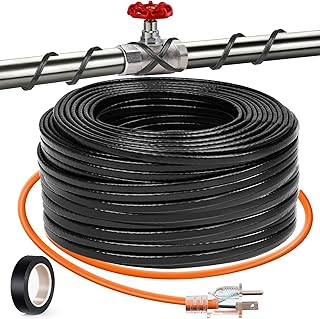
This 50-foot cable is listed for water-filled metal and plastic pipes, including copper, PVC, and PEX. The product information specifies a 5-watt-per-foot output and freeze protection down to -40°F. It also describes an aluminum-alloy shield, a TPE outer jacket, a grounded plug with an indicator light, and an IP67 rating.
Best for: Buyers with a longer pipe run who want a cable with listed protection features for exposed or buried pipe environments. Its listed length and material compatibility make it a broader-coverage option than the short Frost King kits.
Limitation: The listing warns against using it on fuel lines or gutters and says it must be used on water-filled pipes. Verify that the cable’s instructions fit the installation location and pipe material.
Frost King HC6A 6-Foot Heating Cable

The HC6A provides twice the cable length of the HC3A while retaining the same listed output: 120 volts and 7 watts per foot. Frost King states that it is intended for metal and plastic water pipes and can keep water flowing down to -40°F.
Best for: Buyers who need a short-to-medium cable for a plastic or metal water pipe and want more reach than a 3-foot kit. It may be a better fit when the protected section is longer but does not call for a 50-foot cable.
Limitation: Six feet may still be insufficient for extensive pipework. Measure the section that needs protection and check the product’s instructions for placement on plastic pipes.
8-Watt Heat Tape With Thermostat

This 50-foot option is listed at 120 volts and 8 watts per foot. Its product information describes an automatic thermostat, a 5-foot plug wire with an indicator light, an IP67 rating, and metal retainers. The listing says the thermostat can withstand temperatures down to -45°F and switch on and off automatically.
Best for: Buyers looking for a longer cable with a thermostat and included metal retainers. It is a potential choice for longer water-pipe runs where the listed 50-foot length is appropriate.
Limitation: The product description also mentions uses beyond water pipes, but buyers should follow the specific instructions for pipe materials and placement. Do not assume that every listed application or mounting method is suitable for plastic pipe.
HEATIT 50-Foot Self-Regulating Cable

HEATIT’s 50-foot cable is listed as a 120-volt, self-regulating product with an output of 3 watts per foot. The listing says it is intended for metal and plastic water pipes, including copper, PVC, and stainless steel, and provides freeze protection down to -40°F. It also states that the cable is ETL certified and the plug is UL certified.
Best for: Buyers who want a lower listed wattage per foot and a self-regulating cable for a longer pipe run. Its listed plastic-pipe compatibility is relevant for people comparing options for PVC or other plastic water lines.
Limitation: The package includes a 2-foot power cord, so check that the outlet location works with the planned installation. Follow the full cable instructions, including any requirements for insulation or spacing.
Buying Guide: How To Choose Heating Tape For Plastic Pipes
How much cable length do you need?
Measure the pipe section that requires freeze protection before choosing a cable. The products here range from 3 feet to 50 feet, and the listings describe some models as available in multiple lengths. Do not choose a cable only by the total length printed in its name; account for the route, fittings, and the manufacturer’s specified installation pattern.
A 3-foot or 6-foot kit is more appropriate for a short, defined section. A longer cable may suit an extended run, but extra length is not automatically better. Use only the amount and layout permitted by the product instructions, and do not cut or alter a cable unless the manufacturer explicitly allows it.
Is the cable specifically suitable for plastic pipe?
Plastic pipe can require particular installation practices because heating cable output and attachment methods vary. Choose a product whose listing or instructions name plastic pipe or the relevant material, such as PVC or PEX. Then check whether the manufacturer specifies a particular cable arrangement, tape, insulation, or spacing for that pipe.
Do not assume that a cable intended for metal pipe can be installed on plastic pipe in the same way. If the instructions do not clearly cover the pipe material, contact the manufacturer or select a different product with clear material guidance.
How should you compare watts per foot?
Output is one useful comparison, but it is not a complete measure of suitability. The listed products range from 3 to 8 watts per foot. A higher number does not automatically mean better freeze protection for every pipe or installation. Consider the product’s stated temperature range, pipe-material compatibility, control features, and required installation method together.
For plastic pipe in particular, follow the manufacturer’s output and installation guidance rather than combining cables or choosing a higher-output model without checking. If the pipe is insulated or exposed to severe weather, use the product instructions to determine whether the setup is appropriate.
Do you need a thermostat or self-regulating cable?
The 8-watt cable in this list describes an automatic thermostat, while HEATIT identifies its 3-watt cable as self-regulating. These terms describe different product features; they do not remove the need to install the cable correctly. Check the instructions for how the control works, when it operates, and whether the cable must be attached to a particular part of the pipe.
The Frost King products are named automatic electric heat kits, but the supplied feature details do not explain their control operation. Consult their product instructions for exact behavior rather than assuming all automatic or self-regulating systems work identically.
What safety details should you check?
Review the complete product documentation before installation. Confirm the cable is intended for water pipes, that the pipe material is named, and that the plug, cable, and any controls are suitable for the location. Some product listings provide certification or protective-jacket details; verify the exact claims and installation requirements in the manufacturer’s documentation.
Keep the cable away from applications excluded by its instructions. One listed product specifically warns against use on fuel lines and gutters and says the pipe must contain water. Do not overlap, cross, or modify a heating cable unless its manufacturer expressly permits that arrangement.
Should you insulate the pipe after installing heat tape?
Insulation can be part of a freeze-protection setup, but it must be compatible with the heating cable and installed as directed. Check the cable instructions to see whether insulation is recommended, what materials are allowed, and whether the cable needs to remain visible or accessible. Do not cover a cable in a way that conflicts with its instructions.
Also consider the pipe’s location, exposure to drafts, and access to an electrical outlet. A cable cannot compensate for an installation that does not follow its stated requirements. If the pipe is difficult to access or the setup is unclear, consult a qualified plumber or electrician.
Frequently Asked Questions
Can heating tape be used on plastic water pipes?
Some products are specifically listed for plastic water pipes. Confirm that the exact cable supports the pipe material and follow its instructions for attachment, spacing, and insulation.
Which listed cable is shortest?
The Frost King HC3A is listed as 3 feet long. The Frost King HC6A is 6 feet long, while the other featured options are listed as 50 feet.
Which option has the lowest listed wattage per foot?
The HEATIT cable has the lowest listed output in this comparison at 3 watts per foot. Output alone does not determine which cable is suitable; check the pipe material and installation instructions.
Can pipe heating cable be used on fuel lines?
Do not use a cable on fuel lines unless its manufacturer explicitly approves that application. The 50-foot shielded cable listing specifically warns against use on fuel lines.
Does a longer cable provide better freeze protection?
Not necessarily. Cable length should match the pipe section and the manufacturer’s permitted installation layout. Choose enough cable for the intended run without using extra length in an unapproved arrangement.