If you are searching for a 250,000 BTU tankless water heater, the closest options in this selection provide 160,000 to 199,000 BTU. The Rinnai RX199iN is the highest-output choice listed, while the Westinghouse 180,000 BTU model offers app and voice controls. The Rheem models provide 160,000 BTU in different fuel and installation configurations. Compare actual hot-water demand, fuel supply, and installation requirements before choosing: none of these listed products is rated at 250,000 BTU.
| Product | Maximum listed input | Fuel and installation | Best suited for |
|---|---|---|---|
| Rinnai RX199iN | 199,000 BTU | Natural gas or propane; indoor or outdoor | Buyers seeking the highest listed output and flexible placement |
| Westinghouse 26L | 180,000 BTU | Propane; installation details need confirmation | Buyers who prioritize app and voice control |
| Rheem RTG, propane | 160,000 BTU | Liquid propane; outdoor | Homes needing a straightforward outdoor propane configuration |
| Rheem RTG, natural gas indoor | 160,000 BTU | Natural gas; indoor | Homes with natural gas and an indoor venting plan |
| Rheem RTG, natural gas outdoor | 160,000 BTU | Natural gas; outdoor | Homes with natural gas that prefer outdoor installation |
Rinnai RX199iN Condensing Tankless Water Heater

Best for: Buyers who want the highest listed BTU input in this comparison, a choice of natural gas or propane, and indoor-or-outdoor installation flexibility. The RX199iN is rated at up to 199,000 BTU and 11.1 gallons per minute (GPM), making it the closest listed option to a 250,000 BTU target.
Rinnai describes this compact condensing model as supporting up to seven fixtures at once. Its listed features include a UEF of .98, an easy-to-use interface, and a Quick Flush feature. The Smart Sense gas control system supports natural gas or propane, but fuel conversion and installation must follow the manufacturer’s requirements.
Limitation: Its 199,000 BTU input is still below 250,000 BTU. Outdoor installation requires the RX-OVC vent cap, and Wi-Fi control requires a separate Controlr module. Confirm that its rated capacity meets your household’s peak demand rather than relying on fixture-count claims alone.
Westinghouse 180,000 BTU Propane Tankless Heater

Best for: Buyers who want propane operation and built-in app and voice controls. The listing specifies up to 180,000 BTU and 7.9 GPM, and describes the unit as suitable for three to five fixtures. It also lists temperature stability of plus or minus 1°F through self-modulating adjustment of gas and water flow.
Choose this model if remote temperature adjustment, operating-status monitoring, and fault alerts are priorities. The product information says Wi-Fi and voice-control features are included without extra accessories. Its 26L designation is also included in the listing, but household suitability should be based on the unit’s specifications and local conditions.
Limitation: At 180,000 BTU, it does not meet a 250,000 BTU target. There is also a discrepancy in the supplied product information: the name says “indoor,” while the feature description says the unit is designed for outdoor installation. Confirm the required installation location and venting details with the seller and a qualified installer before purchase.
Rheem RTG 160,000 BTU Liquid Propane Outdoor Model

Best for: Homes that use liquid propane and can install the water heater outdoors. This non-condensing Rheem model is listed at 160,000 BTU and up to 7.0 GPM at a 35°F temperature rise. Its stated output makes it a lower-capacity alternative to the Rinnai and Westinghouse models in this comparison.
The listing describes it as a whole-house residential unit for multiple bathrooms and says it can supply two to three simultaneous showers under the stated flow conditions. Outdoor installation avoids the need for indoor venting, and the product has a metal cabinet and wall-mount design. Its stated UEF is 0.82.
Limitation: The 160,000 BTU input is substantially below 250,000 BTU, and the stated 7.0 GPM depends on a 35°F temperature rise. Actual flow changes with incoming-water temperature and the desired hot-water temperature. This version is for liquid propane and outdoor installation, so it is not the right choice for a natural-gas or indoor-only setup.
Rheem RTG 160,000 BTU Natural Gas Indoor Model

Best for: Buyers with natural gas service who need an indoor tankless water heater and can provide the required direct-vent system. The unit is rated at 160,000 BTU and up to 7.0 GPM at a 35°F temperature rise. It is a practical configuration to compare when outdoor installation is unsuitable but natural gas is available.
Rheem lists this non-condensing model for residential whole-house use and says it can support two to three simultaneous showers under the stated flow conditions. The wall-mounted format can free floor space. Its listed UEF is 0.82, and the manufacturer’s product information describes on-demand heating.
Limitation: This model is not close to 250,000 BTU in rated input. Indoor installation requires appropriate venting, and the advertised flow rate depends on temperature rise. Confirm venting, gas capacity, and local code requirements with a qualified professional before selecting it.
Rheem RTG 160,000 BTU Natural Gas Outdoor Model
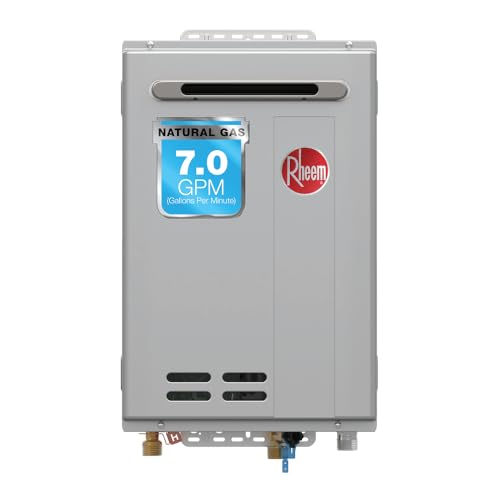
Best for: Homes with natural gas that prefer an outdoor installation. This Rheem version shares the 160,000 BTU rating and stated maximum of 7.0 GPM at a 35°F temperature rise with the indoor version, but its outdoor configuration is intended to avoid indoor venting.
The listing identifies it as a non-condensing, whole-house residential heater for homes with multiple bathrooms. It states that the unit can serve two to three simultaneous showers under the specified temperature-rise conditions. The product also has a metal cabinet and a wall-mount design. Its listed UEF is 0.82.
Limitation: This is a 160,000 BTU model, not a 250,000 BTU heater. It uses natural gas and is designed for outdoor installation, so buyers should not assume it can be installed indoors. Check the manual and local requirements for placement, clearances, gas supply, and protection from site conditions.
Buying Guide: How to Choose a High-BTU Tankless Water Heater
Do you need exactly 250,000 BTU?
None of the five products above is rated at 250,000 BTU. Their listed inputs range from 160,000 to 199,000 BTU. If a contractor or project specification calls for exactly 250,000 BTU, look for a model whose manufacturer documentation explicitly states that input rating. Do not treat GPM, a product name, or a general “whole-house” description as a substitute for BTU input.
A higher BTU rating can help a heater raise water temperature at a given flow, but it does not guarantee a particular number of simultaneous showers. Incoming-water temperature, target temperature, flow rate, and the household’s overlapping hot-water use all affect performance.
How much hot water does your household need at once?
List the fixtures and appliances that may run together during peak use. For example, consider showers, sinks, laundry, and a dishwasher. Add their expected flow rates, then determine the temperature rise needed from the incoming water to your preferred delivery temperature. Use the manufacturer’s performance chart at that temperature rise to compare usable GPM.
The RX199iN has the highest listed flow rate here, at up to 11.1 GPM, while the 180,000 BTU Westinghouse is listed at up to 7.9 GPM. Rheem’s 160,000 BTU models state up to 7.0 GPM at a 35°F rise. These figures are not directly interchangeable unless the temperature-rise conditions match.
Which fuel does the home use?
Confirm whether the property has natural gas or liquid propane and whether the selected heater is designed for that fuel. The Rinnai RX199iN is described as supporting either fuel through Smart Sense. The Westinghouse model and the Rheem outdoor model at 160,000 BTU are listed for propane; the two other Rheem versions are listed for natural gas.
Ask an installer to verify that the gas line, meter or propane supply, and other equipment can provide the required input. A heater cannot deliver its rated performance if the fuel supply or installation is inadequate.
Should the unit be installed indoors or outdoors?
Choose a model that matches the home’s available installation location and the manufacturer’s requirements. Indoor models need a suitable venting plan. Outdoor models avoid indoor venting but still require placement that follows clearance and environmental guidance. The RX199iN is described as supporting either location, with an RX-OVC vent cap required for outdoor installation.
Check the Westinghouse listing carefully because the supplied name and description conflict about indoor versus outdoor installation. Resolve that discrepancy before ordering or planning work.
Does condensing or non-condensing matter?
The Rinnai RX199iN is a condensing model with a listed UEF of .98. The Rheem RTG products are described as non-condensing, with a listed UEF of 0.82. These efficiency figures can help compare models, but they do not by themselves determine operating costs. Fuel type, usage, installation, and local energy rates also affect the household’s costs.
Condensing and non-condensing systems can have different venting and drainage requirements. Ask a qualified installer what the complete installation needs, including any required materials and maintenance access.
What should you check before buying?
- Confirm the exact BTU input and performance chart for the model and fuel you plan to use.
- Size the heater around peak simultaneous hot-water use and incoming-water temperature.
- Verify gas-line capacity, venting or outdoor placement, clearances, and local code requirements.
- Check whether accessories are required. For example, the RX199iN needs a separate Controlr module for Wi-Fi control.
- Review maintenance needs and the manufacturer’s instructions for flushing and scale management.
- Have a qualified professional confirm the model is appropriate for the home before installation.
Frequently Asked Questions
Is there a 250,000 BTU water heater in this comparison?
No. The highest listed input is 199,000 BTU for the Rinnai RX199iN. The other selected models are rated at 180,000 or 160,000 BTU.
Which listed model has the highest BTU rating?
The Rinnai RX199iN has the highest listed input at 199,000 BTU. It is the closest option here to a 250,000 BTU target, but it does not reach that rating.
Does a higher BTU rating always mean more hot water?
No. Actual hot-water flow depends on BTU input, incoming-water temperature, required temperature rise, and the heater’s performance at that rise. Compare manufacturer flow charts rather than BTU ratings alone.
Which option supports natural gas or propane?
The Rinnai RX199iN is described as supporting natural gas or propane through its Smart Sense gas control system. Confirm fuel setup and installation requirements with the manufacturer and installer.
Can I install a tankless water heater myself?
Installation requirements depend on the model, fuel, venting, electrical needs, and local codes. A qualified professional can confirm the required setup and whether the home’s gas supply and installation location are suitable.
Is 7.0 GPM enough for a whole house?
It may be enough for some homes, but the answer depends on simultaneous fixture use and temperature rise. The Rheem models’ 7.0 GPM figure is specified at a 35°F temperature rise, so compare that condition with your home’s incoming-water temperature and demand.