The best angled thermostatic radiator valve depends on your pipe size, connection type, and whether you need a complete valve or only a valve body. The CRIDENG DN15 is a candidate for smaller connections, while its DN20 version is intended for a larger size. UPPALFit offers five temperature settings and horizontal or vertical mounting. Sumsoctober is a brass valve body sold without a thermostatic head. Check the exact thread and installation layout before choosing any model.
| Product | Best suited for | Standout detail |
|---|---|---|
| CRIDENG DN20 | Buyers matching a DN20 connection | Liquid sensor and manual control |
| UPPALFit 15mm x 3/4-inch | Installations needing flexible orientation | Five settings; horizontal or vertical mounting |
| CRIDENG DN15 | Buyers matching a DN15 connection | Automatic flow adjustment |
| Sumsoctober DN15 body | Buyers sourcing a separate valve body | Brass construction; no head included |
| Vacumist DN15 angle | Buyers seeking a compact angle-type option | Liquid sensor and automatic adjustment |
CRIDENG DN20 Angle Thermostatic Valve

This CRIDENG model is best for buyers whose heating setup calls for a DN20 valve and whose existing pipework matches the listed G1/2-inch or G3/4-inch connection details. The product name identifies it as a copper angle valve for radiator or floor-heating use, with manual control and frost protection listed.
Its liquid thermostatic sensor is designed to detect temperature and adjust the flow rate automatically. That makes it a suitable choice when the goal is to regulate heat output without continually adjusting the water flow by hand. The listing also describes the valve as energy efficient, but does not provide quantified savings.
- Best for: Buyers prioritizing automatic temperature response and a DN20-sized option.
- Why it stands out: It combines a liquid sensor with manual control and an angle configuration.
- Check before buying: Confirm the actual thread and pipe connection needed. The listing names more than one size, so do not assume both apply to every installation.
Choose this if your measured connection matches the valve specifications. Avoid selecting it based on DN20 alone if the radiator’s thread or pipe arrangement has not been checked.
UPPALFit 15mm Angle Valve

The UPPALFit valve is best for buyers whose system matches the listed 15mm x 3/4-inch connection and who want a choice of five temperature settings. Its product information describes a three-way angle thermostatic radiator valve for home heating. It also says the valve can be mounted horizontally or vertically, which may help when the available space or pipe orientation affects installation.
The five settings give users defined adjustment positions rather than an unmarked control. The listing says the valve is intended to maintain room temperature and avoid unnecessary heating, but it does not state exact temperatures for each setting. Treat the settings as adjustment levels, not as a guaranteed temperature scale.
- Best for: Buyers who want five selectable settings and flexible mounting orientation.
- Why it stands out: Its installation options are explicitly described as horizontal or vertical.
- Check before buying: Verify that 15mm x 3/4-inch matches both sides of the existing connection.
Choose this model when the stated size and orientation options fit the installation. The listing does not provide detailed temperature values for its five settings, so it may not suit buyers who need a specific temperature range documented in advance.
CRIDENG DN15 Angle Thermostatic Valve

This CRIDENG version is best for buyers looking for a DN15 option rather than the brand’s DN20 model. It is described as a copper angle valve for radiator or floor-heating applications, with G1/2-inch and G3/4-inch sizes listed. The product name also mentions manual control and frost protection.
A liquid thermostatic sensor responds to temperature and adjusts flow through the valve. This automatic regulation is the main reason to consider it over a basic manual valve: the stated design aims to maintain a comfortable temperature range by changing the flow rate. The listing also describes energy-efficient operation, without specifying a measured reduction in energy use.
- Best for: Buyers whose installation requires the DN15 version and whose connection details match.
- Why it stands out: It offers the same listed sensor and control features as the DN20 model in a different nominal size.
- Check before buying: Confirm the precise thread and whether the valve is supplied in the configuration your system needs.
Choose the DN15 model over DN20 only when the measured connection calls for it. Nominal size labels and thread sizes are not interchangeable; verify both before ordering.
Sumsoctober Brass Angle Valve Body

The Sumsoctober model is best for buyers who need a valve body and plan to source the thermostatic head separately. The product title explicitly says “without head,” so it is not the most straightforward choice for someone expecting a complete, ready-to-adjust valve. It is described as a DN15 brass angle body with an M30 x 1.5 thread; the title also includes DN20 wording, so confirm the exact variant before purchase.
The listing says the self-regulating body adjusts water flow based on ambient air temperature. Its brass construction is identified as a material feature, and its angle design is described as allowing vertical or angled mounting, with a maximum tilt of 85 degrees. These specifications may be useful in tight or nonstandard radiator layouts, subject to the actual installation.
- Best for: Buyers replacing or assembling a system around a compatible separate head.
- Why it stands out: It specifies a brass body and an adjustable angle configuration.
- Limitation: The thermostatic head is not included according to the product title.
Choose this only if you have confirmed head compatibility and the required DN size. Avoid it if you need a complete valve with a control head in the same package.
Vacumist DN15 Angle Thermostatic Valve
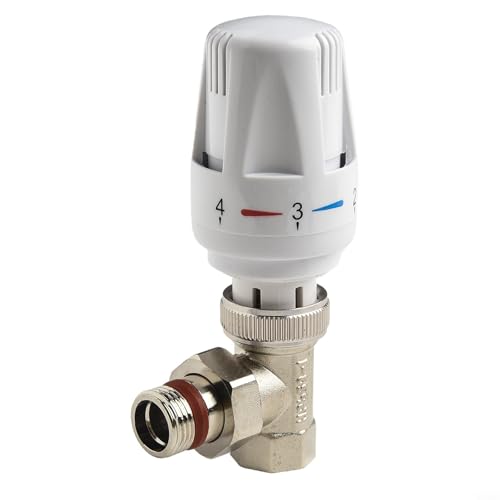
The Vacumist valve is best for buyers considering an automatic thermostatic option in a DN15 angle configuration. Its product title identifies the selected version as DN15 and angle type, while the broader name also mentions DN15 1/2-inch or DN20 3/4-inch thread sizes. Confirm which size applies to the specific version being ordered.
The listed features include copper construction, a liquid thermostatic sensor, and automatic flow adjustment intended to maintain a comfortable temperature range. The listing also describes the valve as designed to optimize heat output. These are stated product functions, not a guarantee of a particular room temperature or energy saving.
- Best for: Buyers who need a DN15 angle valve with automatic temperature sensing.
- Why it stands out: The description names a liquid sensor and automatic regulation.
- Check before buying: Confirm whether the chosen option is DN15 or DN20 and whether its threads match the radiator and pipework.
Choose this model when the selected angle configuration and connection size are clearly compatible. The listing’s multiple size references make checking the exact variant particularly important.
Buying Guide: How to Choose an Angled Thermostatic Radiator Valve
An angled thermostatic radiator valve changes water flow to help regulate heat output while connecting pipework and a radiator at an angle. It is important to match the valve to the existing system rather than choosing by appearance alone. The product listings vary in nominal size, connection descriptions, control features, and whether a head is included.
Which valve size and thread should I check?
Start by identifying the pipe and radiator connections on the existing installation. Product descriptions may use nominal sizes such as DN15 or DN20 alongside thread dimensions such as G1/2-inch, G3/4-inch, or 15mm x 3/4-inch. These labels describe different aspects of a connection and should not be treated as interchangeable without confirmation.
- Record the pipe diameter and the radiator connection details.
- Check both ends of the valve, not only the nominal DN size.
- Confirm the exact variant in the listing when multiple sizes are mentioned.
- Ask a qualified heating professional if the existing connection is unclear.
Do I need a complete valve or only a valve body?
A complete thermostatic valve normally includes the control component used to set or regulate temperature. A valve body sold without a head requires a compatible head to provide the intended control. The Sumsoctober listing explicitly says it is without a head, so buyers should account for that before choosing it. For other products, check the included parts rather than assuming that a head, adapters, or fittings are supplied.
What is the difference between automatic sensing and manual settings?
A liquid thermostatic sensor is described as responding to temperature and changing water flow automatically. This can reduce the need for repeated manual flow adjustments. A model with numbered or selectable settings provides defined control positions, but those numbers do not necessarily correspond to published temperatures. UPPALFit lists five settings, while the CRIDENG and Vacumist listings emphasize liquid sensing and automatic adjustment.
When does an angle configuration matter?
An angle valve is intended for a connection where the pipe and radiator inlet meet at an angle. It may be a better fit than a straight valve when the pipework approaches from the floor or wall in a way that calls for a turn, but the correct layout depends on the actual installation. Measure the available clearance and check the orientation before buying. UPPALFit’s listing specifically describes horizontal or vertical mounting; the other models should be checked against their product instructions and the installer’s requirements.
What should I compare for heating efficiency?
Compare the control method and the stated features rather than relying on broad energy-saving language. Automatic temperature response can adjust flow as conditions change, while selectable settings allow the user to choose a control level. The listings do not provide standardized energy-use results, so they do not establish how much one valve will save compared with another. Correct sizing and installation are essential to getting the intended control behavior.
Can I install an angled thermostatic valve myself?
Installation may involve draining or isolating a heating circuit, matching threaded connections, and preventing leaks. The product descriptions do not provide enough information to determine whether a particular home installation is suitable for do-it-yourself work. Follow the manufacturer’s installation instructions and consult a qualified heating professional if you are unsure about system isolation, connections, or compatibility.
Frequently Asked Questions
What does DN15 mean on a radiator valve?
DN15 is a nominal size designation used for the valve connection. It does not by itself confirm the thread or every fitting dimension, so compare it with the valve’s detailed connection specifications and the existing pipework.
Can I replace a straight radiator valve with an angled one?
Only if the angle configuration suits the pipe and radiator layout and the connections match. Check the space, direction of flow requirements, and fitting dimensions before making a replacement.
Does a thermostatic radiator valve need electricity?
The products in this article are described with thermostatic sensing and automatic mechanical flow adjustment. Their supplied product information does not describe an electrical control requirement. Check the specific manufacturer instructions for the selected model.
Does the Sumsoctober valve include a thermostatic head?
No. Its product title states that it is a valve body without a head. Buyers should confirm the compatible head separately if they choose this model.
Which model is best for a five-setting control?
The UPPALFit listing specifies five adjustable temperature settings. It does not provide exact temperature values for each setting, so check the product documentation if specific setpoints matter.