The best heating tape for PVC pipe is a water-pipe heat cable explicitly listed for plastic pipes, sized to the pipe run, and installed according to its manufacturer’s instructions. The five options below are described for metal and plastic water pipes and provide freeze protection down to -40°F. MAXKOSKO is a compact self-regulating choice with a thermostat; HEATIT offers a lower listed wattage and a longer 20-foot option; the Frost King cables suit shorter runs.
| Product | Best for | Listed output or control |
|---|---|---|
| 50-foot pipe heating cable | Longer pipe runs | 5 W/ft; 120V |
| Frost King HC6A | Six-foot runs | 7 W/ft; automatic |
| MAXKOSKO 6-foot cable | Short runs with thermostat control | 5 W/ft; self-regulating |
| HEATIT 20-foot cable | Medium runs and lower listed wattage | 3 W/ft; self-regulating |
| Frost King HC3A | Very short runs | 7 W/ft; automatic |
50-Foot Pipe Heating Cable
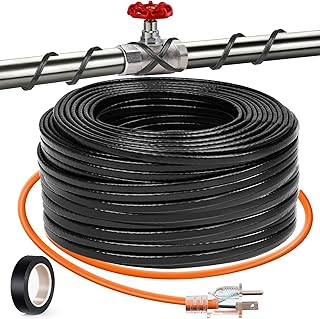
Best for: Longer water-pipe runs where a 50-foot cable is an appropriate length. The listing specifies use on water-filled metal and plastic pipes, including PVC and PEX, and describes operation down to -40°F. Its stated output is 5 watts per foot at 120 volts.
The product description highlights a grounded plug with an indicator light, an aluminum-alloy shield, and a TPE outer jacket. It also states that the cable is intended for water pipes and warns against using it on fuel lines or gutters. Those details make this a relevant option for buyers seeking a longer cable with listed protective construction.
Why it was selected: It explicitly names PVC compatibility and provides a longer cable length than the other fixed-length examples here. That makes it easier to compare for a substantial run, though the correct length depends on the actual pipe layout and the product’s installation instructions.
Limitation: The 50-foot version may be excessive for a short exposed section. Do not use it on non-water applications such as fuel lines or gutters, as the listing warns against those uses.
Frost King HC6A Heating Cable

Best for: A six-foot section of metal or plastic water pipe. Frost King lists this cable as a 6-foot, 120-volt product rated at 7 watts per foot. Its stated freeze-protection temperature is down to -40°F.
This is a straightforward shorter-length option for buyers who do not need a long cable or a variable-length selection. The listed automatic operation may appeal to someone looking for an automatic heat kit rather than a cable described as manually controlled. The product information identifies it for plastic water pipes, making it relevant to PVC-pipe freeze protection.
Why it was selected: Its stated length, voltage, wattage, pipe-material range, and minimum temperature are clearly provided, so it can be compared with the 5-watt and 3-watt cables in this list.
Limitation: A six-foot cable may not cover a longer pipe run. The supplied product details do not specify a separate thermostat temperature or provide additional installation guidance, so check the product instructions before choosing it for a particular PVC pipe arrangement.
MAXKOSKO 6-Foot Self-Regulating Cable
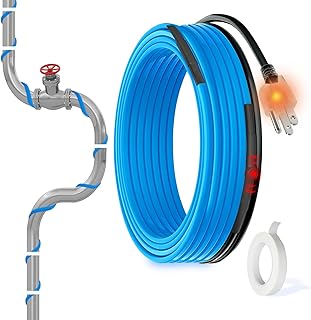
Best for: Short water-pipe sections where a built-in thermostat and self-regulating operation are priorities. The listing gives an output of 5 watts per foot and says the cable is designed for metal and plastic pipes, with freeze protection down to -40°F.
MAXKOSKO says the thermostat turns the cable on at 38°F and that the self-regulating technology adjusts power output. The package includes a 3-foot power cord in addition to the heating cable. The listing describes straight-traced, spiral, and overlapped installation arrangements; follow the manufacturer’s instructions to determine which arrangement is permitted for the particular pipe and product.
Why it was selected: It combines a short cable length with thermostat-based operation, making it a useful comparison against the fixed-output Frost King options. The PVC buyer should note that the listing says plastic pipes are supported, although it does not name PVC in the provided details.
Limitation: The 3-foot power cord affects how far the heating cable can be positioned from an outlet. Confirm that the cable length and cord reach suit the installation location.
HEATIT 20-Foot Self-Regulating Cable

Best for: Buyers who need a medium-length cable and prefer a product listing with a lower stated output of 3 watts per foot. HEATIT describes the cable as self-regulating and says its built-in thermostat operates when temperatures approach freezing. The listing identifies metal and plastic pipes, including PVC, and states protection down to -40°F.
The product is offered in cable lengths ranging from 3 to 160 feet, with a 2-foot power cord. HEATIT also states that the cable is ETL certified and that the plug is UL certified. These are claims from the product information; buyers should check the product labeling and instructions for details relevant to the specific model and installation.
Why it was selected: PVC compatibility is explicit, and the listed 20-foot length can suit a longer run than the shorter 3- and 6-foot products. Its 3-watt-per-foot rating also gives buyers a distinct output option for comparison.
Limitation: The 2-foot cord may limit placement relative to an outlet. Do not assume that a lower wattage is suitable for every climate or pipe exposure; use the manufacturer’s guidance for the conditions at the installation site.
Frost King HC3A Heating Cable

Best for: A very short exposed water-pipe section. The HC3A is listed as a 3-foot, 120-volt cable rated at 7 watts per foot. Frost King says it is for metal and plastic water pipes and keeps water flowing down to -40°F.
Its compact length distinguishes it from the 6-foot HC6A and the longer cable options. For a PVC pipe, its stated suitability for plastic water pipes makes it a candidate, provided the pipe arrangement and installation meet the manufacturer’s directions.
Why it was selected: It offers a simple way to compare a very short automatic heat kit with the longer cables. Buyers with a small section to protect may prefer not to select a much longer cable than the run requires.
Limitation: Three feet is not enough for a longer pipe section. The provided features do not give a specific thermostat activation temperature, so do not assume a particular switching point.
Buying Guide: How to Choose Heating Tape for PVC Pipe
For PVC plumbing, “heating tape” often refers to an electric pipe-heating cable. The important first step is choosing a product whose listing and instructions identify it for plastic water pipes. PVC is a plastic, but confirm that the specific product and installation method are approved for the pipe in question. Do not substitute a cable meant for a different use.
How much cable length do you need?
Measure the pipe section that needs protection and account for the product’s allowed routing method. A 3-foot or 6-foot cable is aimed at shorter sections; a 20-foot or 50-foot cable can cover a longer run. Do not assume you can cut excess cable or overlap it: only do so if the instructions for that exact model explicitly allow it.
Check whether the stated length refers to the heating cable or includes the power cord. MAXKOSKO specifies a 3-foot power cord in addition to the heating cable, while HEATIT lists a 2-foot power cord. Account for cord reach when locating the outlet, and use the product documentation to verify total dimensions.
Should you choose a thermostat or self-regulating cable?
A thermostat switches heating based on a temperature threshold stated by the manufacturer. MAXKOSKO lists a built-in thermostat that turns on at 38°F. HEATIT describes a built-in thermostat that operates as temperatures approach freezing but does not state an exact temperature in the supplied details.
Self-regulating describes a cable that adjusts its heat output according to the product’s design. MAXKOSKO and HEATIT use that term. Frost King describes its HC3A and HC6A as automatic cables, but the provided features do not list their thermostat thresholds. Compare the operating details in the instructions rather than treating these descriptions as identical.
How should wattage affect your choice?
The listed options range from 3 to 7 watts per foot: HEATIT lists 3 W/ft, the 50-foot cable and MAXKOSKO list 5 W/ft, and both Frost King cables list 7 W/ft. Wattage is a product specification, not a guarantee that one cable is best for every location. Exposure, pipe layout, and the manufacturer’s requirements all matter.
Check the product’s electrical requirements and installation directions before purchase. The products described here are listed as 120-volt cables, but cord length and the location of the available outlet can still affect which product fits the job.
What should PVC pipe owners verify before installation?
Read the complete instructions for the selected cable and confirm that PVC or the relevant plastic pipe type is allowed. Follow the specified routing, spacing, attachment, insulation, and electrical safety directions where provided by the manufacturer. Do not improvise a method based on another product’s instructions.
Use pipe-heating products only for the water-pipe applications they specify. The 50-foot cable listing specifically warns against use on fuel lines and gutters. If the pipe material, cable placement, or installation conditions are unclear, check with the manufacturer or a qualified plumbing or electrical professional before installing.
Which features matter most for a particular buyer?
- For a short run: Compare the Frost King HC3A at 3 feet and MAXKOSKO at 6 feet. The MAXKOSKO listing adds a stated 38°F thermostat threshold.
- For a medium run: HEATIT’s 20-foot option provides a lower listed 3 W/ft output and explicitly names PVC compatibility.
- For a longer run: Compare the 20-foot HEATIT cable with the 50-foot cable, and verify the actual required length rather than buying by name alone.
- For clearly stated PVC compatibility: The 50-foot cable and HEATIT explicitly name PVC; the Frost King and MAXKOSKO listings describe compatibility with plastic pipes.
- For listed automatic or thermostat operation: Compare the specific control details. A stated threshold is more precise than a general description such as “automatic.”
Frequently Asked Questions
Can heating tape be used on PVC pipe?
Some pipe-heating cables are listed for plastic water pipes, and the 50-foot cable and HEATIT product details specifically name PVC. Confirm that the chosen model permits use on your pipe and follow its installation instructions.
What temperature protection do these products list?
All five product listings state freeze protection or continued water flow down to -40°F. This is a product claim, not a guarantee for every pipe location or installation condition.
Can heating cable be overlapped on PVC?
Do not assume overlap is safe. MAXKOSKO lists overlapping among possible installation arrangements, but the instructions for the exact model and pipe must govern. Do not apply that guidance to another product.
Which option is best for a short PVC pipe section?
The Frost King HC3A is a 3-foot option for metal and plastic water pipes. MAXKOSKO offers a 6-foot cable with a stated thermostat threshold of 38°F. Choose based on the pipe length, cable instructions, and outlet reach.
Does a lower wattage always mean lower energy use?
No. Wattage per foot is one factor, and actual operation depends on the product’s control design and conditions. HEATIT lists 3 W/ft, while the other options list 5 or 7 W/ft; compare the instructions and intended application rather than wattage alone.