The best underfloor heating timer thermostat depends on the heating system: choose a radiant-floor controller with a floor sensor and suitable electrical rating for electric heating, or verify compatibility before using a general smart thermostat. The Casmer and BOWSEN models offer programmable schedules, dual sensing, and built-in GFCI protection; MAXKOSKO adds app and voice control. The Nest models are smart home thermostats, but the supplied product information does not confirm compatibility with electric underfloor heating.
| Product | Best suited for | Key listed feature |
|---|---|---|
| Casmer Programmable Radiant Thermostat | Scheduled electric floor heating | 7-day programming and dual sensors |
| MAXKOSKO WiFi Smart Thermostat | App and voice control | Wi-Fi, Alexa, and Google Assistant support |
| BOWSEN Programmable Radiant Thermostat | Users needing floor and air sensing | 120/240V operation and built-in GFCI |
| Google Nest Learning Thermostat | Buyers considering a general smart thermostat | Product name lists a temperature sensor |
| Google Nest Thermostat | Buyers considering a programmable Wi-Fi thermostat | Product name identifies Wi-Fi programming |
Casmer Programmable Radiant Thermostat

Best for: Homeowners seeking a programmable controller for electric radiant floor heating, particularly where both air and floor temperature sensing are useful. This model is selected because its listed features directly address underfloor heating, timed schedules, and floor temperature limits.
The thermostat is described as supporting 120V or 240V AC, with a 15-amp maximum rating and maximum loads of 1,800 watts at 120V or 3,600 watts at 240V. Its dual-sensor arrangement includes an indoor air sensor and a floor probe. The listed 7-day schedule allows heating periods to be programmed across the week.
The product description also lists built-in Class A GFCI protection with a 5mA trip threshold and a one-click self-test. Floor temperature limits are intended to help prevent overheating of tile, hardwood, and vinyl flooring. Confirm the heating load and wiring requirements before purchase or installation.
Limitation: The listed maximum wattage varies by supply voltage, so this is not a fit for every heating load. The supplied details do not specify Wi-Fi or app control.
MAXKOSKO WiFi Smart Floor Thermostat

Best for: Buyers who want to adjust a compatible underfloor heating thermostat remotely and use voice control. It stands out among the listed options for its stated smartphone control and support for Alexa and Google Assistant.
The product description says users can change temperature settings from a smartphone and create customized programmed settings, so the heating does not need to be adjusted manually throughout the day. It is described as compatible with most underfloor heating systems, although the listing does not define the full compatibility conditions.
Choose this model if app-based adjustments and smart-home voice commands matter more than having a clearly stated electrical rating in the product details provided here. A schedule can help align heating with daily routines, but the available description does not give a specific number of schedule periods or days.
Limitation: The supplied features do not state voltage, maximum amperage, maximum wattage, or whether the thermostat includes a floor probe or GFCI. Verify those points against the actual heating system and product documentation before installation.
BOWSEN Dual-Sensor Radiant Thermostat
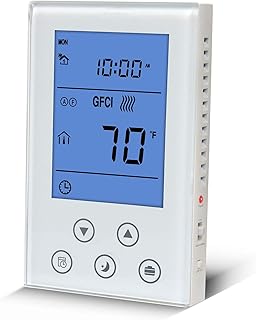
Best for: Buyers looking for a radiant-floor thermostat with stated 120V/240V operation, a floor and air sensor, and built-in GFCI. It is selected because the supplied details identify its electrical limits and sensing features specifically for underfloor heating.
The product is listed for 50/60Hz operation, with a maximum current of 15A. Its stated maximum load is 1,800W at 120V or 3,600W at 240V. The thermostat includes a floor sensor, an air sensor, and a GFCI function test. The description says the GFCI interrupts current when it detects leakage and advises testing the function after installation.
Choose this model if these stated electrical limits suit the heating system and you want both floor and room sensing. The product description says that a GFCI trip indicates detected electrical leakage; investigate the cause rather than treating the alert as a routine setting.
Limitation: The supplied information does not specify the length or type of schedule programming. It also cautions that a GFCI trip requires troubleshooting and checking for leakage or a cable short.
Google Nest Learning Thermostat

Best for: Buyers researching a general-purpose smart thermostat who will first confirm whether it supports their particular heating equipment. The product name identifies it as a Nest Learning Thermostat and says a Nest Temperature Sensor is included.
The listed product name also mentions compatibility with Alexa, Apple HomeKit, and the Google Home app. These details may be relevant to buyers comparing smart-home control options, but the supplied information does not describe floor-heating wiring, electrical load limits, a floor probe, or direct control of electric radiant heating.
Choose this only after checking the manufacturer’s current compatibility information for the specific underfloor heating system. A room temperature sensor is not, by itself, confirmation that a thermostat can sense floor temperature or safely switch a radiant heating load.
Limitation: Underfloor heating compatibility is not established by the supplied product information. Do not assume it can replace a dedicated radiant-floor thermostat.
Google Nest Programmable Wi-Fi Thermostat

Best for: Shoppers considering a programmable Wi-Fi thermostat for home heating, provided they verify that it is suitable for their exact system. The supplied product name describes it as a smart home thermostat with programmable Wi-Fi functionality.
The product details provided do not list voltage, amperage, a floor sensor, or specific radiant-floor compatibility. Those omissions matter for electric underfloor heating, which may require a controller designed for the heating load and floor temperature monitoring. The name alone is not enough to establish that this thermostat can control a floor-heating circuit.
Choose this product for an underfloor application only if the manufacturer’s compatibility guidance explicitly covers the system and installation arrangement. Otherwise, compare it with thermostats that state their radiant-heating voltage and load ratings.
Limitation: The supplied product information does not confirm compatibility with underfloor heating or direct control of an electric floor circuit.
Buying Guide: How To Choose An Underfloor Heating Timer Thermostat
Is the thermostat made for your type of underfloor heating?
Start by identifying the heating system. Electric radiant cables or mats use a thermostat that must be appropriate for the circuit and its electrical load. Hydronic systems circulate heated water and may use different control equipment. A product described as a general home thermostat is not automatically suitable for either type. Check the heating-system documentation and the thermostat manufacturer’s compatibility information before buying.
For electric systems, favor product details that explicitly mention radiant floor heating and give voltage, amperage, and maximum wattage. The Casmer and BOWSEN descriptions list 120V/240V operation and 15A maximum current. The MAXKOSKO description mentions broad underfloor-system compatibility but does not provide electrical ratings in the information supplied here, so those details need verification.
Do you need a floor sensor, an air sensor, or both?
A floor sensor measures temperature at the floor; an air sensor measures room temperature. Dual-sensor control can be useful when both floor comfort and room conditions matter. It can also allow a floor temperature limit to be set, which may help protect floor finishes. Casmer and BOWSEN explicitly list floor and air sensing. The supplied details do not confirm that MAXKOSKO or either Nest model includes a floor probe.
Check whether the sensor included with a thermostat is suitable for the installation and whether the system requires a separate probe. Do not treat a general room sensor as a floor sensor. When a product page does not state sensor type, ask the manufacturer or consult the installation instructions rather than assuming.
What does the electrical rating tell you?
The thermostat’s voltage and maximum load must match the heating circuit. A rating of 15A does not mean every heating system is appropriate; the listed maximum wattage and supply voltage also matter. Casmer and BOWSEN state maximum loads of 1,800W at 120V and 3,600W at 240V. Compare those limits with the heater’s specifications, and have a qualified professional assess wiring or installation questions.
Never select a thermostat based only on its screen, smart features, or brand. A mismatch between the controller and the electrical load can make a product unsuitable. If the heating load exceeds the thermostat’s stated rating, do not assume the thermostat can handle it.
Which timer or schedule features matter?
A programmable schedule can reduce unnecessary heating by matching operation to the household’s routine. Look for a clear statement of how many days can be programmed and whether separate settings can be assigned to different times of day. Casmer lists a 7-day schedule. MAXKOSKO lists customized programmed settings but does not specify schedule structure in the supplied details. BOWSEN’s provided description focuses on sensing and electrical specifications rather than schedule options.
Consider how quickly the floor responds to heating. A schedule that starts too late may not provide the desired comfort at the intended time. Follow the heating-system instructions when setting schedules, and adjust based on the system’s response rather than relying on assumptions about warm-up time.
Should you prioritize app control or a basic programmed schedule?
Wi-Fi and voice control can make remote adjustments more convenient. MAXKOSKO lists smartphone control and Alexa and Google Assistant support. That may suit buyers who want to change settings away from home or use voice commands. However, smart features do not replace checking voltage, load capacity, sensors, and system compatibility.
A non-Wi-Fi programmable thermostat may be a better fit when the main goal is a dependable daily or weekly schedule and remote access is not needed. Compare what the listing actually confirms: app access, voice platforms, schedule options, sensor types, and electrical ratings.
Why should GFCI protection and testing matter?
Casmer and BOWSEN list built-in GFCI protection and a test function. GFCI protection is a safety feature described by the manufacturers, but it does not remove the need to follow local electrical requirements or install the thermostat correctly. Use the test procedure and installation instructions provided with the product.
BOWSEN’s description says a GFCI trip indicates detected leakage and advises checking the wiring and heating cable. Do not ignore repeated trips or disable a safety alert as a substitute for finding the cause. Consult a qualified electrician when troubleshooting is beyond your experience.
Frequently Asked Questions
What is an underfloor heating timer thermostat?
It is a thermostat that controls a floor-heating system and can use programmed times to adjust heating operation. Features differ by model; some include floor sensors, air sensors, Wi-Fi, or safety functions.
Can I use any smart thermostat for electric underfloor heating?
No. Confirm that the thermostat is specifically compatible with the heating system and can handle its voltage and electrical load. A Wi-Fi label does not establish radiant-floor compatibility.
Is a floor sensor necessary?
It depends on the heating system and the control requirements. A floor sensor measures floor temperature and may support floor limits. Check the heating manufacturer’s instructions and the thermostat’s listed sensor configuration.
What is the difference between 120V and 240V thermostat ratings?
They identify supported supply voltages and may correspond to different maximum wattages. Match the thermostat’s stated ratings to the heating circuit and consult product instructions or a qualified professional if uncertain.
Can a thermostat schedule lower energy use?
A schedule can reduce heating during times when a space does not need the same temperature. Actual energy use depends on the system, building, schedule, and household habits; a programmable feature does not guarantee a specific saving.
Do the listed Nest thermostats have confirmed underfloor compatibility?
The supplied product information does not confirm compatibility with underfloor heating. Check the manufacturer’s current compatibility guidance for the exact heating system before considering either Nest model.