The best 24-inch fireplace grate depends on your firebox size, log length, and preferred construction. The Mr IRONSTONE grate is a straightforward no-assembly steel option; Jusgym is best for buyers who want eight support legs and included fire tools; FEED GARDEN clearly states both its overall width and usable log span; and the Amagabeli cast iron and Panacea grates suit buyers who prefer cast iron. Check your fireplace measurements before choosing: “24 inch” may describe the grate’s outside width, not the space available for logs.
| Product | Best For | Standout Detail |
|---|---|---|
| Mr IRONSTONE 24-Inch Grate | Simple setup | Solid steel bars and six legs |
| Jusgym 24-Inch Grate | Added support and included tools | Eight legs, dense bars, tongs and poker |
| FEED GARDEN 24-Inch Grate | Buyers checking usable log width | 19-inch usable interior span |
| Amagabeli One-Piece Cast Iron Grate | Ember-retaining side flanges | One-piece cast iron construction |
| Panacea 15424 Cast Iron Grate | Traditional cast iron design | Openings let smaller burned wood fall through |
Mr IRONSTONE 24-Inch Fireplace Grate

The Mr IRONSTONE grate is a practical choice for buyers who want a solid steel log rack with no assembly required. Its listed structure uses seven solid steel bars and six legs, including four thick feet and two middle supports. The V-shaped frame is intended to help hold logs in place and distribute support across the grate.
Best for: Buyers seeking a ready-to-place grate with central support for a wood load. It was selected because its six-leg layout and installation-free construction address two common buying priorities: stability and simple setup.
Consider: The supplied product details do not give the usable interior span or grate height. Measure your firebox and compare it with the actual product dimensions before buying, especially if you burn longer splits.
Jusgym 24-Inch Grate With Fire Tools

The Jusgym grate stands out for its eight support legs and included fire tongs and poker. Its eight tightly spaced steel bars are designed to hold hot coals and reduce log slippage. The grate lifts firewood 4.5 inches above the hearth, according to the supplied product information.
Best for: Buyers who want a raised steel grate with added base supports and basic tending tools in the package. Choose this if the 4.5-inch lift suits your fireplace and you value a dense bar layout.
Consider: A grate’s height affects how much space remains above the firewood. Check the firebox height and clearance before choosing this model. The listed details do not provide a usable interior width, so confirm that your preferred log length fits.
FEED GARDEN 24-Inch Solid Steel Grate
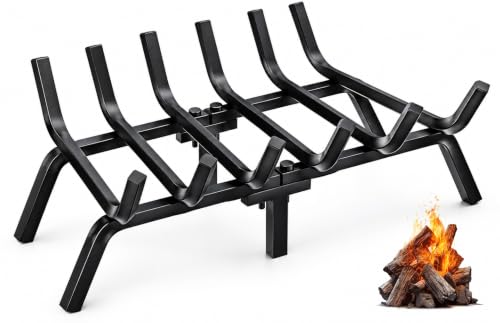
FEED GARDEN gives buyers particularly useful sizing information: the grate measures 24 inches wide overall, but the usable interior span between the end uprights is 19 inches. It has six half-inch square solid steel bars on a V-shaped frame, with four corner feet and two center support legs. The listed height is 6.3 inches overall, with the logs held about 3 inches above the hearth floor.
Best for: Buyers who want to compare both outside dimensions and the space available for logs. It was selected because its measurements make it easier to screen for firebox fit and log length.
Consider: Logs longer than the 19-inch usable span may not sit as intended. The product information also lists a one-piece, no-assembly 24-inch option, so check the specific version before ordering.
Amagabeli One-Piece Cast Iron Grate

This Amagabeli model uses a one-piece cast iron construction and requires no assembly. Its slotted design raises firewood above the floor so air can circulate underneath, while ash can fall through the openings. Raised side flanges are described as helping keep logs on the grate and catching some sparks and embers.
Best for: Buyers who want a cast iron grate with built-in side flanges rather than a simple open-ended rack. The flanges offer a physical barrier at the sides, and the one-piece design avoids assembly.
Consider: Side flanges can limit how logs are positioned compared with an open-sided grate. The supplied details do not state the usable interior width or overall height, so verify those measurements against your hearth and firewood.
Panacea 15424 Cast Iron Fire Grate

The Panacea 15424 is a 24-inch cast iron grate with openings that allow smaller pieces of burned wood to drop to the fireplace floor. The product description says the resulting bed of hot coals supports a bottom-up fire. Raising the fire above the fireplace floor is also described as helping draft smoke and fumes toward the chimney.
Best for: Buyers looking for a basic cast iron grate with an open design that lets smaller burned pieces fall through. It was selected as a simple alternative to models with added supports, flanges, or included tools.
Consider: The provided product details do not specify leg count, grate height, or usable interior width. Check the product’s dimensions and compare them with your fireplace opening before purchase.
Buying Guide: How to Choose a 24-Inch Fireplace Grate
Will a 24-inch grate fit my fireplace?
Do not rely on the “24 inch” label alone. It may refer to the outside width, while the area that can hold logs is narrower. Measure the fireplace opening at the floor level where the grate will sit. Also check the depth and height available, including clearance above the grate for logs and flames.
Leave enough room for safe placement and handling rather than selecting a grate that barely fits the opening. A grate that is too wide or deep may not sit flat. If a listing provides separate outside and usable measurements, use the usable span to judge log fit and the overall dimensions to judge firebox fit.
How much usable width do my logs need?
Measure the firewood you actually plan to burn. The FEED GARDEN model illustrates why this matters: it is 24 inches wide overall but lists a 19-inch usable interior span. Do not assume that logs matching the nominal grate width will fit between end supports.
When a product page does not state usable width, seek the manufacturer’s complete dimensions before buying. If your splits are longer than the load-bearing area, they may extend past the supports or sit unevenly. Choose a grate whose usable span suits your usual firewood rather than relying on the nominal size.
Steel or cast iron: which construction should I choose?
These products include both steel-bar designs and cast iron models. Steel grates often use a frame with multiple bars and legs, so buyers can compare bar spacing and support layout. Cast iron options in this selection include one-piece construction and, in the Amagabeli model, raised side flanges.
Material alone does not tell you whether a grate will fit your firebox or suit your preferred firewood. Compare the listed dimensions, bar arrangement, support structure, and assembly requirements. Avoid assuming that one material will last longer in every fireplace; the supplied product details do not establish a universal lifespan.
How important are the legs and center supports?
Leg count and placement affect how a grate supports a wood load. Several models here describe center or evenly distributed support legs intended to help reduce sagging. Mr IRONSTONE lists six legs, while Jusgym lists eight. FEED GARDEN lists four corner feet and two center supports.
More legs do not, by themselves, prove that a product will suit every load or firebox. Look at the full frame design and the manufacturer’s stated construction details. A stable, level surface is also important: a grate that rocks on an uneven hearth may not hold logs securely.
How high should the grate lift the firewood?
Elevation creates space beneath the logs for air to reach the fire and for ash to fall away from the wood. The products in this list specify different designs: Jusgym lists a 4.5-inch lift, while FEED GARDEN says its logs sit about 3 inches above the hearth. These measurements are not necessarily taken in exactly the same way, so compare the listed definitions when available.
A taller grate is not automatically better. Consider the height of the firebox and the space above the loaded grate. A high rack may reduce overhead clearance, while a low rack provides less room beneath the logs. Match the grate height to your fireplace’s usable interior space.
Do I need side flanges or a dense bar layout?
Side flanges can help keep logs from sliding sideways and may catch some sparks or embers, according to the Amagabeli product description. They are worth considering if a raised edge is a feature you specifically want. They do not replace a fireplace screen or other safe fire practices.
Dense bars can support smaller pieces of wood and help keep coals from falling through too quickly. More open spacing may allow ash and smaller burned pieces to drop to the hearth. Think about the size of your usual logs and kindling, and choose a layout that matches how you build fires.
Should I choose an assembled or one-piece grate?
Assembly requirements vary. Mr IRONSTONE and Jusgym are listed as requiring no assembly, and the Amagabeli cast iron grate is a one-piece design. The FEED GARDEN listing describes both an assembled option and an available one-piece version, so verify which version is selected.
A no-assembly grate can be convenient to place directly in the fireplace, but it still needs to be measured and positioned correctly. If a grate requires assembly, check the included instructions and confirm that its assembled dimensions suit your firebox.
What should I confirm before buying?
- Measure the fireplace opening, hearth depth, and available height.
- Compare the grate’s outside dimensions with the opening.
- Check usable interior width against the length of your firewood.
- Review the leg count, center supports, bar spacing, and stated lift height.
- Confirm whether the grate is one piece, assembled, or offered in multiple versions.
- Consider whether you want side flanges, included tools, or a particular material.
Frequently Asked Questions
Does a 24-inch fireplace grate have a 24-inch log area?
Not necessarily. The measurement may describe the grate’s overall width. The FEED GARDEN model, for example, lists a 24-inch outside width and a 19-inch usable interior span.
How do I measure for a fireplace grate?
Measure the fireplace opening where the grate will rest, including width and depth. Check the available height above the hearth, then compare those measurements with the grate’s overall dimensions and usable log span.
Do fireplace grates improve airflow?
Elevating firewood can leave space beneath the logs for air circulation. Several products in this selection describe raised designs intended to promote airflow, but the result depends on the grate, the firewood, and the fireplace setup.
Are cast iron fireplace grates better than steel grates?
Neither is automatically the best choice for every buyer. Compare the individual grate’s dimensions, support structure, bar layout, and features. Cast iron models here include a one-piece option with side flanges and a simpler open design.
Can I use a 24-inch grate in an outdoor fire pit?
Some product descriptions state that the grate is suitable for indoor and outdoor use, but fit depends on the fire pit’s dimensions and shape. Check the specific product details and measure the surface where it will sit.