The best 220V-class garage heater depends on your space, electrical setup, and installation preference. These picks are 240-volt models, a common supply category for high-output electric heaters; confirm the unit’s exact voltage and circuit requirements before buying. The COMFORT ZONE 5,000-watt model is best for a smaller workshop, while the InoKraft 7,500-watt heater adds a plug, remote, and digital controls. For larger spaces, consider the 8,500-watt CTSC or 10,000-watt COMFORT ZONE. Hardwired models require appropriate installation, and some plug-in models still need a dedicated 240V outlet.
| Heater | Best for | Power and setup |
|---|---|---|
| COMFORT ZONE 5,000W | Smaller garages and workshops | 240V hardwired; three heat settings |
| InoKraft 7,500W | Convenient controls and flexible placement | 240V NEMA 14-50P plug; remote and thermostat |
| CTSC 5,600W | Buyers with a suitable 240V outlet | NEMA 6-30P plug and included matching socket |
| TEMPWARE 7,500W | Adjustable heat and digital control | 240V hardwired; three heat levels |
| CTSC 8,500W | Larger garages and workshops | 240V hardwired; external thermostat ready |
COMFORT ZONE 5,000-Watt Ceiling Heater

Best for: A smaller garage or workshop where keeping the floor clear is important. This fan-forced heater mounts to the ceiling and offers three settings: 3,000, 4,000, and 5,000 watts. Louvers and an adjustable mounting angle help direct the airflow toward a work area rather than leaving the heat pointed in one fixed direction.
The heavy-gauge steel body is designed for demanding workspaces. Choose this model if you want selectable output and adjustable airflow in a permanently installed heater. It is a practical option for buyers who do not need the higher wattage or remote-control features of larger models.
Limitation: This is a 240V hardwired heater, not a standard household plug-in unit. Plan for a suitable electrical installation, and avoid it if you need a portable heater or do not have the required wiring.
InoKraft 7,500W Heater With Remote

Best for: Buyers who want higher output with convenient temperature and timer controls. The 240V fan-forced heater includes a digital thermostat adjustable from 40°F to 99°F, a 1-to-24-hour timer, remote control, high and low settings, and an ECO mode that adjusts output based on ambient temperature. The listed coverage is up to 750 square feet, though actual results depend on insulation, ceiling height, and outdoor conditions.
The product includes an 8.2-foot power cord and a NEMA 14-50P plug, so it may suit a garage with a compatible outlet. Its stated noise level is 65 dB. Choose it over a basic hardwired model if remote operation and programmable timing matter to your routine.
Limitation: A NEMA 14-50P plug requires a matching 240V receptacle; it cannot be used in an ordinary 120V outlet. Confirm that the outlet and circuit match the heater’s requirements before installation.
TEMPWARE 7,500W Adjustable Heater
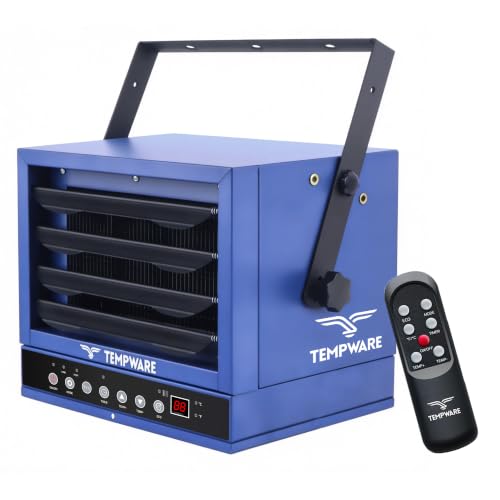
Best for: A larger garage or workshop where adjustable output and a digital thermostat are priorities. This 240V hardwired fan-forced heater offers three heat settings from 5,000 to 7,500 watts, a stated maximum output of 25,590 BTU, and listed coverage up to 1,250 square feet. Its digital thermostat ranges from 45°F to 95°F, and ECO mode adjusts output to help maintain the selected temperature.
Choose this model if you want a higher-output heater with multiple power levels rather than a single fixed setting. The thermostat and ECO feature provide more control than a simple mechanical dial. The listed coverage should be treated as an estimate, not a guarantee; insulation and garage layout affect heating performance.
Limitation: The heater is hardwired and does not include a power cord. The manufacturer calls for installation by a qualified electrician, so it is not the right choice for someone seeking a plug-in setup.
CTSC 5,600W Heater With 240V Outlet

Best for: A buyer who prefers a plug-connected commercial heater and already has, or can arrange, the correct 240V electrical setup. This 5,600-watt fan-forced ceiling model includes a 6.2-foot power cord, a NEMA 6-30P plug, and a matching 240V socket. Its listed features also include remote control, digital thermostat, 10-hour timer, and memory function.
The body is made from SPCC cold-rolled steel, and the product information lists overheat protection. Compared with a hardwired heater, the included plug and socket can be a better fit for a garage equipped for this connection. Choose it if the 5,600-watt output and control features meet your needs.
Limitation: The manufacturer identifies this as a commercial heater, not a household heater. It cannot operate from a standard 120V outlet; verify the required 240V outlet and installation details before use.
CTSC 8,500W Heater With Thermostat Connection
Best for: A larger garage or workshop where a higher-output heater and wall thermostat control are desired. The manufacturer lists 8,500 watts, 29,010 BTU, and coverage up to 850 square feet. The heater is pre-wired for an external thermostat, allowing a compatible wall thermostat to be connected for temperature control.
This fan-forced model has a steel body and listed overheat protection. Choose it over a lower-wattage option when the space is larger or colder, while remembering that coverage depends on insulation, ceiling height, climate, and air leakage. The external-thermostat connection is a useful differentiator for buyers who want controls located away from the ceiling-mounted heater.
Limitation: The product information does not specify a plug-in connection. Confirm whether the installation is hardwired and check the required circuit and thermostat details before purchasing.
Buying Guide: How to Choose a 220V-Class Garage Heater
Many shoppers use “220V” as a general search term for high-output electric heaters. The products here are described as 240V models. Do not assume that every 220V- or 240V-labeled heater uses the same connection, circuit, or installation method. Check the product label and instructions, and have an electrician confirm that your supply and wiring are appropriate.
How much heater output does your garage need?
Compare wattage, the manufacturer’s coverage estimate, and the conditions in your garage. The listed models range from 5,000 to 8,500 watts, while the TEMPWARE and InoKraft listings provide coverage estimates. These estimates are not universal performance guarantees. A poorly insulated garage, high ceiling, frequent door opening, or cold climate can make a space harder to heat.
- Consider a 5,000- to 5,600-watt model for a smaller space or targeted workshop heating.
- Compare 7,500-watt models when you need adjustable output or more control features.
- Consider 8,500 watts for a larger area, but verify that the electrical supply can support the heater.
Should you choose a hardwired or plug-in heater?
A hardwired heater connects directly to the building’s electrical wiring. The COMFORT ZONE and TEMPWARE models listed here require hardwiring, and the TEMPWARE listing specifically says the power cord is not included and recommends professional installation. A plug-in heater can be more convenient only when the outlet matches the heater’s voltage, plug type, and circuit requirements.
The InoKraft uses a NEMA 14-50P plug, while the CTSC 5,600W model lists a NEMA 6-30P plug and matching socket. These plugs are not interchangeable. Never use an adapter or standard 120V outlet as a substitute for the specified electrical setup.
Which controls make daily use easier?
Basic heat settings let you choose an output level; a thermostat helps maintain a chosen temperature. Remote controls are useful when the heater is mounted overhead. Timers can schedule operation, while ECO modes adjust output according to the product’s control system. The InoKraft provides a remote, digital thermostat, and 24-hour timer. The TEMPWARE 7,500W model offers a digital thermostat and ECO mode. The CTSC 5,600W listing includes a remote, digital thermostat, and 10-hour timer.
What safety and installation details should you check?
Read the manual for mounting clearances, wiring, circuit requirements, and any restrictions on use. The listed products include features such as overheat protection, but that does not replace correct installation or safe placement. Keep the heater clear of stored items and follow its instructions for airflow and mounting. For a hardwired unit or an uncertain outlet, consult a qualified electrician before buying or installing it.
How should you compare coverage claims?
Coverage figures are useful for initial comparison, not a substitute for evaluating the building. The InoKraft listing states up to 750 square feet, the CTSC 8,500W listing states up to 850 square feet, and TEMPWARE lists up to 1,250 square feet for its 7,500W model. Those claims differ, so check each manufacturer’s instructions and consider insulation, ceiling height, and local winter temperatures when choosing.
Frequently Asked Questions
Can a 240V garage heater plug into a regular outlet?
No. A standard household outlet is typically 120V, and these heaters require a specified 240V connection. Use only the connection described for the individual model and confirm that the circuit is suitable.
Is a 220V heater the same as a 240V heater?
“220V” is often used casually for higher-voltage residential equipment, but the exact supply and appliance requirements matter. Check the heater’s nameplate and installation instructions rather than relying on the search term alone.
Is a hardwired garage heater difficult to install?
Hardwired models require a suitable electrical circuit and direct wiring. The TEMPWARE listing recommends a qualified electrician. Ask an electrician to confirm the installation requirements for any model before purchase.
What wattage is suitable for a garage?
There is no single wattage that suits every garage. Compare the heater’s output and stated coverage with the space’s size, insulation, ceiling height, and climate. A poorly insulated or frequently opened garage may need more heating capacity than a similar-sized enclosed space.
Does a ceiling-mounted heater warm the whole garage?
A fan-forced ceiling heater circulates heated air, and adjustable louvers or mounting angles can direct airflow. Results depend on the heater’s output and the garage layout, so a single unit may not heat every area evenly in all conditions.