The best digital thermostat for a water-heating setup depends on whether you need a plug-in controller for a separate heater or a heater with its own built-in thermostat. The Inkbird ITC-308 offers heating and cooling control, while the BN-LINK heating-only controller suits simpler setups. The WILLHI WH2408 adds a broad probe range and knob controls. For direct water heating, the immersion heater includes its own temperature control. These products are not all replacements for a household water heater’s built-in thermostat or safety controls.
| Product | Best suited for | Key distinction |
|---|---|---|
| Inkbird ITC-308 | Setups needing heating and cooling outputs | Dual relay and dual display |
| BN-LINK Reptile Thermostat | Heating-only applications | Three-button setup and probe |
| WILLHI WH2408 | Wide temperature settings and simple knobs | Probe range from -58°F to 230°F |
| BN-LINK Dual Thermostat Outlet | Separate heating and cooling devices | Independent outlets and overload protection |
| Immersion Water Heater | Portable water heating | Built-in thermostat and auto shut-off |
Inkbird ITC-308 Digital Temperature Controller

The Inkbird ITC-308 is best for a setup that needs a plug-in controller with both heating and refrigeration outputs. Its dual relay can power heating or cooling equipment as conditions change, and its dual display shows the measured temperature and set temperature together. The controller supports Celsius and Fahrenheit display.
Choose this model if you want to see the current reading and target at a glance or need to control equipment in both temperature directions. It was selected because its dual-output design offers more flexibility than heating-only controllers in this list.
Limitation: This is an external temperature controller, not a complete water heater. Confirm that the connected appliance and electrical load are appropriate for the controller before use. The listed features do not specify its load rating, so consult the manufacturer’s product details for that information.
BN-LINK Heating-Only Digital Thermostat

This BN-LINK controller is best for buyers who need straightforward temperature control for a heating device. The manufacturer describes it for heating equipment such as heat mats and heat lamps, with a temperature setting range of 40°F to 108°F and a 1,000-watt rating. Three buttons handle temperature programming and Fahrenheit or Celsius selection.
A sensor probe monitors temperature, while a bright display and heating and power indicator lights make the operating status visible. The hanging tab may help position the controller near the setup. It is a useful choice when cooling control is unnecessary and the desired temperature falls within its stated range.
Limitation: The product is explicitly intended for heating devices only; it does not control cooling equipment. Its stated range may not suit applications that require higher water temperatures. Check the connected device’s electrical requirements and follow its instructions.
WILLHI WH2408 Temperature Controller
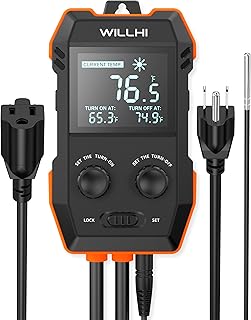
The WILLHI WH2408 is best for users who prefer direct on/off temperature adjustments with knobs instead of navigating menus. Its stated control range is -58°F to 230°F, and it is rated for 10 amps and 1,200 watts. The included probe measures within the same stated temperature range, and the controller can retain settings through power outages.
The manufacturer lists applications including aquarium heaters, greenhouses, incubators, and brewing equipment. That range of uses may make it a candidate for a compatible plug-in heating setup where the setpoint falls within its limits. Its food-grade probe is described as suitable for direct use in food preparation.
Limitation: The controller’s housing is not waterproof, even though its probe is. Keep the controller dry, and do not use the probe in salt water for extended periods. Verify that the connected heater’s electrical load does not exceed the controller’s rating.
BN-LINK Dual Heating and Cooling Controller

This BN-LINK controller is best for an indoor setup that needs separate heating and cooling devices. It has independent outlets for heating equipment and cooling equipment, which it switches according to temperature settings. The waterproof metal probe measures from -58°F to 230°F, while the stated control range is -40°F to 176°F.
It supports Fahrenheit and Celsius display with one-degree adjustment increments. Its listed electrical capacities include up to 15 amps or 1,875 watts for a resistive load, 10 amps or 1,250 watts for a tungsten load, and a 1/2 horsepower TV-5 rating. Overload protection is also listed. These details make it the most explicitly rated dual-output option in this selection.
Limitation: A dual-output controller may be unnecessary if the setup only needs heat. Match the load type and ratings to the connected equipment; do not assume the maximum resistive-load rating applies to every appliance.
Immersion Water Heater With Built-In Thermostat

This immersion heater is best for portable water-heating needs, such as warming water in a bucket or suitable bath setup, rather than controlling an existing household water heater. It is listed at 2,000 watts and includes a built-in thermostat, auto shut-off, delay start, and an LCD showing water temperature. The delay timer is described as programmable up to 999 minutes, or about 16 hours.
Choose this product if you need a submersible heater with temperature controls integrated into the unit. The product description says heating time varies with water volume and gives example estimates, but actual results depend on conditions.
Limitation: This is an appliance that heats water, not an external thermostat for a tank water heater. The listing instructs users to fully submerge the element before plugging it in and unplug it before removal. Follow the product’s electrical and water-safety instructions, including the stated guidance about a grounded, GFCI-protected outlet.
Buying Guide: How to Choose a Digital Water-Heater Thermostat
Start by identifying what you want to control. A plug-in temperature controller is designed to switch a compatible connected device based on a probe reading. An immersion heater warms water directly and may have an integrated thermostat. A controller outlet is not automatically a replacement for a water heater’s internal thermostat, high-limit switch, or other safety components.
Do you need a replacement thermostat or an external controller?
If your goal is to regulate a conventional household water heater, verify the appliance’s design and follow its manufacturer’s service instructions. The five products here are primarily plug-in controllers or a portable immersion heater. They should not be treated as universal replacement parts for built-in water-heater controls. Incorrect wiring or control selection can create electrical and scalding hazards; consult a qualified professional when the work involves appliance wiring.
If you are controlling a separate plug-in heater, check whether that heater is designed to be switched by an external controller. Confirm the connection type, voltage, current, and load rating. Do not connect an appliance to a controller simply because its plug fits.
Should the controller support heating only or heating and cooling?
A heating-only thermostat is a simpler match when the only task is switching a heater. The BN-LINK reptile thermostat is explicitly described as heating-only, so it is not the right choice for a cooling device. A dual-output model such as the Inkbird ITC-308 or BN-LINK dual controller may suit an environment that also needs cooling or ventilation control.
Dual control does not necessarily improve a basic water-heating setup. Choose it when you have a real need for separate heating and cooling outputs, and check how the product handles each output before installation.
What temperature range and sensor should you check?
Compare the controller’s usable temperature range with the temperature you need to measure and set. The BN-LINK heating-only model lists a 40°F to 108°F setting range, while the WILLHI WH2408 lists a much broader range. The BN-LINK dual controller lists separate probe measurement and control ranges. A broad probe range does not mean every connected heater can safely operate across that full range.
Also consider where the probe must sit. A probe’s position affects the reading, so use the placement method specified by the controller and the connected appliance. For water, confirm that the probe is intended for the environment and is appropriately protected. The WILLHI listing warns that its controller housing is not waterproof and that prolonged salt-water use can shorten probe life.
How much electrical capacity do you need?
Check the heater’s electrical specifications and compare them with the controller’s rating for the relevant load type. The products in this list have different stated capacities: the BN-LINK heating-only model lists 1,000 watts; the WILLHI WH2408 lists 10 amps and 1,200 watts; and the BN-LINK dual controller gives separate ratings for resistive, tungsten, and motor-related loads.
Do not compare wattage alone if the manufacturer provides different ratings for different load types. A controller’s maximum rating is not a recommendation to operate at the limit. Use the appliance and controller instructions, and choose equipment that is suitable for the electrical circuit and environment.
Which display and controls are easiest to use?
A dual display can make it easier to compare the measured temperature with the target setting. The Inkbird ITC-308 lists both readings on its display. The BN-LINK heating-only controller uses three buttons, while the WILLHI WH2408 uses two knobs for on/off temperature adjustments. The BN-LINK dual model supports one-degree increments in either Fahrenheit or Celsius.
Consider whether you want a set-and-check interface, visible status lights, or a controller that remembers settings after a power interruption. These features can make routine operation simpler, but they do not replace checking that the equipment is operating correctly.
When is an immersion heater the better choice?
Choose an immersion heater when you need to heat water directly in an appropriate container, rather than regulate a separate heater through a plug-in controller. The listed immersion product includes an integrated thermostat, temperature display, delay timer, and auto shut-off. Its safety instructions are especially important because the heating element is submerged and must be unplugged before removal.
For a fixed household water heater, a portable immersion unit is not a substitute for the appliance’s thermostat or service parts. Confirm the intended use, container, electrical connection, and manufacturer instructions before operating a portable water heater.
Frequently Asked Questions
Can a plug-in digital thermostat control a standard tank water heater?
Not necessarily. The controllers listed here are external plug-in devices for compatible equipment; they are not presented as universal replacements for a tank water heater’s built-in thermostat. Check the water heater’s documentation and use a qualified professional for wiring or repair questions.
What is the difference between a thermostat controller and an immersion heater?
A thermostat controller measures temperature with a probe and switches a compatible connected device on or off. An immersion heater is the heating appliance itself; the listed model also has a built-in thermostat and temperature display.
Can I use a heating-only controller with a cooling device?
No. The BN-LINK reptile thermostat is described as intended for heating devices only. For a setup that needs heating and cooling outputs, compare dual-output models and confirm that their ratings match the connected equipment.
Does a wider temperature range mean a controller is better?
No. A wider range is useful only if it matches the application. Also check the control range separately from the probe’s measurement range, as well as the connected heater’s safe operating limits.
Can a temperature controller prevent scalding?
A controller can switch compatible equipment according to its settings, but it should not be assumed to provide every safety function needed to prevent scalding. Follow the water heater and controller instructions, and use appropriate temperature and safety controls for the specific installation.
What should I verify before buying a plug-in controller?
Check that the controller supports the required heating or cooling function, temperature range, probe environment, voltage, and electrical load type. Confirm that the connected appliance allows external control and follow both products’ safety instructions.