The best dog heater for a dog house depends on the shelter’s size, your climate, and whether you need to warm the air or provide a heated resting surface. The TURBRO Neighborhood is best for adjustable, fan-assisted heating in a space up to 100 cubic feet. The 500W thermostat model is a practical choice when you want a stated capacity, timer, and temperature range. A heating pad suits dogs that need warmth where they lie rather than heat throughout the house.
| Product | Best suited for | Notable listed feature |
|---|---|---|
| TURBRO Neighborhood Dog House Heater | Small-to-medium enclosed spaces | 200W or 400W settings; stated capacity up to 100 cubic feet |
| 500W Dog House Heater | Buyers wanting thermostat and timer controls | 40–115°F setting range; 24-hour timer |
| 300W/600W Smart Thermostat Heater | Automatic temperature maintenance | Two temperature ranges with auto on/off |
| GOLOPET Large Dog Heating Pad | Warming a dog’s resting spot | Adjustable 80–130°F and timer choices |
| 1300W WiFi Dog House Heater | Remote controls and higher heat output | Three modes and app, remote, or panel control |
TURBRO Neighborhood Dog House Heater

Best for: Owners who want adjustable air heating for a modest-size dog house. The listing describes a built-in fan and a heating capacity of up to 100 cubic feet, making the stated capacity useful when comparing the heater with the shelter’s interior volume.
The unit has low and high settings of 200W and 400W. Its controller is described as IPX4 waterproof and can be adjusted from outside the dog house. The listing also identifies a heat-insulating metal body, a 9.8-foot chew-proof cord, overheat protection, and UL testing.
Why it was selected: It combines two power levels, fan-assisted heat circulation, and a stated coverage volume. Those details make it easier to compare with a dog house than products whose listings do not specify a capacity.
Limitation: The stated capacity is up to 100 cubic feet, so it may not be the right match for a larger shelter. Check the dimensions and layout of the dog house before choosing it.
500W Dog House Heater With Thermostat
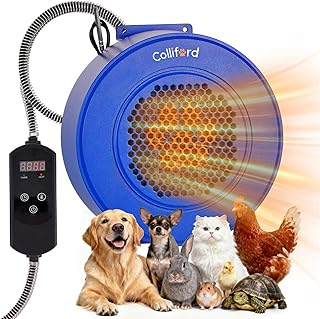
Best for: Buyers who prioritize adjustable temperature and scheduled operation. This 500W heater lists a thermostat range of 40–115°F and a 24-hour timer, providing more explicit control details than some of the other options.
The product description says it can warm up to 125 cubic feet. It also lists a 9.8-foot chew-proof cord, an internal overheat sensor, and an aluminum body. The listing describes the unit as having passed a UL test report and says the cord and plug meet ETL standards; confirm the product documentation for the exact claims and applicable details.
Why it was selected: It pairs a stated coverage volume with a broad temperature setting range and timer. That combination can help buyers compare expected shelter size and desired operating schedule.
Limitation: The listing does not describe app or remote control. Choose another model if remote adjustment is a priority.
300W/600W Smart Thermostat Heater

Best for: Owners who want a heater that automatically responds to ambient temperature. The listing gives two output levels: 300W and 600W. It describes a PTC thermostat that switches the heater on and off based on the surrounding temperature.
The stated temperature ranges are 80–88°F on Low and 98–102°F on High. Other listed features include a steel spring around the power cord, a rubber-covered waterproof switch on the cord, a removable hair barrier mesh, and operating noise below 45 dB.
Why it was selected: Automatic temperature control and two heating levels are useful comparison points for buyers who do not want to rely only on manual switching. The protective cord spring and removable mesh are also clearly specified product details.
Limitation: The supplied listing does not give a dog-house coverage volume or a timer. Compare the heater’s placement and capacity with the shelter rather than assuming it suits every kennel.
GOLOPET Large Dog Heating Pad

Best for: Dogs that need a warm place to rest inside a shelter, rather than a device intended to heat all the air in the dog house. The listed pad measures 36 by 24 inches and offers adjustable temperatures from 80–130°F in 5-degree increments.
The LED controller sets the temperature and timer. The listing describes 13 timing options, including an always-on setting and automatic shutoff choices from one to 24 hours. It also claims UL/MET dual safety certification and a one-year warranty; review the current product documentation for the terms and certification details.
Why it was selected: The pad’s defined surface area, adjustable settings, and timer make it a distinct option for targeted warmth. It may suit buyers who want to warm a specific resting area.
Limitation: A pad warms its surface rather than circulating warm air through the whole dog house. It also requires a suitable power connection and careful placement so the dog can move away from the heated area.
1300W WiFi Dog House Heater

Best for: Buyers who want multiple ways to adjust a heater. The listing describes control through an app, remote, or onboard panel, as well as a thermostat display showing real-time temperatures.
This model lists three modes: Low at 850W, High at 1300W, and ECO mode. Its description says it provides heat quickly and that ECO protection monitors ambient temperature and shuts the unit down if it becomes too warm.
Why it was selected: The combination of app, remote, and panel control distinguishes it from the manually adjusted options. Multiple modes may appeal to buyers who want to change settings for different conditions.
Limitation: The supplied listing does not state a coverage volume, cord length, or chew-resistant cord feature. Check those details and confirm that the heater is suitable for the intended dog-house location before purchase.
Buying Guide: How to Choose a Dog House Heater
Should you heat the air or the dog’s resting spot?
An air heater is intended to raise the temperature in an enclosed space. It is generally the more relevant type when the goal is to warm the dog house itself. A heating pad provides warmth at a specific resting location, so it may be better when you want a warm surface without relying on it to heat the entire shelter.
These approaches are not interchangeable. A pad’s temperature setting does not indicate how warm the surrounding air will become. Likewise, an air heater’s wattage does not tell you the temperature at every point in a dog house. Consider the dog’s ability to move away from a heat source and keep the shelter arranged so the heated area does not take up the entire resting space.
What size heater fits the dog house?
Compare the shelter’s interior volume with the manufacturer’s stated coverage, where one is provided. In this group, the TURBRO listing gives a capacity of up to 100 cubic feet, and the 500W heater listing says up to 125 cubic feet. The other listings do not provide a comparable volume figure, so avoid treating wattage alone as proof of suitability.
Insulation, drafts, outdoor temperatures, and the shelter’s design can affect heating needs. A drafty or poorly insulated dog house may lose warmth faster than a well-sealed one. Do not assume a heater will compensate for a shelter that allows rain, wind, or cold air to enter.
Which control features matter most?
- Thermostat: A thermostat can help maintain a selected or listed temperature range. Check whether the model provides a precise set point or a narrower selection of modes.
- Timer: A timer allows scheduled operation or shutoff. The GOLOPET pad lists timer options, while the 500W heater lists a 24-hour timer.
- Remote or app control: The 1300W model lists app, remote, and panel control. This may be useful when the heater is positioned away from the house entrance.
- Power levels: Adjustable wattage can offer different output choices. The TURBRO model lists 200W and 400W settings; other models specify separate power levels or modes.
What safety details should you check?
Read the product instructions and verify that the heater is designed for its intended environment. Look for details such as overheat protection, cord construction, control placement, and water-resistance claims. A chew-resistant cord can reduce one specific cord hazard, but it does not make an electrical heater chew-proof or remove the need to keep wiring protected.
Keep the heater and cord positioned according to the manufacturer’s instructions. Avoid placing a heat source where bedding, water, or other materials can contact it unless the product directions explicitly allow that arrangement. Inspect the cord and unit regularly, and discontinue use if either is damaged. Do not leave a dog with a heater that is not installed or operated as directed.
How should you compare energy use?
Wattage indicates the heater’s rated power level, not the exact amount of electricity it will use over a day. Actual use depends on operating time, selected mode, thermostat behavior, and conditions in the shelter. A timer or thermostat may help control operation, but the listings do not provide enough information to calculate an individual household’s energy costs.
Choose the lowest appropriate setting that maintains a suitable environment, following the product instructions and your veterinarian’s advice for your dog. Do not select a higher-wattage product solely because its number is larger.
Which option makes sense for a cold outdoor kennel?
For an enclosed kennel up to the capacity stated in its listing, compare the TURBRO and 500W models first because both provide a coverage figure. If automatic temperature control is the priority, compare the 300W/600W model’s stated temperature ranges with the 500W model’s thermostat range. If the main need is a warm surface, the GOLOPET pad is the clearest match. Consider the 1300W model when its remote-control options are useful and you have confirmed its suitability for the space.
Frequently Asked Questions
Can a dog heating pad warm an entire dog house?
A heating pad warms the surface where it is placed. The GOLOPET listing does not describe it as an air-circulating heater, so it should be considered for targeted warmth rather than as a substitute for a dog-house air heater.
What is the best dog house heater for a small kennel?
Start by measuring the kennel’s interior volume and comparing it with a heater’s stated coverage. The TURBRO listing specifies up to 100 cubic feet, while the 500W model specifies up to 125 cubic feet. Neither figure guarantees the same result in every climate or shelter.
Are dog house heaters safe to leave on?
Use a heater only as instructed by its manufacturer. Some products list timers, thermostats, or overheat protection, but those features do not replace correct installation, cord inspection, and supervision appropriate to the product and setting.
Do I need a chew-proof cord?
A chew-resistant cord is a useful feature if a dog can reach the wiring, but it is not a guarantee against damage. Route and protect cords according to the product instructions, and keep electrical connections away from water and chewing access.
Is higher wattage always better for a dog house?
No. The right output depends on shelter volume, insulation, weather, and the heater’s intended use. Compare stated capacity and controls rather than choosing by wattage alone.
Can I use an indoor heater in an outdoor dog house?
Do not assume an indoor heater is suitable for outdoor use. Check the product’s stated intended environment, installation instructions, and any water-resistance details before placing a heater in a dog house exposed to outdoor conditions.