Answering a common buyer question, these 120V baseboard heaters with built-in or compatible thermostats deliver steady heat for small to medium spaces. They’re best for room-by-room heating, apartment livings, and zones that need simple, affordable warmth without hardwiring. This guide highlights five practical models, showing who each is best for, plus a quick at-a-glance table to compare key traits.
Summary table of selected products
| Product | Type | Best For | Key Note |
|---|---|---|---|
| Cadet Portable Electric Baseboard Heater (1500W, 120V) | Plug-in heater with built-in dial thermostat | Renters or rooms without wiring work | Portable and quiet convection heat |
| Stelpro Brava Electric Baseboard Heater (500W, 120V) | Hardwired, with external thermostat required | Quiet, compact spaces; requires thermostat | Durable steel construction, suitable for small areas |
| Cadet Built-In Thermostat Kit (Model BTF1W) | Thermostat kit for Cadet baseboards | Upgrading existing Cadet units for control | Easy end-mount installation |
| YeloDeer 4-Wire Manual Thermostat (110-265V) | Line-voltage thermostat for 120V/240V | Precise temperature control with high accuracy | Supports wide voltage range with digital-like precision |
| YeloDeer 4-Wire Manual Thermostat (240V Only) | Line-voltage thermostat for 240V | Dedicated 240V baseboard systems | Single-pole dial control for 240V circuits |
Cadet Portable Electric Baseboard Heater — 1500W, 120V

Best for renters or spaces that need easy heat with minimal installation. This plug-in unit requires no hardwiring and uses a six-foot grounded cord for flexible placement. It includes a built-in dial thermostat for immediate temperature control, avoiding the need for a separate wall thermostat. The heater uses quiet convection to deliver up to 5,120 BTU in a compact form suitable for bedrooms, offices, and small living rooms. A potential limitation is its plug-in design, which depends on outlet availability and cord length.
Who it’s best for: Tenants, students, or homeowners seeking portable warmth without any electrical work. Why selected: Combines simple setup, built-in control, and quiet operation in one package. Caution: Ensure your outlet circuit can handle the wattage on longer use to avoid tripping a breaker.
Stelpro Brava Baseboard Heater, 500W

Best for small rooms where quiet operation is key and a hardwired setup is already in place. The Stelpro Brava uses a single-piece steel construction and maintains a smooth, silent convection warmth. It requires an external thermostat (sold separately), making it a good pick for users who want flexible control with a dedicated wall unit. It’s not a plug-in model, so plan for wiring and appropriate circuit capacity. Limitation: Requires external thermostat and hardwiring, which adds installation steps.
Who it’s best for: Homeowners or condo owners who want a durable, quiet unit with the option to pair with a precise thermostat. Why selected: High-quality construction and silent performance. Caution: Pair with an appropriate thermostat to achieve full temperature control.
Cadet Single Pole Built-In Thermostat Kit (BTF1W)

Best for upgrading existing Cadet baseboards to controlled cooling and heating. This kit includes a large dial for straightforward adjustments and mounts at either end of the heater. It eliminates the need for extra wiring in many installations, making it suitable for DIY projects. One caution is that the kit assumes compatibility with Cadet baseboard models and may require confirming fitment before purchase.
Who it’s best for: Homeowners or landlords looking to add thermostat control to existing Cadet baseboards. Why selected: Simple installation, centralized temperature control, and compatibility with Cadet units.
YeloDeer 4-Wire Manual Thermostat (110-265V)
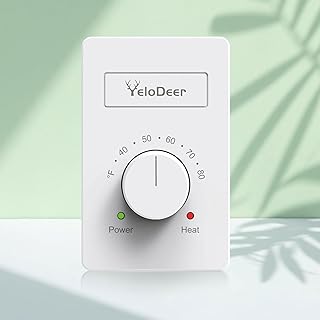
Best for precise, electronic temperature control on 120V or 240V heating systems. This line-voltage thermostat offers higher accuracy than traditional mechanical options, with a control range from 40°F to 80°F (4.4°C to 26.7°C). It accommodates dual-voltage setups, making it versatile for rooms that may switch between 120V and 240V configurations. A limitation is that it requires a compatible baseboard model and proper wiring to ensure safety and function.
Who it’s best for: Users who want tighter temperature precision in larger or multi-volt systems. Why selected: Higher accuracy and compatibility with various voltages. Caution: Ensure correct wiring and safety clearance when installing.
Buying Guide: 120V Baseboard Heater With Thermostat
Buying Guide: Key purchase considerations and comparisons
What to consider when choosing a 120V baseboard heater
- Heat output and room size: Look for BTU ratings or wattage to match space needs. Higher wattage suits larger rooms; smaller rooms benefit from 500W–1000W models.
- Plug-in vs. hardwired: Plug-in units offer portability and ease of setup; hardwired units often pair with in-wall thermostats for cleaner aesthetics.
- Thermostat type: Built-in digital or dial thermostats provide simpler control; external thermostats enable more precise zoning and integration with home systems.
- Noise level: Convection heaters typically operate quietly; two-piece assemblies may have ticking sounds as metal expands or cools.
- Installation considerations: Check outlet availability, circuit capacity, and whether wall or end-mount thermostats are compatible with existing baseboards.
- Safety features: Look for tip-over protection, overheat safeguards, and stable mounting options for pets and children.
Practical questions buyers ask
- Can I use a 120V baseboard heater in a small apartment? Yes, especially plug-in models that don’t require wiring.
- Do I need a thermostat with baseboard heaters? External thermostats or built-in controls help maintain consistent comfort and energy efficiency.
- Is a hardwired unit harder to install? It usually requires basic electrical work or professional installation but provides tidy, permanent heat.
- Are these units energy efficient? Baseboard heaters are efficient for zone heating when used to heat only occupied spaces.
- What maintenance is required? Wipe surfaces and ensure vents aren’t blocked; no routine parts require lubrication since units are solid-state convection types.
Frequently asked questions
- What is the difference between plug-in and hardwired baseboard heaters? Plug-in units are portable and install without wiring; hardwired units stay in place and often integrate with built-in thermostats.
- Will a baseboard heater overheat a room? Most models have built-in safeguards; use a thermostat to regulate temperature and prevent overheating.
- How many watts should I choose for a given room? A general rule is 10 watts per square foot; larger spaces may require higher wattage or multiple units.
- Can I mix 120V and 240V baseboard heaters in one home? Yes, but ensure proper circuit capacity and separate circuits for higher-power units.
- Do baseboard heaters heat quickly? They provide steady, long-lasting heat and may take longer to warm a room than forced-air systems, but they maintain consistent temperatures.