Answering the demand for on-demand hot water in off-grid and mobile living, these 12V tankless water heaters provide instant heat with minimal propane or electricity use. They’re best for RV owners, camper crews, and tiny-home travelers who need reliable hot water without bulky tank systems. The following five models stand out for rugged design, altitude tolerance, and ease of installation. A quick summary table below highlights key suitability at a glance.
| Product | Best For | Key Advantage |
|---|---|---|
| Somokg RV Tankless Water Heater | Off-grid camping and high-altitude RVing | Smart ignition with propane savings |
| ORBEK RV Tankless Water Heater | Standard RV openings & high-altitude use | Staged combustion with high-altitude adaptability |
| APUS RV Tankless Water Heater | Compact RVs needing strong flow | 3.9 GPM and 68,000 BTU propane capability |
| RVPart Pro RV Tankless Water Heater | Family use and easy troubleshooting | Built-in panel and fault code displays |
| Jocoevol 55,000 BTU RV Tankless | Family RVs needing safety and control | CSA certified with advanced safety features |
The table above helps compare core strengths. Each model is 12V or propane-fueled, designed to heat water on demand, reduce waste, and fit standard RV openings. Consider burner capacity, altitude performance, door size compatibility, and control interfaces when choosing.
Somokg RV Tankless Water Heater

This 12V propane-powered unit delivers up to 3.9 GPM with rapid heating. It features precise ±1°F temperature control for steady showers and a fast 3-second heat response. It uses a 1.5 kg copper heat exchanger and thicker elbows to resist leaks and cracking in freezing conditions. Gas nozzles are widened to sustain ignition at altitudes as high as 9840 feet. Best for off-grid campers who prioritize quick hot water and reliable ignition in challenging weather. Potential limitation: performance may vary if water flow is very low or supply pressure is inconsistent.
ORBEK RV Tankless Water Heater
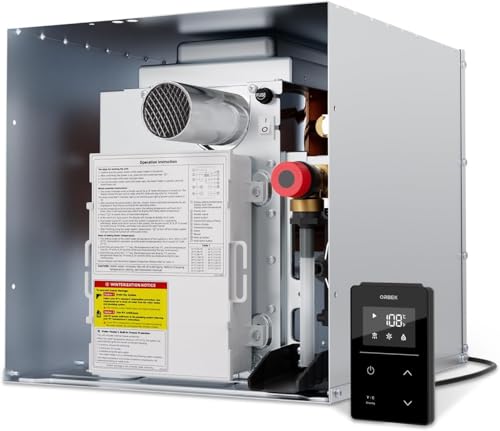
Orbek offers continuous on-demand hot water with a 60,000 BTU propane burner and 12V DC operation. It heats water only when requested, reducing propane use while delivering consistent temperatures. The system supports standard RV openings (15″ × 15″, 15″ × 18″, 18″ × 18″). It’s designed for high-altitude use with oxygen-free copper heat exchangers and a brushless DC fan. Best for campers needing predictable temperature stability and straightforward replacement. Limitation: verify cutout fit before purchase to ensure compatibility with your cabinet opening.
APUS RV Tankless Water Heater

APUS provides 68,000 BTU propane heating with up to 3.9 GPM flow. The unit is designed to fit most standard RV openings and can run on 12V DC. It supports high-altitude operation and includes features to stabilize temperature even during weather shifts. This model is best for RV owners who want a balance of high heat output and a compact footprint. Caution: ensure your electrical and propane systems can safely support 60–68k BTU during peak demand.
RVPart Pro RV Tankless Water Heater

RVPart Pro emphasizes user-friendly operation with a built-in microcomputer panel. It delivers about 60,000 BTU with a 12V DC option and an oxygen-free copper heat exchanger. The unit includes a panel that displays fault codes, aiding troubleshooting, and a 150 PSI pressure reducing valve for easier integration. Best for families who value clear diagnostics and easy temperature control. Limitation: like many tankless RV heaters, performance depends on stable water flow and proper venting.
Jocoevol 55,000 BTU RV Tankless Water Heater

Jocoevol delivers 55,000 BTU with high-altitude availability and a CSA certification. It features an LCD display with touch controls and can regulate water temperatures from 95°F to 123°F. The system is designed for RV families, offering a reliable hot water supply for showers and dishes. It includes safety features like flame stabilization and anti-dry burning protection. Choose this when safety certification and clear temperature readouts are priorities. Limitation: lower BTU versus some 65k BTU models may affect peak hot water performance on very large households.
Buying Guide
What should you consider when choosing a 12V tankless water heater for an RV or camper?
- Hot water flow: Look for GPM ratings that match your shower and faucet usage. 3.5–4.0 GPM covers most typical RV needs.
- Power source and efficiency: Some units run on 12V DC, others require propane. Consider how you power your RV (solar, generator, or propane tank).
- Altitude and cold-weather performance: For mountain trips, select models designed for high altitude and low water pressure.
- Openings and installation: Check door size, cutout dimensions, and compatibility with standard RV openings to simplify installation.
- Controls and diagnostics: LCD displays and fault-code reporting help ongoing operation and troubleshooting.
- Safety features: Look for flame stabilization, dry-fire protection, and anti-freeze or freeze protection if you travel in cold climates.
Frequently Asked Questions
- Do 12V tankless water heaters require a lot of power?
It depends on the model; some use propane with 12V ignition, while others are electric tankless units requiring high-widelity power or USB-supply in RVs. Check the exact wattage and power source for your system. - Can these units operate at high altitudes?
Yes, many are designed for high-altitude use and include features to maintain temperature consistency and reliable ignition. - What is the typical flow rate for RV tankless heaters?
Most models in this list provide around 3.5–4.0 GPM, suitable for multiple outlets with careful usage. - Is CSA certification important?
CSA certification indicates adherence to safety standards, which is beneficial for any RV appliance actively heating water. - Should I choose propane or electric?
Propane models offer independence from shore power, while electric (110V) units can be convenient where electric service is abundant. Consider fuel availability and your travel patterns. - Are there installation caveats I should know?
Ensure venting, proper clearances, and compatibility with the RV door and cutout sizes; improper installation can affect safety and performance.