The best 220-volt heater depends on the room, installation, and kind of warmth you need. For home rooms, the Envi panel heater is the most residential-focused option in this selection. For garages and workshops, the Comfort Zone ceiling heaters and Dura Heat 240-volt unit are better suited to higher-output, dedicated-circuit heating. Check the voltage and wiring requirements before buying: 220-volt and 240-volt heaters are not automatically interchangeable with standard household outlets.
| Product | Best for | Key distinction |
|---|---|---|
| Envi 220 Volt Panel Heater | Bedrooms, offices, and other home rooms | Wall-mounted, fanless operation |
| Comfort Zone 5000W Ceiling Heater | Garages and workshops | Ceiling mount and adjustable airflow |
| Comfort Zone CZ220BK | Workshops with limited floor space | Hard-wired 240-volt, 5,000-watt heating |
| Dura Heat EUH4000 | Garage or utility-area heating | 240-volt, 20-amp electric heater |
| Dura Heat EUH1500 | Smaller spaces needing portable forced air | Thermostat and adjustable stand; voltage needs confirmation |
Envi 220 Volt Panel Heater

Best for: People seeking supplemental heat in a bedroom, bathroom, office, kitchen, or other home room. This product is explicitly described as a 220-volt hardwired wall heater, making it the clearest match for a search for a 220-volt home heater.
The Envi uses a fanless convection design to circulate gentle warmth. Its manufacturer describes it as quiet, with a comfort-level thermostat and an auto-dimming power light. The wall-mounted format avoids taking up floor space, while the stated lower-wattage design is intended for targeted room heating alongside or instead of central heat.
The listed safety features include a cool-to-the-touch surface and a wall sensor that cuts power if the heater is removed from its mounting. The fanless operation may also suit people who prefer not to have a heater blowing dust or allergens around the room.
Why it was selected: It is the most directly home-oriented option and the only listing that specifically identifies itself as a 220-volt panel heater. Limitation: It requires hardwiring, and the supplied information does not specify wattage or room-size coverage. Confirm those details and installation requirements before purchase.
Comfort Zone 5000W Ceiling Heater

Best for: A garage, warehouse, or storage area where floor space is valuable and a ceiling-mounted heater is practical. The product listing describes a 5,000-watt, 240-volt, fan-forced heater with hard-wired installation.
The heater’s ceiling-mount design keeps the unit out of the way. Heavy-gauge steel construction is intended for demanding areas with temperature fluctuations. Louvers and an adjustable mounting angle help direct airflow toward a work area or other target zone.
The listing also describes three heat settings and overheat protection. These features make it a useful choice for buyers who want directional forced-air heat and prefer a permanently mounted solution over a portable floor heater.
Why it was selected: It combines substantial listed wattage with space-saving installation and adjustable heat direction, which are practical features for garages and workshops. Limitation: It is a hard-wired 240-volt product, not a plug-in heater for a standard outlet. Plan for appropriate electrical installation and verify that the circuit matches the product requirements.
Comfort Zone CZ220BK 5000W Heater

Best for: Garage and workshop owners who want a 240-volt ceiling-mounted heater with fan-forced heat. The listing identifies this model as a hard-wired 5,000-watt, 240-volt unit and describes it as suitable for workshop and garage use.
Like the other Comfort Zone ceiling heater in this selection, the CZ220BK has a heavy-gauge steel body, adjustable mounting angle, and louvers to direct airflow. Its fan-forced design moves heated air into the space, while the ceiling installation leaves the floor clear for vehicles, tools, and work areas.
Listed safety features include overheat protection and a thermal cut-out switch. The provided feature descriptions closely overlap with those of the other Comfort Zone model, so compare the exact model information and installation documentation before choosing between them.
Why it was selected: It is a clearly specified 240-volt, 5,000-watt option designed for garage and workshop settings. Limitation: It requires hardwiring and is not described as a portable heater. It may be a poor fit for renters or anyone who cannot arrange a suitable dedicated electrical installation.
Dura Heat EUH4000 240V Heater
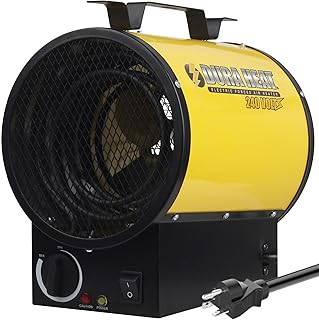
Best for: Buyers looking for a 240-volt electric heater for a garage or similar utility space. The listing identifies a 240-volt, 20-amp electric model and gives a 4,000-watt rating. Its name also lists 3,750 watts and 12,800 BTU, so check the product label and current manufacturer information to confirm the precise specification.
This Dura Heat option is a straightforward candidate for shoppers comparing dedicated-voltage electric heaters. The supplied details are much more limited than for the Comfort Zone models, so there is less information here about mounting, airflow direction, thermostat controls, or safety features.
Why it was selected: The listed 240-volt and 20-amp electrical details make it relevant to buyers seeking a higher-voltage garage heater. Limitation: The wattage information in the supplied product name is not fully consistent. Confirm the exact model rating, required circuit, installation type, and included controls before purchase.
Dura Heat EUH1500 Forced-Air Heater

Best for: Buyers who need adjustable, directed forced-air heat in a space described as up to 250 square feet. Listed features include a built-in thermostat, overheat shut-off, and an adjustable stand for changing the direction of heat.
This model differs from the hard-wired ceiling heaters because its stand allows the user to direct the airflow. The stated heating area offers a useful starting point for comparing it with room dimensions, although actual comfort can vary with insulation, ceiling height, outside temperature, and air leakage.
Why it was selected: It adds a smaller-area, directional-heating option to a comparison otherwise focused on 220- and 240-volt products. Important limitation: The supplied information does not state this model’s voltage. Do not assume it is a 220-volt heater based on the article topic; verify its nameplate and electrical requirements before buying.
Buying Guide: Choosing A 220-Volt Heater
Is a 220-volt heater the same as a 240-volt heater?
Product listings may use 220, 230, or 240 volts in different ways, but buyers should not assume that every heater labeled with one voltage is suitable for a circuit labeled with another. Follow the heater’s nameplate, installation instructions, and electrical requirements. A qualified electrician can confirm whether the home’s circuit is appropriate.
In the United States, most standard wall outlets supply lower-voltage household power and are not suitable for a 220- or 240-volt hard-wired heater. The Comfort Zone models and the EUH4000 listing specify higher-voltage installation details. The EUH1500 listing does not provide voltage, so its suitability for a 220-volt setup is unconfirmed.
Should you choose a wall heater or a ceiling heater?
A wall-mounted panel heater can be a better match for a home room where quiet operation and a low-profile installation matter. The Envi listing describes fanless convection, wall mounting, and room-focused use. Ceiling heaters are more appropriate when you want to keep the floor clear, especially in garages and workshops, and the airflow can be directed toward a particular area.
Installation differs too. The Envi and Comfort Zone products are described as hard-wired. Before selecting one, consider the mounting location, electrical access, clearance requirements, and whether professional installation is needed. Do not choose a product solely because its voltage appears close to an existing circuit rating.
How much wattage do you need?
Higher wattage indicates greater electrical input, but it does not by itself guarantee that a heater will warm every space comfortably. Room size, insulation, air leaks, ceiling height, and climate all affect heating needs. The Comfort Zone models list 5,000 watts, while the EUH4000 listing contains more than one wattage figure. The Envi listing does not provide wattage in the supplied details.
Use any stated room-coverage figure as a starting point rather than a promise. The EUH1500 listing says it is intended for areas up to 250 square feet, but its voltage is not supplied. For rooms with poor insulation or high ceilings, a heater may not deliver the same comfort as it would in a smaller, better-sealed space.
Do you need fan-forced or fanless heat?
Fan-forced heaters move warm air with a fan and can be useful when you want airflow directed toward a work area. Both Comfort Zone models are described as fan-forced, with louvers and adjustable mounting angles. The Envi uses a fanless convection design, which the listing describes as quiet and as not blowing dust or allergens around the room.
Choose based on the room and your priorities. A fanless panel may suit a bedroom or office where quiet operation is important. A fan-forced heater may be preferable in a garage or workshop where directional airflow is useful. The product information provided does not specify comparable noise levels for the fan-forced models.
What safety and installation details should you check?
Look for clearly stated protections and verify that the product’s installation instructions match the intended location. The Envi listing describes a wall sensor that cuts power if the unit is removed from the wall. The Comfort Zone CZ220BK lists overheat protection and a thermal cut-out switch; the other Comfort Zone model lists overheat protection. The EUH1500 lists overheat shut-off.
- Confirm the heater’s voltage, wattage, amperage, and wiring method from its product documentation.
- Check whether the unit is hard-wired or designed to plug in; do not use an unsuitable outlet or adapter.
- Review mounting and clearance instructions before installing a wall or ceiling heater.
- Keep the heater’s use and placement consistent with the manufacturer’s directions.
- When electrical requirements are unclear, ask a qualified electrician to assess the circuit.
Frequently Asked Questions
Can I plug a 220-volt heater into a regular household outlet?
Do not assume that you can. Standard household outlets may not match a 220- or 240-volt heater’s voltage, current, or connection requirements. Check the heater documentation and have the circuit assessed if necessary.
Which product in this list is most clearly intended for a home room?
The Envi panel heater is the most home-focused option in the supplied product information. It is described for rooms including bedrooms, bathrooms, offices, and kitchens, and it has a fanless, wall-mounted design.
Which options are better suited to garages and workshops?
The Comfort Zone 5,000-watt ceiling heaters and the Dura Heat EUH4000 are listed as 240-volt or higher-voltage heating options for garage, workshop, or utility use. Confirm the exact installation and electrical specifications before selecting one.
Is the Dura Heat EUH1500 a 220-volt heater?
The supplied product details do not state the EUH1500’s voltage. Verify the model’s nameplate and manufacturer specifications rather than assuming it is compatible with a 220-volt circuit.
Are 220-volt heaters suitable as the only heat source?
That depends on the heater’s capacity, the room, insulation, climate, and the home’s heating plan. The Envi listing says the heater can supplement or replace central heating, but the supplied information does not provide a wattage or a room-coverage figure to assess a specific installation.