Looking for a reliable 40,000 BTU garage heater to keep your shop comfortable without breaking the bank? This guide highlights five practical choices that deliver steady infrared or forced-air heat for garages, workshops, and similar spaces. Each option targets different needs—fuel type, electrical availability, ceiling height, and installation style—so you can select a model that matches your space and usage pattern.
Buyer type snapshot:
– Best for infrared heat enthusiasts who want silent, zone-focused warmth with minimal airflow.
– Best for garages with no electrical access or simple setups.
– Best for larger garages or industrial spaces needing consistent ambient temperature.
– Best for ceiling-mounted installations where space efficiency matters.
– Best for flexible fuel options (propane or natural gas) and higher BTU capacity.
| Product | BTU and Type | Fuel | Best For |
|---|---|---|---|
| Mr. Heater 40,000 BTU Garage/Workshop Radiant Propane Heater | 40,000 BTU, Radiant Infrared | Propane | Small to medium garages needing quick, direct heat |
| Mr. Heater 40,000 BTU Propane Garage Heater | 40,000 BTU, Infrared Heat | Propane | Simple, cost-effective warmth for basic shop spaces |
| Reznor 45,000 BTU Unit Natural Gas Heater Indoor Use Garage and Shop Heater | 45,000 BTU, Forced Air | Natural Gas | Ceiling-mounted or suspended installations in moderate-to-large spaces |
| Mr. Heater 50,000 BTU Forced-Air Unit Heater (Propane or Natural Gas) | 50,000 BTU, Forced Air | Propane or Natural Gas | Large garages needing consistent ambient heat |
| Reznor 60,000 BTU Unit Natural Gas Heater Indoor Use Garage and Shop Heater | 60,000 BTU, Forced Air | Natural Gas | Industrial-grade warmth in bigger spaces |
Mr. Heater 40,000 BTU Garage/Workshop Radiant Propane Heater

Best for: small to midsize garages where direct infrared warmth is preferred. This unit provides efficient infrared heat suitable for well-ventilated spaces with 12–15 ft ceilings. Clearances are Top 36″, Sides & Back 30″, Below 68″.
Why selected: Its infrared design focuses heat where you need it, reducing energy waste. It’s a straightforward installation choice for spaces without complex ductwork. A potential limitation is the need for proper clearances around the unit to ensure safe operation and prevent fire risk.
Mr. Heater 40, 000 BTU Propane Garage Heater #MH40LP,Multi

Best for: spaces where electric power is limited or not required for operation. This model delivers efficient infrared warmth with no electricity dependency, making it suitable for off-grid or single-outlet garages. Clearances: Top 36″, Sides & Back 30″, Below 68″.
Why selected: It’s an excellent choice when you want reliable heat without wiring constraints. Limitations include reliance on propane supply and the need for proper venting and outdoor-rated installation in some configurations.
Mr. Heater 50,000 BTU Forced-Air Unit Heater

Best for: larger garages, barns, or workshops that require consistent ambient warmth and ducted air distribution. It is compatible with standard 24-volt thermostats (sold separately) for smart control. Clearances and venting vary by installation.
Why selected: The higher BTU output supports bigger spaces and more even heating. A caution: Forced-air units can move dust and create airflow noise; ensure ventilation is adequate and space is safe for a blower environment.
Mr. Heater 125,000 BTU Forced-Air Unit Heater
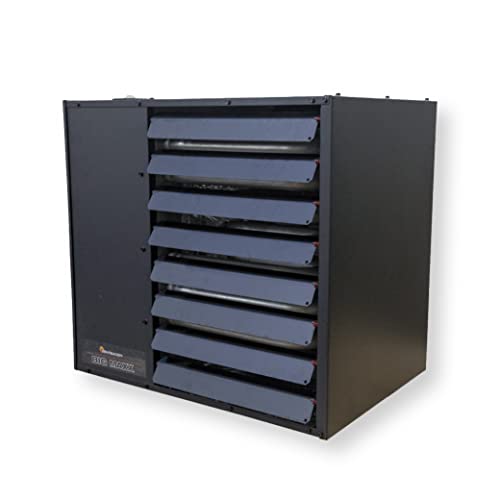
Best for: large commercial garages or workshops requiring robust heat with flexible fuel options. This model uses electronic ignition and includes liquid propane conversion for broader fuel compatibility. Best used with appropriate venting and installation by a qualified professional.
Why selected: It provides substantial heating capacity for very large spaces. Limitation: Higher BTU output means greater energy use and more complex installation considerations than smaller units.
Reznor 45,000 BTU Unit Natural Gas Heater Indoor Use Garage and Shop Heater

Best for: ceiling-mounted or suspended installations in mid-sized garages or workshops. It achieves 83% thermal efficiency with 45,000 BTU. Mounting brackets are sold separately, and this is suitable for indoor use in commercial or residential spaces.
Why selected: Reznor units are known for reliable forced-air performance and proven efficiency. Caution: Mounting hardware and brackets are not included; ensure appropriate mounting and ventilation for safe operation.
Reznor 60,000 BTU Unit Natural Gas Heater Indoor Use Garage and Shop Heater
Best for: larger industrial spaces needing robust, reliable heat with quiet forced-air operation. The 60,000 BTU rating provides substantial warmth for bigger garages or workshops. It comes with 83% thermal efficiency as a performance benchmark.
Why selected: It offers a balance of capacity and efficiency for demanding use. Limitation: Like other gas heaters, installation should consider venting and code compliance; mounting and service access are important for safe operation.
Buying Guide: Key Considerations for 40,000 BTU Garage Heaters
- Heat type: Infrared (radiant) vs. forced-air. Infrared heats objects and people directly, while forced-air warms the air for uniform space heating. Choose based on ceiling height, space layout, and noise tolerance.
- Fuel type: Propane vs. natural gas. Propane units are versatile for standalone setups; natural gas requires a gas line but can offer steady fuel costs for larger or constant use spaces.
- Ventilation and safety: Ensure proper clearance to combustibles, installation clearances, and venting requirements per model. Indoor-use gas heaters require appropriate ventilation and safety measures.
- Installation style: Ceiling-mounted, wall-mounted, or free-standing. Ceiling and wall options save floor space but may require professional installation or mounting kits.
- Space size and BTU needs: Larger spaces demand higher BTU output. Match the unit’s BTU rating to the garage or shop size to avoid over-heating or under-heating.
- Thermostat compatibility: Some models work with standard or smart thermostats. If you want automation, verify compatibility or required accessories.
- Maintenance and service: Consider units with accessible ignition systems, ease of filter or burner maintenance, and local service support.
Frequently Asked Questions
- What is the benefit of infrared vs. forced-air heaters for garages? Infrared heats people and objects directly, which can feel warmer quickly without moving a lot of air. Forced-air heats the entire space more evenly but may circulate dust or require ducting.
- Can these heaters be used in unvented garages? Infrared radiant heaters are often safer for partially vented spaces when installed with proper clearance, but combustion heaters (gas) typically require proper ventilation and adherence to local codes.
- Do these units require electricity? Some operate without electricity (certain propane infrared models), while many forced-air units rely on electricity for ignition and fan operation.
- How do I choose the right BTU for my garage? Calculate by space size, ceiling height, insulation quality, and typical desired temperature. A professional can help size a system for efficiency and safety.
- Are higher BTU units always better? Not necessarily. Oversized units heat quickly but may cycle more, wasting fuel. Match BTU to space to maintain a comfortable, stable temperature.
- Is professional installation recommended? For gas-fired and ceiling-mounted units, professional installation is advisable to ensure venting, clearances, and electrical connections meet safety standards.