The best air exchanger with heat recovery depends on whether you need ventilation for one room or a home-wide HVAC setup. The Weiworld is best for a single room with app control, while the LINGGONGAIR adds humidity and sleep modes. The Pioneer ECOasis 150 is a strong option for filtered, monitored single-room ventilation. For ducted systems, consider the Fantech AEV80; the Broan B160H65RS is a higher-airflow wall- or ceiling-mounted model, though the listed details are limited.
| Product | Best For | Key Detail |
|---|---|---|
| Weiworld 6-Inch HRV | Single-room ventilation and remote control | Ceramic core; three modes |
| LINGGONGAIR 4-Inch HRV | Bedrooms and rooms needing humidity or sleep modes | Six ventilation modes |
| Pioneer ECOasis 150 | Filtered, monitored single-room ventilation | Up to 88 CFM; four-stage filtration |
| Fantech AEV80 | Small-home HVAC integration | Up to 82 CFM; washable MERV 8 filter |
| Broan B160H65RS | Wall- or ceiling-mounted ventilation | 150 CFM listed capacity |
Weiworld 6-Inch Ceramic Heat Recovery Ventilator
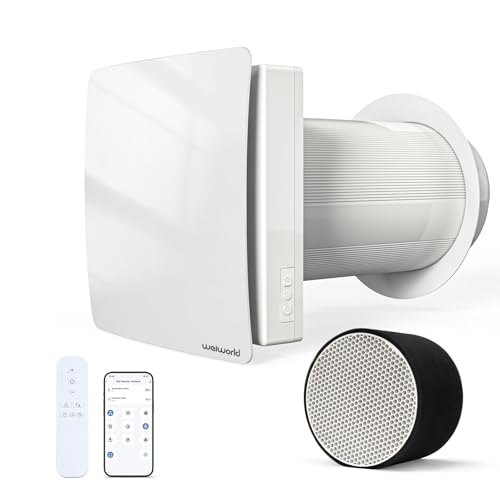
Best for: A homeowner who wants heat-recovery ventilation in an individual room and values app or remote operation. The product is designed as a wall-mounted, single-room system rather than a whole-house ducted unit.
Its ceramic heat exchanger is listed as recovering up to 90% of heat energy from exhaust air. That figure describes the stated heat-recovery capability; it does not mean the unit heats or cools a room. The system offers Fresh Air, Exhaust, and Recirculation modes, plus a 65-second cycle mode.
- Tuya app and included remote control
- Fan-speed, humidity, and mode adjustments
- Wall-mounted design for single-room ventilation
Why it was selected: It combines a ceramic core, several operating modes, and remote controls in a compact room-focused product. Limitation: The supplied details do not state airflow capacity, room-size coverage, or filter specifications, so compare those details before choosing it for a space with a particular ventilation requirement.
LINGGONGAIR 4-Inch WiFi Heat Recovery Ventilator

Best for: Someone ventilating a bedroom, home office, attic, or similar individual space who wants more than basic supply and exhaust settings. Its listing emphasizes app and remote operation and includes humidity and sleep functions.
The ceramic heat exchanger transfers thermal energy between incoming and outgoing air to help reduce the temperature penalty of ventilation. Six listed modes include Supply, Exhaust, Recirculation, Humidity, and Sleep functions, with the product description presenting the system as a six-in-one unit. Sleep mode is described as ultra-quiet with dimmed indicators.
- WiFi app and included remote control
- Humidity and sleep functions
- Supply, exhaust, and recirculation operation
Why it was selected: Its mode options make it a flexible room-level choice, especially for buyers who want humidity-related operation or reduced disturbance at night. Limitation: The provided specifications do not give airflow, heat-recovery percentage, or a precise room-size rating. Confirm those figures for the intended installation before purchase.
Pioneer ECOasis 150 Ductless Energy Recovery Ventilator
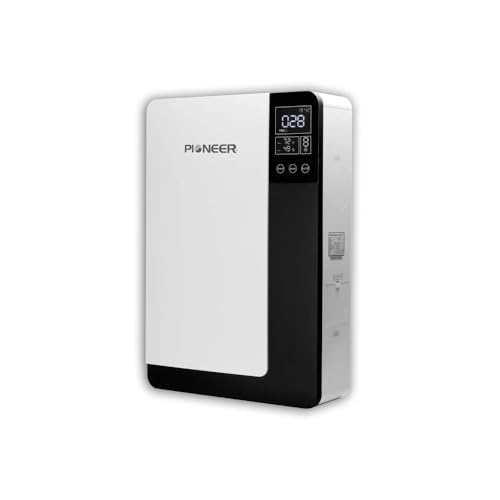
Best for: A buyer seeking a ductless, single-room system with filtration and air-quality monitoring. The stated coverage is 200 to 500 square feet, and the unit does not require connection to central HVAC ductwork.
The ECOasis 150 is listed with an 82% efficient heat exchanger, airflow up to 88 CFM, and a four-stage filtration arrangement. Its PM2.5 sensor and CO2 monitor track indoor air quality, with automatic fan-speed adjustment across eight levels. The listed filters include an outside-air/return-air primary filter, a PM2.5 filter, and an activated-carbon HEPA H10 filter. The product description states up to 99% purification efficiency when all four stages are used together.
- 35-watt power consumption, as listed
- Wall-mounted installation with side or rear connection options
- Designed to temper incoming air, not to replace heating or air conditioning
Why it was selected: Its stated airflow, coverage, monitoring, and filtration information make it easier to compare against room needs. Limitation: Installation requires an exterior-wall penetration; the listing recommends consulting a qualified installer for a proper, code-compliant setup.
Fantech AEV80 Air Exchanger Ventilator
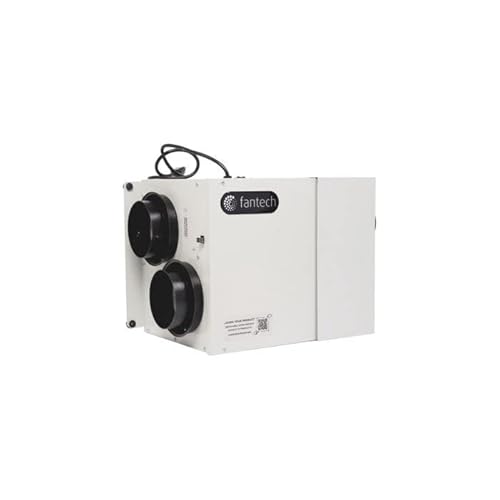
Best for: A buyer looking for an HVAC-compatible ventilator for a smaller home rather than a standalone wall-mounted room unit. The product information says it is compatible with an HVAC system and serves one- to two-bedroom homes.
The AEV80 is listed for airflow up to 82 CFM at 0.2 inches of static pressure. Its washable MERV 8 synthetic filter provides a defined filter type, while an external three-position switch offers Low, Standby, and Medium settings. The unit can be installed in any position, according to the listed features.
- Up to 82 CFM airflow
- Washable MERV 8 synthetic filter
- Three-position external switch
Why it was selected: It is a practical comparison for buyers who want a compact ventilation unit integrated with HVAC rather than a room-by-room WiFi system. Limitation: The provided information does not specify a heat-recovery efficiency percentage, detailed controls, or installation requirements. Check the product documentation and confirm compatibility with the planned HVAC setup.
Broan B160H65RS 150 CFM Heat Recovery Ventilator
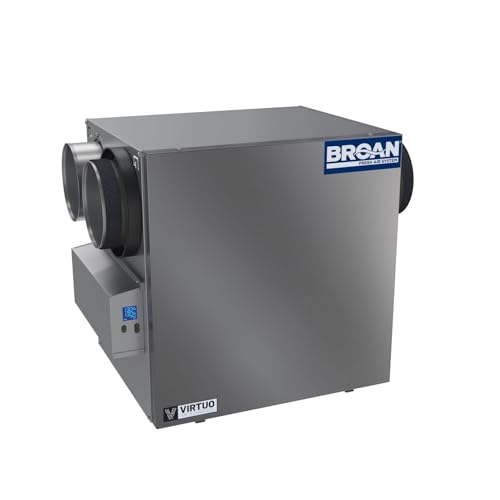
Best for: Buyers comparing a higher-capacity HRV intended for wall or ceiling mounting. The product name lists 150 CFM and VIRTUO Air Technology, with side ports.
The available product details identify the Broan B160H65RS AI as a 150 CFM heat recovery ventilator that can be wall- or ceiling-mounted. Beyond those nameplate details, the supplied feature information does not describe its controls, filtration, recovery performance, or installation needs. Those specifics matter when matching an HRV to a home’s ventilation plan.
- 150 CFM listed capacity
- Wall- or ceiling-mounted configuration
- Side ports and VIRTUO Air Technology named in the product title
Why it was selected: Its stated capacity and mounting options make it relevant to buyers comparing larger-capacity equipment with room-specific units. Limitation: Product details are sparse in the supplied information. Review the manufacturer’s specifications, including recovery performance and duct requirements, before selecting it for a project.
Buying Guide: How to Choose an Air Exchanger With Heat Recovery
Do you need a single-room unit or a ducted system?
Start by deciding whether the goal is ventilation for one room or coordinated ventilation for multiple areas. Wall-mounted ductless products such as the Weiworld, LINGGONGAIR, and Pioneer are presented for individual spaces. The Fantech is described as HVAC-compatible, while the Broan is a wall- or ceiling-mounted HRV. A central or duct-connected installation may better suit whole-home planning, but it must match the home’s ductwork and ventilation design.
What is the difference between HRV and ERV?
An HRV transfers heat between outgoing and incoming air. An ERV is designed to transfer heat and some moisture, though exact performance depends on its core and operating conditions. Product names and descriptions use these terms, so check the manufacturer’s documentation to confirm what the specific unit exchanges. Do not assume every product labeled an air exchanger has the same moisture-transfer behavior.
How much airflow does the room or home require?
Compare a unit’s airflow rating with the ventilation needs of the space and the intended installation. The listed products range from models with no supplied airflow figure to the Fantech at up to 82 CFM, the Pioneer at up to 88 CFM, and the Broan at 150 CFM. Maximum capacity alone is not enough: duct resistance, room layout, operating mode, and system design can affect delivered airflow.
How should heat-recovery efficiency affect the choice?
Use an efficiency figure as a comparison point, not a promise of a particular utility-bill reduction. The Weiworld listing states up to 90% heat-energy recovery, while the Pioneer lists an 82% efficient heat exchanger. The other selected product details do not provide a comparable percentage. Check how the manufacturer defines the figure and whether it applies to the conditions relevant to your climate and installation.
Which controls and modes are useful?
Choose controls based on how the space will be used. App and remote controls can simplify adjustments, while humidity operation may help buyers who want a moisture-responsive setting. Sleep mode may be useful in bedrooms, and a basic switch can suit buyers who prefer straightforward operation. Compare the actual listed modes rather than assuming similarly named products offer identical automation.
What should you check before installation?
Confirm wall or ceiling requirements, exterior access, electrical needs, duct connections, and any local building or ventilation requirements. A wall-mounted ductless system can still require a substantial wall opening; the Pioneer listing specifically recommends a qualified installer. HVAC-compatible and higher-capacity equipment may require a professional to assess duct sizing and system integration.
Do filters and maintenance matter?
Yes. Check whether a unit includes filters, what type they are, and whether they need replacement or cleaning. The Fantech lists a washable MERV 8 synthetic filter, while the Pioneer describes multiple filtration stages. Filter design and maintenance affect operating convenience, but a filter rating alone does not establish the system’s overall ventilation or air-cleaning performance.
Frequently Asked Questions
Does a heat recovery ventilator heat a room?
No. An HRV transfers some heat from outgoing air to incoming air to reduce ventilation-related energy loss. It tempers incoming air but is not a substitute for a heating system. The Pioneer listing explicitly describes its unit as a ventilation system, not an air conditioner or heater.
Can a single-room air exchanger serve an entire house?
These products are described as single-room or room-focused systems. One unit should not automatically be treated as a whole-house solution. Whole-home ventilation needs depend on the home’s layout, occupancy, and ventilation plan.
Is a higher CFM rating always better?
No. The correct airflow depends on the space and system design. A higher maximum rating does not guarantee better performance if the unit is oversized, improperly installed, or not suited to the ductwork and room requirements.
Do heat recovery ventilators need filters?
Filter arrangements vary. The Fantech lists a washable MERV 8 filter, and the Pioneer describes four-stage filtration. The supplied details for other selected models do not clearly specify filter types, so confirm the maintenance requirements for the exact product.
Can I install a wall-mounted HRV myself?
Installation requirements vary by model and location. Wall penetration, electrical connections, and local codes may be involved. The Pioneer product information recommends consulting a qualified installer; check the instructions and local requirements for any model before installation.