Milk house heaters can be safe for supplemental heat when used as directed, kept clear of anything that can burn, and monitored while operating. They are not risk-free: hot surfaces, electrical overloads, blocked airflow, and tip-overs can create fire or burn hazards. Among these options, the HiCFM and BEYOND HEAT models list specific safety features; the Comfort Zone offers thermostat control and tip-over and overheat protection in its product name. Choose based on the protections and controls you need, and follow the heater’s manual.
| Product | Best suited for | Listed safety information |
|---|---|---|
| HiCFM Milkhouse Space Heater | Buyers prioritizing listed safety features | Overheat sensor, tip-over switch, UL safety approval claim |
| Comfort Zone CZ798GR3 | Garage or workshop spot heating | Product name lists tip-over and overheat protection |
| BEYOND HEAT 2-Pack | Buyers seeking two heaters with shutoff features | Tip-over switch, overheat protection, ETL certification claim |
| Plexon Milkhouse Heater | Buyers wanting high, low, and fan-only modes | Product details do not specify safety shutoffs |
| Fanspex Portable Heater | Buyers comparing a 1500W milk-house model | Safety features are not provided in the supplied details |
Are Milk House Heaters Safe?
They can be used safely for supplemental heating if the specific unit is in good condition and the user follows its instructions. A product’s safety switches can reduce certain risks, but they do not make it safe to leave unattended or place close to combustible materials. “Milk house” describes a heater style, not a guarantee that every model has the same protections or is suitable for every room.
Check the manual and product label for operating instructions, clearance requirements, and electrical specifications. Use the heater only in the type of space allowed by its manufacturer. Keep it on a stable, level surface, and do not use it where it can be exposed to water or where airflow can be blocked.
Milk House Heater Safety Basics
- Keep the heater away from bedding, curtains, paper, clothing, furniture, and other combustible items. Follow the clearance distances in the manual.
- Plug the heater directly into a suitable wall outlet unless its instructions specifically say otherwise. Avoid overloading the circuit or using a damaged cord, plug, or outlet.
- Do not run the power cord under rugs or place furniture on it. Stop using the heater if the cord, plug, or unit is damaged.
- Place the heater on a stable, flat surface where it cannot be knocked over. Keep children and pets away from its hot surfaces.
- Do not leave a portable heater running unattended or while sleeping. Turn it off when leaving the room.
- Do not use a heater in a damp area unless its instructions explicitly permit that use. Keep the intake and outlet unobstructed.
Tip-over and overheat protection are useful features, but they are backup protections rather than substitutes for careful placement and supervision. A thermostat controls temperature; it does not, by itself, prevent every fire or electrical hazard.
HiCFM Milkhouse Space Heater
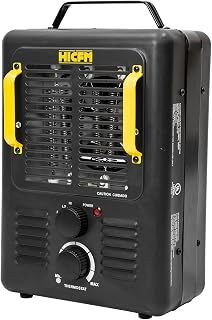
Best for: Buyers who want a milk house heater with several specifically listed safety features. The supplied product details list an overheat sensor, a tip-over switch, and a caution indicator light, as well as a metal body described as made with V0 flame-retardant materials. The listing also claims UL safety approval.
It offers fan-only, 1300W, and 1500W settings. The product description reports a 47 dB airflow noise level and states that it can warm a 100-square-foot room by 8°C in five minutes; actual results can vary with room conditions. Its six-foot power cord is also specified in the supplied features.
Why it was selected: Compared with products whose supplied details do not describe shutoff protections, this model lists both tip-over and overheat safeguards. Caution: It remains a portable heater that requires supervision and safe clearance. Treat the UL statement as a listing claim and check the product label and documentation for confirmation.
Comfort Zone Milkhouse Style Utility Heater

Best for: Buyers looking for a portable heater for targeted heating in an enclosed garage or workshop. The product name lists overheat protection and a tip-over switch, while the features describe 1500W performance, an adjustable rotary thermostat, and three modes: low heat, high heat, and fan-only.
The adjustable thermostat gives users a way to set a preferred temperature, and fan-only mode circulates air without selecting a heat setting. The supplied description focuses on enclosed garage heating, so buyers should check the manufacturer’s instructions before using it in any other kind of space.
Why it was selected: Its listed shutoff protections and adjustable thermostat make it a useful comparison against simpler models with fewer supplied details. Caution: A thermostat is not a safety shutoff, and neither it nor the listed tip-over and overheat features removes the need for monitoring and proper clearance.
BEYOND HEAT 1500W Milkhouse Heater

Best for: Buyers interested in a two-pack with listed tip-over and overheat protection. The product features specify fan-only, 1300W, and 1500W settings, plus an anti-freeze setting that the description says turns the heater on when the temperature drops below 40°F.
The product information describes heavy-duty construction and claims ETL certification. The two-pack format may suit a buyer who needs two units, but each heater still needs an appropriate outlet, suitable placement, and supervision. Do not assume that two heaters can safely run on the same circuit; check circuit capacity and manufacturer instructions.
Why it was selected: It offers a distinct low-temperature setting and identifies two automatic shutoff protections in the supplied features. Caution: The anti-freeze function should not be treated as unattended or freeze-damage protection unless the manufacturer’s instructions specifically say so. Verify certification information on the product and documentation.
Plexon Milkhouse Heater
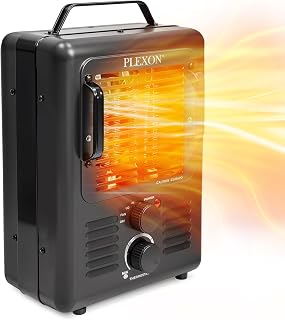
Best for: Buyers who want high- and low-heat settings plus a fan-only mode. The supplied features describe a metal construction and position the heater for small to medium-sized spaces, including rooms and garages. They also describe 1500W power and rapid heating, but do not provide a specific safety-switch list.
Why it was selected: Its three operating modes make it straightforward to compare with models that include a thermostat or additional listed protections. The metal body is a construction detail, not proof that the heater cannot overheat or start a fire.
Caution: The supplied product information does not identify a tip-over switch, overheat protection, or a certification. Confirm these details in the manufacturer’s manual and on the unit before buying if they are important to you. Although the product description mentions outdoor spaces, use it outdoors only if the manufacturer’s instructions explicitly allow that use.
Fanspex 1500W Portable Electric Space Heater

Best for: Buyers considering a 1500W portable milk-house heater who are willing to verify specifications before purchase. The supplied product information provides the model name and image but does not include feature details about modes, thermostat controls, tip-over protection, overheat protection, or certification.
Why it was selected: It is identified as a 1500W portable electric heater for indoor use, so it is relevant to shoppers comparing milk-house heater options. However, the available details are too limited to compare its safety features with the HiCFM or BEYOND HEAT models.
Caution: Do not assume that this heater includes safety switches or a thermostat based on the product name or image. Review its instructions, safety labeling, and electrical requirements before use.
Buying Guide: Choosing a Milk House Heater
Which safety features should you compare?
Look for clearly documented tip-over and overheat protection, then confirm the features in the product manual or labeling. These protections address different situations: a tip-over switch can stop operation if a unit falls, while overheat protection can shut a unit down if it becomes too hot. Neither prevents every hazard or replaces safe placement and supervision.
Check whether the product provides a verifiable safety listing or certification claim and whether the relevant details appear on the heater or its documentation. A claim in a product description is not a substitute for checking the actual product information.
Do you need a thermostat or multiple heat settings?
A thermostat can help control the selected temperature. High and low settings let users choose between heat levels, while fan-only mode runs air without a heat setting. An anti-freeze feature, when offered, has a particular low-temperature purpose; read its instructions rather than assuming it will keep a room or pipes safe in every condition.
How much wattage is appropriate?
Several heaters in this comparison are rated at 1500W, and the BEYOND HEAT model also lists 1300W. Follow the unit’s electrical requirements and check that the outlet and circuit can support the heater. Do not connect multiple high-wattage appliances to an overloaded circuit. A heater’s stated capacity does not guarantee a particular temperature in every room.
Can you use one in a garage or workshop?
Choose a model whose instructions permit the intended location. A garage or workshop can contain dust, stored materials, fuel, paint, or other items that increase fire risk. Keep the heater away from flammable substances and combustible storage, and do not use it in a damp area unless the manufacturer explicitly allows it.
Is a portable heater safe to leave on?
Do not leave a portable space heater unattended or running while asleep. Turn it off when leaving the room, and unplug it when it is not in use if the instructions recommend that practice. Check the cord and plug periodically for damage or unusual heat, and stop using the unit if you notice a problem.
What should you check before first use?
- Read the manual and confirm the heater is intended for the room or work area.
- Inspect the heater, plug, and cord for visible damage.
- Place the unit on a stable surface with the manufacturer’s required clearance.
- Confirm the outlet and circuit meet the heater’s electrical requirements.
- Test any listed controls or safety features according to the manual.
- Keep the heater, cord, and air openings clear during operation.
Frequently Asked Questions
Are milk house heaters safe to use indoors?
They can be used indoors when the specific heater is approved for that setting and operated according to its manual. Keep it on a stable surface, clear of combustible materials, and supervised.
Can I leave a milk house heater on overnight?
Do not leave a portable milk house heater running while you sleep. Turn it off when sleeping or leaving the room, and follow the manufacturer’s instructions.
Does a tip-over switch make a heater completely safe?
No. A tip-over switch can reduce risk if the heater falls, but it does not prevent hazards from blocked airflow, nearby combustible materials, electrical problems, or unattended operation.
Can I use a milk house heater in a garage?
Only if the heater’s instructions allow garage use. Keep it away from flammable materials and follow the specified clearance and electrical requirements.
Is 1500W too much for a standard outlet?
Whether a circuit can support a 1500W heater depends on the circuit and other connected loads. Check the heater label, outlet condition, and circuit capacity, and do not overload the circuit.
Are all milk house heaters UL listed?
No. Safety listings vary by product. Check the specific heater’s label and documentation; do not assume a model is listed unless its information confirms it.