The best camp hot water heater depends on how you plan to heat water: portable propane tankless units provide continuous on-demand water, while an immersion heater warms water in a container. The CAMPLUX AY132 is best for lightweight, low-pressure setups; the Ranein 6L offers a higher listed flow rate; and the BSEED is best for buyers who want a rechargeable shower pump paired with an immersion heater.
| Product | Best For | Listed Hot Water Flow or Heating Method |
|---|---|---|
| CAMPLUX AY132, White | Lightweight camping and low-pressure water sources | 1.32 GPM propane tankless |
| 18L Baococo Tankless Heater | Higher-flow outdoor hot water needs | 4.76 GPM propane tankless |
| Ranein 6L Tankless Heater | Portable showers with a hanging setup | 1.58 GPM propane tankless |
| CAMPLUX AY132G, Gray | Compact propane heating with included regulator | 1.32 GPM propane tankless |
| BSEED Portable Shower and Immersion Heater | Heating water in a bucket or basin | 2000W immersion heater |
CAMPLUX AY132 Portable Tankless Heater

Best for: Campers who want a light, portable propane heater that can start with a low-pressure water source. The listed weight is 10 pounds, and the folding handle is intended to make carrying and storage easier.
This outdoor tankless model is rated for 1.32 gallons per minute. The product details state that it starts at 3.0 PSI, which may suit setups using a small 12-volt water pump or a gravity-fed water bag. It does not need electricity to operate, according to the listing.
Why it was selected: Its low-pressure startup, compact form, and stated off-grid use make it a practical option for simple campsite shower or cleanup setups. The listed uses include rinsing off, washing pets, and doing camp dishes.
Limitation: The stated flow rate is lower than the 1.58 GPM Ranein and 4.76 GPM Baococo models in this list. Choose another option if a higher listed flow rate is your priority.
Baococo 18L High-Flow Tankless Heater

Best for: Buyers prioritizing a higher listed water flow for outdoor bathing, dishwashing, or washing pets. The product specifies a maximum output of 115,425 BTU per hour and a flow rate of 4.76 gallons per minute.
This propane tankless heater has a digital display and an adjustable temperature range listed as 17°F to 113°F. Its features also describe combustion designed for efficient operation and reduced operating noise. The listing names camping, RV travel, outdoor bathing, and pet washing as intended uses.
Why it was selected: Among the propane models included here, its stated 4.76 GPM flow rate is the highest. It also lists six protections: overheat protection, dry-combustion prevention, antifreeze protection, low-flow ignition lockout, flame-failure cutoff, and high-water-pressure relief.
Limitation: The provided product details do not specify its weight, water-pressure startup threshold, or installation requirements. Check the manufacturer’s instructions and confirm the setup suits your water source before buying.
Ranein 6L Portable Tankless Heater
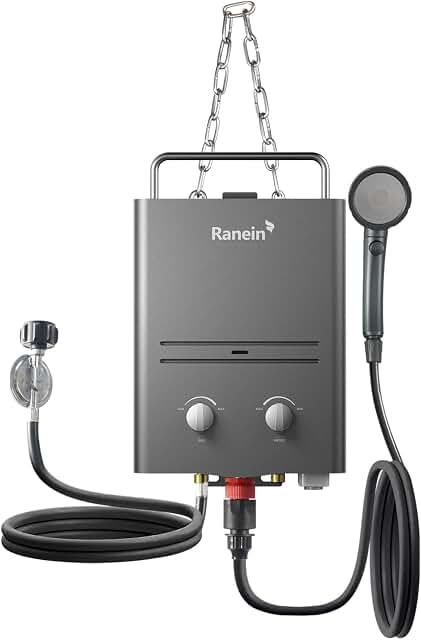
Best for: Campers who want a portable propane shower heater with a hanging chain and mounting bracket. The listing describes a foldable handle and a hanging option for setting up an outdoor shower.
The Ranein is rated at 1.58 GPM and 41,000 BTU. It starts at a listed water pressure of 3.6 PSI and has an adjustable temperature range of 55.4°F to 109.4°F. The package description also names a showerhead and brass connectors.
Why it was selected: Its listed flow rate is higher than the 1.32 GPM CAMPLUX models, while its hanging hardware makes it a distinct choice for campsite shower setups. The product also lists overheat, dry-combustion, and low-flow protection, as well as an antifreeze drain plug.
Limitation: Its 3.6 PSI startup threshold is higher than the 3.0 PSI listed for the CAMPLUX AY132 models. If your pump or gravity-fed source has limited pressure, compare its output with the heater’s stated startup requirement.
CAMPLUX AY132G Battery-Powered Heater

Best for: Campers seeking a compact propane tankless heater that uses batteries rather than a household electrical connection. The listing says it operates on two D-size batteries and weighs 10 pounds.
The AY132G is rated for 1.32 GPM of continuous, on-demand hot water and starts at a listed 3.0 PSI. It has temperature and water-flow dials, a folding handle, and a gas regulator. The product description positions it for camping, RV use, remote cabins, and off-grid water systems.
Why it was selected: It combines a low stated startup pressure with a portable design and battery-powered operation. Choose this model if those details match your setup and you prefer a dial-based way to adjust temperature and flow.
Limitation: Its listed flow rate is 1.32 GPM, so it is not the higher-flow choice in this group. It also requires two D-size batteries; factor that requirement into your trip planning.
BSEED Rechargeable Shower and Immersion Heater

Best for: Travelers who want to heat water in a bucket, portable tub, or basin rather than use a propane tankless heater. This product pairs a rechargeable shower pump with a 2000W immersion heater.
The shower pump has a listed 6000mAh battery and is described as providing 120 to 180 minutes of water flow after a three-hour charge. It can be charged through USB-C using a power bank, laptop, or car USB port. The immersion heater is intended for containers, and the kit includes a digital thermometer for monitoring water temperature.
Why it was selected: It offers a different approach for campsites where heating a container of water is more suitable than connecting an on-demand propane unit. Its display shows battery status and water temperature, with the stated temperature range running from 32°F to 140°F.
Limitation: This is not a propane tankless heater, and its 2000W immersion element needs an appropriate power source. Follow the product instructions for heating water and handling the element safely.
Buying Guide: How to Choose a Camp Hot Water Heater
Do you want tankless hot water or heated water in a container?
Start by deciding how you want to use hot water. A propane tankless unit heats water as it flows through the heater. That format can suit a shower or rinse station with a water supply and propane connection. The BSEED takes a different route: its immersion heater heats water in a bucket, basin, or portable tub, while a rechargeable pump moves water through the shower.
These approaches are not interchangeable in every setup. A tankless heater is designed for flowing water, while an immersion heater is described for use in a container. Compare the product’s instructions and your campsite’s available water and power sources before choosing.
How much water flow do you need?
Compare the stated gallons per minute when selecting a tankless model. The CAMPLUX AY132 and AY132G are each rated at 1.32 GPM, the Ranein at 1.58 GPM, and the Baococo at 4.76 GPM. These are the product listings’ specifications, not a guarantee of a particular shower experience in every setup.
Water temperature and flow can depend on the conditions and configuration of a system. If you are comparing models, consider whether the intended task is a quick rinse, a longer shower, dishwashing, or several uses in succession. Avoid assuming that a higher flow rating alone answers every question about performance.
Will your pump or water source meet the startup pressure?
Check the heater’s stated minimum water pressure and compare it with your pump or gravity-fed arrangement. The CAMPLUX AY132 and AY132G list a 3.0 PSI startup threshold. The Ranein lists 3.6 PSI. The Baococo details supplied here do not state a startup pressure.
A lower startup threshold may be relevant when using a small pump or gravity-fed supply, but you should still confirm that your complete setup works within the manufacturer’s requirements. Do not treat a pressure figure as a substitute for checking connections, water supply, and operating instructions.
Is propane, battery power, or electrical power available?
The CAMPLUX models and Ranein are propane heaters. The AY132 listing says it needs no electricity, while the AY132G specifies two D-size batteries. Check the listed power requirements rather than assuming every heater in a product line uses the same setup.
The BSEED’s pump has a rechargeable battery and USB-C charging, but its immersion heater is rated at 2000W. Confirm that an appropriate power source is available for the heater. The supplied product details do not specify a compatible power setup for every camping situation.
What safety and cold-weather features should you compare?
Read the safety features listed for the exact model. The Ranein describes overheat, dry-combustion, and low-flow protection, plus an antifreeze drain plug. The Baococo lists several protections, including flame-failure cutoff and high-water-pressure relief. The CAMPLUX AY132 feature information mentions overheat protection.
Feature lists vary, and they do not replace proper operation. Use outdoor propane equipment only according to its instructions, and follow all requirements for ventilation, placement, water connections, and storage. For cold-weather use, consult the product directions about draining and freeze protection rather than assuming every unit has the same protection.
How portable does the heater need to be?
Weight and carrying features matter when you pack for a campsite, road trip, or remote area. Both CAMPLUX models list a 10-pound weight and folding handle. The Ranein also describes a foldable handle, hanging chain, and mounting bracket. The supplied Baococo details do not give a weight, so check the product information if carrying size is important.
Consider the full setup, not just the heater body. Depending on the model and your plan, you may also need to account for a water source, pump, propane, batteries, and a stable place to position or hang the unit. Confirm which accessories are included in the product listing before purchase.
Which features matter for showers, dishes, and pet cleanup?
For showers, compare the listed flow rate, startup pressure, temperature controls, and included shower components. The Ranein listing names a showerhead, while the CAMPLUX models describe outdoor shower use. For dishes or pet cleanup, consider whether you need on-demand flow or whether a warmed container of water will meet the task.
Also consider how you will manage the used water and keep the setup stable. The product details describe potential uses, but your campsite rules and available facilities may affect what is practical. Follow local rules and the heater’s directions for use.
Frequently Asked Questions
What is a camp hot water heater?
A camp hot water heater is a portable device for providing hot water outdoors. The products in this guide include propane tankless heaters that warm flowing water and an immersion heater that warms water in a container.
Which listed camp heater has the highest flow rate?
The Baococo 18L tankless heater has the highest listed flow rate among these products at 4.76 gallons per minute. Its listing also states a maximum output of 115,425 BTU per hour.
Which propane models list a 3.0 PSI startup pressure?
The CAMPLUX AY132 and CAMPLUX AY132G listings state that the heaters start at 3.0 PSI. The Ranein lists 3.6 PSI. The supplied Baococo product details do not state a startup pressure.
Can a camp water heater work without electricity?
Some can, according to their listed power requirements. The CAMPLUX AY132 says it needs no electricity, while the AY132G specifies two D-size batteries. The BSEED pump is rechargeable, and its immersion heater is rated at 2000W, so check the power requirements for that heating method.
Is an immersion heater the same as a tankless water heater?
No. A tankless heater warms water as it flows through the unit. An immersion heater warms water in a container, such as a bucket or basin. Choose the format that fits your water source, power access, and intended use.
What should I check before using a propane camp heater?
Read the instructions for the specific model and verify its water-pressure, fuel, placement, and operating requirements. Follow the manufacturer’s safety directions for outdoor use, ventilation, connections, and cold-weather storage.