Ceiling-mount gas heaters provide powerful warmth for large, open spaces like garages, barns, and workshops. This guide highlights five top options, showing who each heater is best for, and why they stand out. Use this to compare installation needs, fuel type, and heating capacity before choosing your setup.
| Product | Best for |
|---|---|
| Mr. Heater 50,000 BTU Forced-Air Unit Heater | Large garages and workshops needing fast, circulating heat |
| Heatstar By Enerco F125444 Radiant Overhead | Overhead radiant heat in well-ventilated spaces |
| Mr. Heater Natural Gas Unit Heater 50,000 BTU/Hr. MHU50NG | Smaller-to-mid-size spaces with natural gas supply |
| ROVSUN 7500W Electric Ceiling Heater | Electrical-ready spaces and rooms where gas isn’t available |
| Modine Gas Wall and Ceiling Unit Heater | Industrial or commercial environments needing robust HVAC pairing |
The following sections compare five options, focusing on installation style, heat delivery, and suitability for different buyers. Each entry notes who benefits most, potential limitations, and practical reasons to choose or avoid it.
Mr. Heater 50,000 BTU Forced-Air Ceiling Unit Heater

This ceiling-mounted, forced-air unit heater delivers 50,000 BTU, warming up to about 1,667 square feet, making it suitable for garages with large open areas or multi-vehicle spaces. It can connect with standard 24-volt thermostats or newer Wi-Fi enabled thermostats (sold separately). Best for: someone who wants quick, controllable heat and compatibility with modern thermostat setups. Caution: ensure proper venting and clearance from combustibles; installation quality impacts performance and safety.
Heatstar By Enerco F125444 Radiant Overhead Garage Heater MH25NG Natural Gas

This overhead radiant heater uses natural gas to provide direct warmth to objects and people in the space below. Radiant heat is advantageous for locations where warm surfaces are a priority, and where quick spot heating is desirable. Best for: spaces with clear overhead mounting and a need for steady radiant warmth. Caution: radiant systems heat objects rather than air immediately; in larger drafts, air movement may still be needed for uniform comfort.
Mr. Heater Natural Gas Unit Heater 50,000 BTU/Hr. MHU50NG

This natural gas unit heater offers 50,000 BTU and is designed for moderate-sized spaces, heating up to about 700 square feet. It includes angle brackets for ceiling mounting, aiding a straightforward install. Best for: users who prefer natural gas and a compact footprint. Caution: check gas line compliance and venting requirements; improper installation can affect efficiency and safety.
ROVSUN 7500W Electric Ceiling Mount Heater

This electric ceiling heater provides 7500 watts of power, delivering up to 25000 BTU, and includes APP and remote control for convenient operation. It features adjustable directional outlets and protective safety mechanisms, including overheat protection and ETL certification. Best for: spaces with existing electrical wiring and a preference for clean-electric operation. Caution: electric heat may incur higher operating costs in very large spaces compared to gas options; verify electrical capacity before installation.
Modine Gas Wall and Ceiling Unit Heater PDP150AE0130SBAN
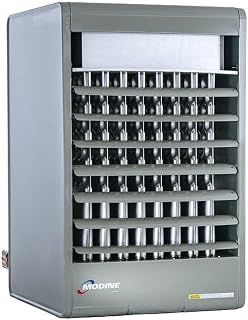
Modine offers a gas-based unit heater designed for industrial and commercial settings, capable of combining with other HVAC components for robust climate control. Best for: buyers seeking a reliable, heavy-duty heating solution in professional environments. Caution: Modine products require proper sizing and professional installation to ensure optimal performance and safety in ceiling or wall mounting contexts.
Buying Guide
- Fuel type: Choose gas for higher steady heat in large spaces, or electric for easier installation where gas isn’t available.
- Space size and heat distribution: Larger spaces benefit from unitized ceiling-mounted systems with either forced-air or radiant heat for uniform warmth.
- Ventilation and clearances: Verify venting requirements, clearance from combustibles, and mounting support structures before installation.
- Thermostat compatibility: Some units support standard or smart thermostats; check compatibility with your existing setup.
- Durability and best-use scenarios: Radiant heaters excel for spot heating and object warmth; radiant + air circulation suits open, drafty areas.
- Electrical vs. gas considerations: Electric models offer clean installation but may have higher operating costs in large spaces; gas models need proper venting and gas line preparation.
Frequently Asked Questions
- What ceiling height is ideal for ceiling-mount heaters? Answer: A higher ceiling requires greater air movement or radiant efficiency; consult product specs for recommended mounting heights.
- Can I install these heaters myself? Answer: Some models permit DIY installation if you have electrical or gas experience and follow local codes; many installations should be performed by a licensed professional.
- Which heater is best for a two-car garage? Answer: A 50,000 BTU ceiling unit or equivalent is typically suited for larger two-car garages, depending on insulation and space layout.
- Are electric ceiling heaters safer than gas? Answer: Both have safety features; electric units eliminate combustion risks but require proper electrical capacity and ventilation compliance for the space.
- Do ceiling-mount heaters require ductwork? Answer: No, most ceiling-mount units are designed for direct heat delivery without ductwork, though some installations may integrate with existing HVAC systems.
- What maintenance is required? Answer: Regularly inspect mounting hardware, venting (for gas units), and clean air intakes to maintain efficiency and safety.