The best clean-burning propane heater depends on where you plan to use it, how much heat you need, and whether the model is approved for that setting. The Mr. Heater Portable Buddy is suited to smaller spaces, while the Big Buddy offers more heat and adjustable output. For larger areas, consider the VEVOR cabinet heater or a vent-free ProCom model—but check local rules and follow the manufacturer’s ventilation and clearance instructions. “Clean burning” does not mean emission-free: propane heaters produce combustion byproducts, so safe use depends on choosing the right heater and operating it correctly.
| Heater | Best For | Listed Heat Output |
|---|---|---|
| Mr. Heater Portable Buddy | Small spaces and flexible use | 4,000 or 9,000 BTU |
| Mr. Heater Big Buddy | Adjustable heat for larger spaces | 4,000, 9,000, or 18,000 BTU |
| VEVOR Cabinet Heater | Garages and larger areas | 6,000, 12,000, or 18,000 BTU |
| Mr. Heater Vent-Free Blue Flame | Large areas needing higher output | 30,000 BTU |
| ProCom Ventless Infrared Heater | Residential spaces needing thermostat control | Up to 25,000 BTU |
Mr. Heater Portable Buddy
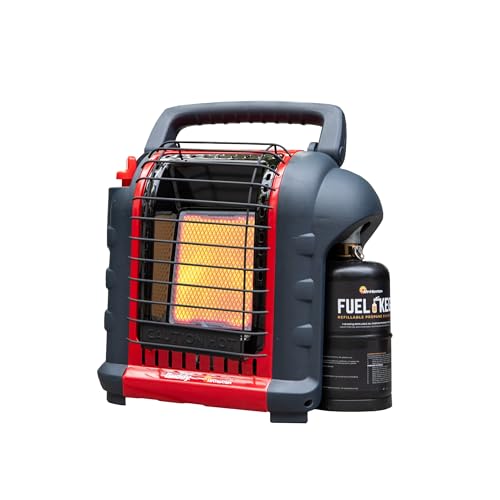
Best for: Buyers who want a portable heater with two output settings for a relatively compact area. The listed output is 4,000 or 9,000 BTU per hour, and the product is designed and approved for indoor and outdoor use. Its stated heating area is approximately 225 square feet.
This model is a practical choice when a lower setting is useful for milder conditions and a higher setting is needed for more heat. It is smaller in listed output and coverage than the Big Buddy and the 18,000-BTU cabinet heater, making it easier to match to modest spaces.
Limitation: Its listed coverage is approximately 225 square feet, so it is not the best match for a large garage or open area. Indoor approval does not remove the need to follow the manual’s operating, clearance, and ventilation directions.
Mr. Heater Big Buddy PRO
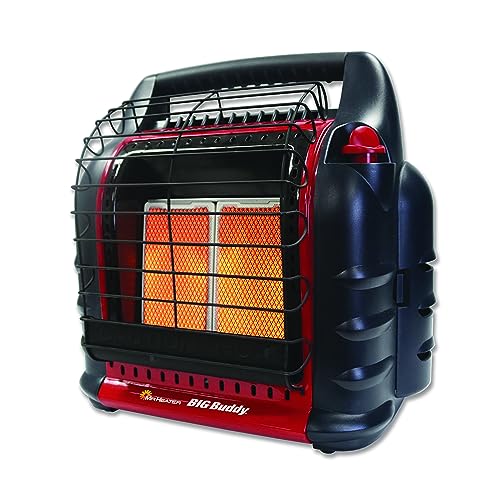
Best for: Buyers who need several heat levels and a higher maximum output than the Portable Buddy. This model has low, medium, and high settings of 4,000, 9,000, and 18,000 BTU, with stated coverage up to 450 square feet.
The broad range makes it easier to select output for different conditions. The product information also states that it can heat for up to 216 hours on two 20-pound propane tanks with an optional hose on the low setting. That runtime is specifically tied to the low setting and the stated tank configuration; it should not be treated as the runtime at higher outputs.
Limitation: The optional hose is not described as included. Choose this model over the Portable Buddy when greater output and stated coverage matter more than a smaller heating capacity. Check the instructions for fuel setup and approved use.
VEVOR 18,000 BTU Cabinet Heater

Best for: Buyers seeking a cabinet-style heater with three output settings for a garage, patio, or other listed application. The heater offers 6,000, 12,000, and 18,000 BTU settings and is described as heating areas up to 450 square feet.
Its listed safety features include low-oxygen protection, tip-over protection, and flameout protection. The product information says it is powered by a 20-pound propane tank and can provide up to 73 hours of warmth. That maximum runtime depends on operating conditions and setting, so compare it with your expected use rather than assuming it applies at full output.
Limitation: A 20-pound tank is the stated fuel source, and the supplied information does not specify whether a tank is included. Choose this heater for adjustable output and cabinet-style construction; verify indoor-use conditions and local requirements before using it inside.
Mr. Heater 30,000 BTU Blue Flame

Best for: Buyers comparing higher-output heaters for larger areas. This vent-free blue flame model is listed at 30,000 BTU per hour and is described as heating up to 1,000 square feet. It has battery-operated electronic spark ignition, and the product information says a battery is included.
Its stated output and coverage are greater than those of the portable Buddy heaters, so it is a better candidate when a small portable unit would not provide enough heat. The dual-fuel description may also appeal to buyers considering fuel flexibility, though the supplied details do not specify additional fuel connection requirements.
Limitation: “Vent-free” is not the same as emission-free or suitable for every indoor location. Confirm local rules and the manual’s requirements for room size, clearances, and ventilation before selecting it for indoor use.
ProCom 25,000 BTU Infrared Heater

Best for: Buyers who want a higher-output liquid propane heater with thermostat control and the choice of wall mounting or floor placement. The listed maximum output is 25,000 BTU, with stated coverage up to 1,150 square feet. High, medium, and low thermostat control is included.
The product is described as a ventless infrared heater for residential areas, with included base feet and wall-mounting hardware. These setup choices may suit buyers who want to keep floor space open or position a heater on the floor. Its output is higher than portable 9,000-BTU models but lower than the 30,000-BTU Mr. Heater option.
Limitation: The heater is listed as liquid propane and ventless, so check fuel requirements and local rules before purchase. Large stated coverage does not guarantee equal warmth in every room layout; follow the manufacturer’s placement and operating instructions.
Buying Guide: How To Choose A Clean-Burning Propane Heater
What does “clean burning” mean for a propane heater?
Propane is often described as a clean-burning fuel relative to some other combustion fuels, but burning propane still creates exhaust and can consume oxygen. A heater marketed as clean-burning is not automatically safe to use in an enclosed room. Do not equate “clean” with zero emissions, zero ventilation needs, or no risk from incorrect operation.
Look for clear information about the heater’s approved setting, safety controls, fuel requirements, and installation. Some listed products describe indoor use or vent-free operation, but those descriptions do not override the owner’s manual, local codes, or restrictions on use in particular rooms or buildings.
How much BTU output do you need?
BTU output is a useful comparison point, but it is not the only factor in real-world heating. A heater’s stated coverage is an estimate from the product information. Insulation, ceiling height, air leaks, outdoor temperatures, and room layout can affect how warm a space feels.
- For a smaller area, compare lower-output options such as the 4,000- or 9,000-BTU Portable Buddy.
- For more adjustable output, the Big Buddy ranges from 4,000 to 18,000 BTU.
- For a larger stated coverage area, compare the 25,000-BTU ProCom or 30,000-BTU Mr. Heater and confirm the space meets the manual’s requirements.
Do not choose solely by the largest coverage claim. A heater that is too powerful for a small room may be difficult to operate comfortably, while a small portable heater may not provide enough warmth in a large or poorly insulated space.
Should you choose portable, cabinet, or wall-mounted?
A portable radiant heater can be convenient when you need to move the unit between approved locations. Cabinet-style designs may suit buyers who prefer that form factor and want several output settings. A wall-mounted or floor-standing ventless heater may be more appropriate for a planned room setup, but placement and installation instructions matter.
Compare the product’s intended use with your own. Outdoor-only heaters should never be treated as indoor heaters. For products described for both indoor and outdoor use, verify the approved operating conditions in the manual rather than assuming every indoor environment is appropriate.
Which safety features should you compare?
Look for listed protections such as tip-over shutoff, flameout protection, low-oxygen protection, or an oxygen depletion sensor. These features address specific hazards; they do not eliminate the need for careful setup and supervision. The VEVOR listing names low-oxygen, tip-over, and flameout protection. The ProCom 20,000-BTU model in the supplied product list includes an oxygen depletion sensor, but it is not among the five products selected above.
Read and follow the manual’s instructions for clearances, fuel connections, ignition, storage, and ventilation. Keep heaters away from flammable materials, use only the specified fuel arrangement, and do not operate a unit if it appears damaged or if a fuel leak is suspected. A safety feature is a backup, not a substitute for correct use.
What should you know about fuel and runtime?
Check whether a tank, cylinder, hose, or other connection is included before ordering. The product details for the VEVOR heater specify a 20-pound tank, while the Big Buddy’s stated extended runtime requires an optional hose and two 20-pound tanks. Runtime figures can vary with heat setting and conditions. A stated maximum on low should not be used as an estimate for high output.
Store and connect fuel as directed by the manufacturer. Check the instructions for leak testing and safe disconnection, and never assume that accessories from another heater will fit or be approved.
Frequently Asked Questions
Are propane heaters safe to use indoors?
Only use a propane heater indoors if that specific model is approved for indoor use and the room and operation meet the manufacturer’s instructions and local requirements. Outdoor-only models are not suitable for indoor use. Vent-free labeling does not mean emission-free.
Does a clean-burning propane heater produce carbon monoxide?
Propane combustion can produce carbon monoxide, particularly if the heater is malfunctioning or used improperly. Follow the manual, maintain the heater as directed, and use carbon monoxide alarms where required or recommended. Do not rely on a heater’s safety features as a replacement for alarms or correct ventilation.
What is the difference between radiant and blue flame heat?
Radiant heaters warm objects and people in their path, while blue flame heaters warm air through combustion. The product descriptions identify the Portable Buddy as radiant and the 30,000-BTU Mr. Heater as blue flame. Choose based on the room, placement, and heating style described by the manufacturer.
Can I use an outdoor propane heater in a garage?
Do not use an outdoor-only heater in a garage or other enclosed space. Use a heater in a garage only when its documentation approves that setting and all operating requirements are met. Garages may contain flammable materials, vehicles, and limited ventilation, so follow the manual and local rules closely.
Is a higher BTU rating always better?
No. Higher BTU output may suit a larger area, but the right size depends on the space and the heater’s approved use. Compare output settings, stated coverage, and room conditions rather than selecting the highest number alone.