The best commercial heat tape for pipes depends on pipe length, cable output, certification, and whether you need self-regulating heat. For longer water lines, the 100-foot HeatTapePro and HEATIT JHSF1 offer commercial-oriented features; the JDZKOMKE and HEATIT 40-foot cables are options to compare for general pipe protection. Always confirm the cable is intended for your pipe and installation conditions before buying.
| Product | Best For | Listed Output or Feature |
|---|---|---|
| HeatTapePro 100 ft | Long runs and end-of-cable status checks | Self-regulating; GlowCap |
| HEATIT JHSF1 100 ft | Long water pipes requiring self-regulation | 5 W/ft; ETL certified |
| JDZKOMKE 50 ft | Metal or plastic water pipes | 5 W/ft; listed -40°F protection |
| HEATIT 40 ft | Moderate-length water-pipe runs | 3 W/ft; ETL certified |
| WABUPD 50 ft | Cold-weather water-pipe protection | 8 W/ft; thermostat included |
HeatTapePro 100-Foot Commercial Cable

This Radiant Solutions Company cable is a commercial-grade, self-regulating heat cable rated at 6 watts per foot and 120 volts. The listing specifies a 100-foot cable with a 10-foot cord. Its GlowCap feature is intended to let users check whether the cable is operating through to its end.
Best for: Buyers covering a long run who value an end-of-cable operating indicator. The listing also describes injection-molded connections, a 10-year warranty, and UL listing. These details make it a strong comparison choice for commercial-oriented projects where cable status and connection construction matter.
Limitation: The listed product description emphasizes roof and ice-dam applications as well as pipe freeze protection. Confirm the exact product configuration and installation instructions support your pipe application before purchase.
HEATIT JHSF1 100-Foot Self-Regulating Cable

The HEATIT JHSF1 is a 120-volt, 5-watt-per-foot self-regulating cable with 100 feet of heating cable. The product information states that its output adjusts according to ambient temperature along the cable. It is listed for plastic and metal water pipes and supports straight, spiral, and overlapping layouts.
Best for: Buyers protecting a longer pipe run who want self-regulating output and listed whole-cable ETL certification. The listing also specifies a grounded plug with a 3-foot cold lead and recommends at least 1/2-inch insulation, with 1-inch insulation when ambient temperatures fall below -20°F.
Limitation: The listing’s pipe-diameter guidance is up to 2 1/2 inches. Check the product’s detailed instructions for the pipe size, layout, insulation, and conditions in your project.
JDZKOMKE 50-Foot Pipe Heating Cable

This 50-foot cable is listed at 5 watts per foot and is designed for water-filled metal or plastic pipes, including copper, PVC, and PEX. Its description specifies a 5-foot grounded plug with an indicator light, an aluminum-alloy shield, and a TPE outer jacket. The manufacturer lists freeze protection at temperatures down to -40°F.
Best for: Buyers seeking a mid-length cable for water pipes who want a grounded plug and listed protection for several pipe materials. The product information describes a shield intended to help prevent shorts and an outer jacket described as resistant to UV exposure and chemicals.
Limitation: The listing warns against use on fuel lines and gutters and says the cable must not be used where there is no water, due to overheating risk. Follow the product instructions and do not assume it is appropriate for other applications.
HEATIT 40-Foot ETL-Certified Cable

This HEATIT cable provides 3 watts per foot and is described as self-regulating. The listing specifies whole-cable ETL certification, a UL-certified plug, and compatibility with metal and plastic water pipes, including copper, PVC, and stainless steel. It is listed for freeze protection down to -40°F and is available in multiple cable lengths.
Best for: Buyers who need a shorter run and prioritize the stated whole-cable certification. Its 3-watt-per-foot output is lower than the 5-watt JDZKOMKE and HEATIT JHSF1 options and the 8-watt WABUPD option in this comparison.
Limitation: The listed power cord is 2 feet long. Check whether that lead length reaches the intended outlet and whether the cable length is suitable for the pipe layout.
WABUPD 50-Foot Thermostatic Heat Tape
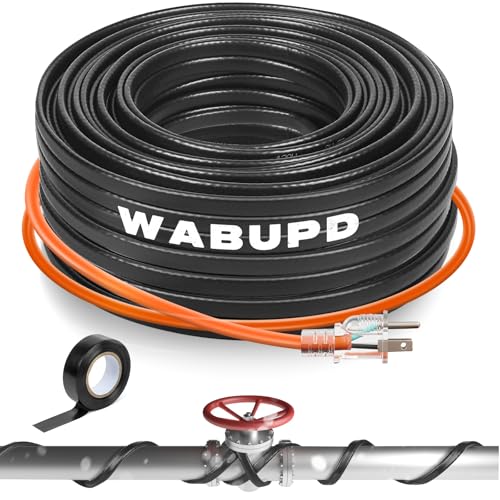
The WABUPD cable is listed at 120 volts and 8 watts per foot, with a thermostat that automatically turns on and off. The product description specifies a 5-foot plug wire with an indicator light, an IP67 rating, and metal retainers intended to keep the heater attached. The listing describes use on metal or rubber water pipes.
Best for: Buyers comparing a 50-foot cable with a thermostat and a higher listed wattage per foot than the other pipe cables in this selection. Its description also gives a low-temperature operating claim of -45°F.
Limitation: The listing mentions roofs and gutters among possible applications, but applications and installation requirements can differ. Verify the manufacturer’s instructions for the specific water-pipe installation rather than relying on broad use claims.
Buying Guide: How to Choose Commercial Heat Tape
What pipe length should you cover?
Measure the section of pipe that needs protection before choosing cable length. Account for the routing method in the product instructions, including any permitted spacing or wrapping. A cable that is too short may leave vulnerable pipe exposed; excess cable should not be looped, overlapped, or cut unless the manufacturer explicitly permits that installation.
Longer options in this selection include 100-foot products from Radiant Solutions and HEATIT. The 50-foot JDZKOMKE and WABUPD products suit shorter runs, while the 40-foot HEATIT option offers another mid-length choice. Compare the heating cable length separately from the power-cord length.
Should you choose self-regulating cable or thermostat control?
Self-regulating cables adjust heat output in response to temperature conditions, according to the product descriptions for the HeatTapePro, HEATIT JHSF1, and HEATIT 40-foot cable. This can be useful on long runs where conditions vary along the pipe. Do not interpret “self-regulating” as a substitute for the product’s installation limits or electrical protection requirements.
Some products describe a thermostat that switches heating on or off at a set temperature. WABUPD lists an automatic thermostat, while other products in the selection describe thermostat-based controls. Check the exact model’s instructions to learn how its control works and what temperature range it uses.
How much wattage per foot is appropriate?
Listed output ranges from 3 watts per foot for the 40-foot HEATIT cable to 8 watts per foot for WABUPD. The JDZKOMKE and HEATIT JHSF1 are listed at 5 watts per foot, and HeatTapePro at 6 watts per foot. Higher wattage alone does not establish that a cable is better for a particular pipe.
Choose based on the manufacturer’s guidance for pipe material, diameter, insulation, exposure, and expected temperatures. A commercial installation may require a design professional or electrician to calculate the required heat output and electrical load, especially for a long run or multiple circuits.
Why does full-cable certification matter?
Check whether the certification applies to the complete heating cable or only to the plug. The HEATIT products in this list state that the cable is ETL certified, and the HeatTapePro listing states that it is UL listed. JDZKOMKE describes the entire cable as meeting standards. Confirm certification details on the product and its documentation before installation.
Certification claims in a listing do not replace local electrical codes or site requirements. Use the specified grounded connection and any required ground-fault circuit interrupter (GFCI) protection. Have a qualified professional review a commercial setup if the electrical installation is outside your experience.
Which pipe materials and locations are supported?
Product descriptions identify different materials and applications. JDZKOMKE lists copper, PVC, and PEX water pipes; HEATIT lists metal and plastic pipes; and WABUPD describes metal or rubber water pipes. Confirm that the specific cable is approved for your pipe material and location, including indoor, outdoor, exposed, or insulated installation.
Do not assume a pipe cable can be used on fuel lines, gutters, or roofs just because another product is marketed for those purposes. Follow the exact cable’s warnings. In particular, JDZKOMKE warns against use on fuel lines and gutters and says not to use it where no water is present.
What insulation and attachment details should you check?
Insulation can affect how much heat is lost from the pipe. The HEATIT JHSF1 listing recommends at least 1/2-inch insulation and 1-inch insulation for conditions below -20°F. Treat those as that product’s stated guidance, not a universal rule for every heat cable. Check whether the manufacturer allows the insulation type you plan to use.
Use only the attachment method specified by the manufacturer. WABUPD includes metal retainers, while other products may require a different method. Avoid improvised attachment, compression, or covering arrangements that conflict with the instructions or could damage the cable.
What should commercial buyers verify before installation?
- Confirm cable length, voltage, wattage per foot, and cold-lead length.
- Check approved pipe materials, diameter limits, temperature claims, and installation layout.
- Review whether the cable may be overlapped, cut, or used with insulation; never assume these practices are allowed.
- Verify certification applies to the complete cable and meet applicable electrical-code requirements.
- Confirm the outlet, circuit capacity, grounding, and required GFCI protection.
- Inspect the cable and connections according to the manufacturer’s instructions before use.
Frequently Asked Questions
Can heat tape be used on plastic water pipes?
Some products in this selection list compatibility with plastic pipes. For example, JDZKOMKE identifies PVC and PEX, and HEATIT describes compatibility with plastic pipes. Confirm the specific cable’s instructions and limits before installation.
Does self-regulating heat tape prevent overheating?
Self-regulating cables are described as adjusting output with temperature, but that does not mean every installation is risk-free. Follow the manufacturer’s rules for overlap, attachment, insulation, and approved applications.
Can I cut heat tape to fit my pipe?
Do not cut a heating cable unless its manufacturer explicitly permits cutting and provides instructions for sealing or terminating it. Check the product documentation before changing cable length.
Is a higher wattage-per-foot cable always better?
No. Wattage must match the pipe, exposure, insulation, and temperature conditions. Compare product instructions and required electrical capacity rather than choosing by wattage alone.
Do I need insulation over pipe heat tape?
Insulation may help reduce heat loss, and some product instructions recommend it. Follow the chosen cable’s guidance on insulation type and thickness, and confirm that covering the cable is permitted.
Can pipe heat tape be installed on a roof or gutter?
Only if the specific product is listed and instructed for that application. Some cables are marketed for roofs, while other pipe cables warn against gutter use. Do not transfer one product’s approved uses to another model.