Find reliable commercial gas water heaters that balance efficiency, durability, and ease of maintenance. This guide highlights five solid options from A. O. Smith and explains who each is best for, plus practical trade-offs. Ideal for small to mid-size commercial spaces such as clinics, restaurants, and service shops that need steady hot water supply with robust safety features.
| Product | Best For | Key Benefit |
|---|---|---|
| AO Smith BTR-199 | Medium-heat demand facilities | High efficiency and reliable ignition |
| AO Smith BT-100 | Small commercial needs | Standing pilot with CSA/ASME compliance |
| AO Smith BTR-200 | Moderate to high demand spaces | Thermal efficiency and stand-by loss control |
| AO Smith BTH-199 | Long-term tank protection | Intelligent LCD control and submerged heat exchanger |
| AO Smith BTX-80 | Ventilation-flexible installs | Barometric draft and direct vent versatility |
Notes: All products listed are designed for commercial natural gas use. They vary in ignition method, venting options, and protection features. When selecting, consider peak hot-water load, installation space, venting constraints, and local codes.
AO Smith BTR-199 Tank Type Water Heater
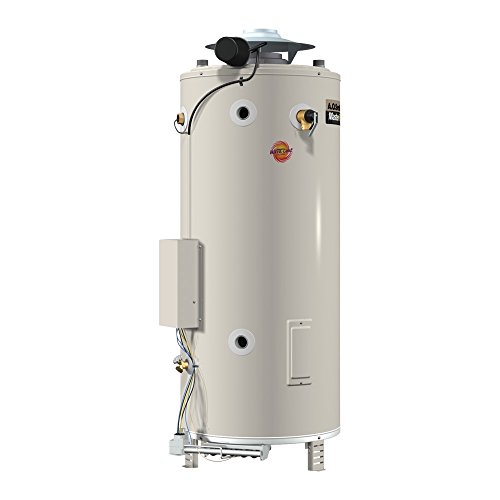
Features: Meets or exceeds thermal efficiency and standby loss requirements, Electronic Ignition, CSA Certified and ASME Rated TandP Relief Valve.
Best for: Facilities with moderate hot-water loads that require reliable electronic ignition and strong safety ratings.
Caution: Ensure proper venting and clearance per local codes, as with all gas-fired tank heaters.
AO Smith BT-100 Tank Type Water Heater
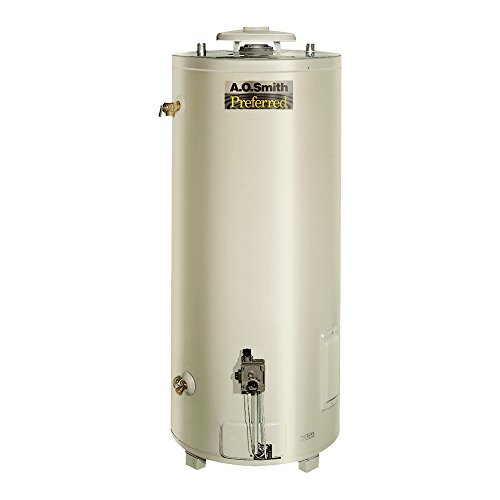
Features: Standing Pilot, CSA Certified and ASME Rated TandP Relief Valve, Complies with SCAQMD Rule 1146.2, Southern California and Texas Approved.
Best for: Small commercial setups that need a straightforward, code-compliant tank with an easy pilot system and strong valve protections.
Limitation: Standing pilot systems can be less energy-efficient than electronic ignition in some applications.
AO Smith BTR-200 Tank Type Water Heater

Features: Meets or exceeds the thermal efficiency and/or standby loss requirements, Electronic Ignition, CSA Certified and ASME Rated TandP Relief Valve.
Best for: Medium-to-large facilities that need dependable efficiency, enhanced ignition reliability, and compliance with safety standards.
Limitation: May require more space than smaller models; verify installation footprint and venting needs.
AO Smith BTH-199 Tank Type Water Heater

Features: Intelligent control system with LCD display, Submerged combustion chamber with helical heat exchanger coil, Powered anodes-provides long-lasting tank protection in varying water conditions.
Best for: Facilities needing advanced monitoring and durable protection against corrosive water conditions.
Caution: LCD displays can require periodic maintenance for long-term visibility; ensure electrical supply compatibility.
AO Smith BTX-80 Tank Type Water Heater

Features: Barometric Draft Regulator, Versatile power-direct vent design, Modular blower-equipped with 120 volt, 60 Hz electrical system (rating 5 amps or less).
Best for: Installations requiring flexible venting options and compact footprint in tight spaces.
Limitation: Venting configuration and modular blower setup may necessitate careful ducting and electrical planning upfront.
Buying Guide
How to choose a commercial gas water heater
- Peak hot-water demand: Match the tank size or flow-rate capacity to the building’s peak usage. Higher BTU input and larger tanks support more fixtures simultaneously.
- Fuel type and venting: Ensure compatibility with your available gas supply (natural gas) and your building’s venting layout (direct vent vs. dedicated chimney).
- Ignition method: Electronic ignition saves energy over standing pilots, but some retrofits or codes may favor pilot systems. Consider maintenance needs and local regulations.
- Safety and compliance: Look for CSA/ASME ratings and tested relief valves. Local codes may require specific certification and T&P valve features.
- Control and diagnostics: Intelligent or LCD controls can simplify monitoring, protection against lime scale, and long-term maintenance planning.
- Space and installation: Tank-type units require clearance and service access; tankless options offer compact footprints but may involve complex venting and gas lines.
- Long-term cost of ownership: Compare efficiency ratings and standby loss performance to minimize operating costs over the unit’s life.
Frequently Asked Questions
- What is the difference between tank-type and tankless commercial gas water heaters?
– Tank-type units store hot water in a tank and provide steady supply at a set pressure, while tankless units heat water on demand, saving space but requiring adequate gas supply and venting for continuous flow. - What does CSA Certified and ASME Rated mean?
– CSA certification ensures safety and performance to recognized standards, while ASME rating verifies pressure vessel safety and reliability. - Why consider electronic ignition over standing pilot?
– Electronic ignition reduces energy usage when the heater is not actively firing, lowering operating costs and improving efficiency. - How do I determine the right capacity for a commercial space?
– Assess peak usage across fixtures (showers, sinks, appliances) and consult a licensed plumber to size a unit that meets demand without excessive standby loss. - What maintenance is typical for these units?
– Regular inspection of venting, T&P valves, anode protection, and periodic flushing to remove sediment is commonly recommended. - Are these units suitable for outdoor installation?
– Some models support outdoor installation with appropriate venting and weather protection; verify model specifications and local code requirements.